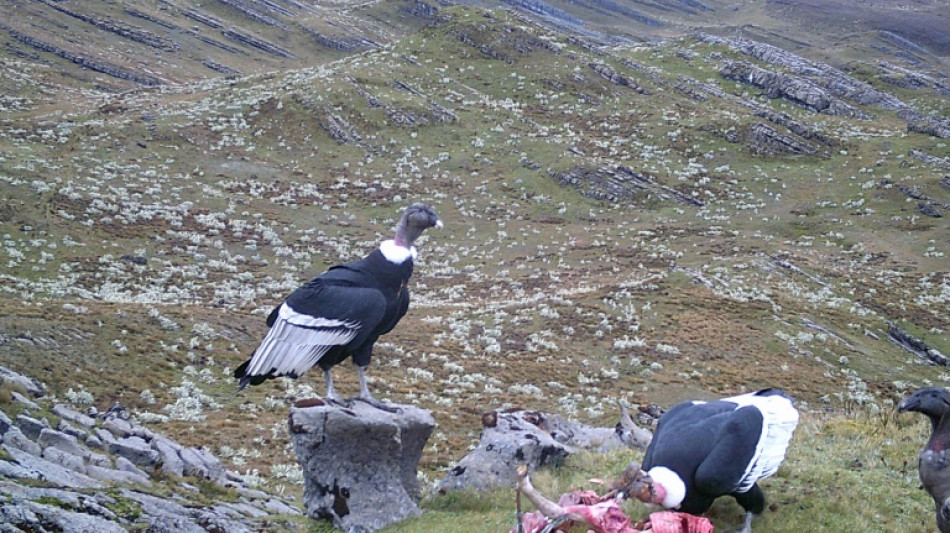
Once the enemy, majestic condor wins hearts of Colombian farmers / Photo: Handout - Fundacion Jaime Duque/AFP

 Kenya's economy faces climate change risks: World Bank

 US Fed dissenters call for rate hikes over sustained inflation

 New York sues online prediction markets giant Kalshi

 Profits surge at US oil giant amid Iran war supply shock

 Stock markets rally on tech rebound

 France, Spain assess scorched terrain as new wildfires threaten other regions

 Chipmaker Kioxia reports AI-driven 45-fold surge in quarterly net profit

 Far right and far left battle for power in polarised Berlin

 The last trio: S.Africa's zoo elephants await their fate

 Oil industry sees war windfall but girds for political blowback

 Amazon beats expectations with cloud and AI growth

 Blowout Microsoft results lift US stocks as oil retreats

 'Beginning of the end': Relief but no party as French wildfire winds down

 Southern Europe 'becoming more flammable' in hotter climate, experts say

 Mammoth bones found on parched bed of Danube in Bulgaria

 MEXC Lists Grvt (GRVT) with $60,000 Worth of GRVT and 10,000 USDT in Airdrop+ Rewards

 George and Amal Clooney flee French home due to wildfire

 MEXC Ventures Supports Alpha Arena's APAC Debut at Coinfest Bali

 AI data centre supplier Zhongji InnoLight slips on Hong Kong debut

 May, June heatwaves caused 2,877 extra deaths in England: govt

 BMW profit down a third as carmaker plans job cuts

 Seoul extends losses as most Asian markets drop, oil rises again

 Gambling.com Group Is Now Grandstand

 Meet the astronomer digging into the Milky Way's 'fossils'

 AI data centre supplier Zhongji InnoLight falls on Hong Kong debut

A group of condors rip into the carcass of a calf at the top of a Colombian mountain which rises 4,200 metres above sea level.
Their meal is a peace offering from local ranchers working to improve their relationship with the world's largest bird of prey, dubbed the King of the Andes.
"It's a bird that, when you see it flying, is so beautiful," said Diana Bautista, of the white-collared creature with a wingspan that can reach up to three metres, tipped by fingerlike feathers.
In the mountainous northeastern municipality of Cerrito where she lives, the condor has not always been looked upon fondly.
Up until a few years ago, villagers would leave out poisoned carrion or shoot at them to scare off the scavenger seen as a threat to their livestock.
A group of 19 families living high up in the moorlands of the Andes, a unique mountain ecosystem, in 2019 formed the ACAMCO association to protect and boost appreciation of the bird.
Now, residents have learned to build pens to protect their most vulnerable livestock, and platforms in the mountains where they leave carrion for the winged giants.
The community initiative is aimed at "protecting and learning about" the bird, which "attracts a lot of people" and could also have an economic benefit for the region, said Andrea Florez, from ACAMCO.
"We must not believe all the bad things that are said about the condor," said Bautista.
"Not everyone is lucky enough to have this bird in their country (...) we must love it."
- 'A great loss' -
Acamco is supported by the Jaime Duque Foundation, a Colombian non-profit organization, which buys weak or sick animals from breeders to give to the condor, in order to study its eating habits using camera traps.
Condors used to feed on small animals, but human activity has chased away their usual prey and they have become dependent on livestock, said Francisco Ciri, a biologist and director of the Neotropical conservation foundation.
The Andean Condor is considered vulnerable by the International Union for Conservation of Nature (IUCN), which lists its population of mature individuals at just over 6,700 and decreasing.
There are only 60 left in Colombia, according to a 2021 national census by the Neotropical Foundation.
Their main threat is deliberate poisonings by humans, says the IUCN.
The death of a single condor is "a great loss" for the species because it reproduces so slowly, said Carlos Grimaldos, an expert with the Jaime Duque Foundation.
The condor reaches sexual maturity at the age of 10 and only gives birth to one chick every two or three years.
Protecting it is essential as the scavenger "cleans" the moorlands by eating dead animals and prevents contamination of water sources, said Grimaldos.
With binoculars in hand, Grimaldos teaches visitors at a reserve run by the foundation to distinguish the condor from other raptors.
The condor finds itself "in an increasingly critical situation" throughout the Andes, said Guillermo Wiemeyer, an Argentine researcher attending a meeting of the South American Condor Network in the province of Santander.
Experts from Chile, Argentina, Bolivia, Ecuador, Colombia, Peru and Venezuela created the network a decade ago to try and protect the condor, already considered extinct in Venezuela.
Alexcevith Acosta, director of Santander's environmental authority, said it is urgent to hold a census throughout Latin America as "condors know no borders."
D.Avraham--CPN