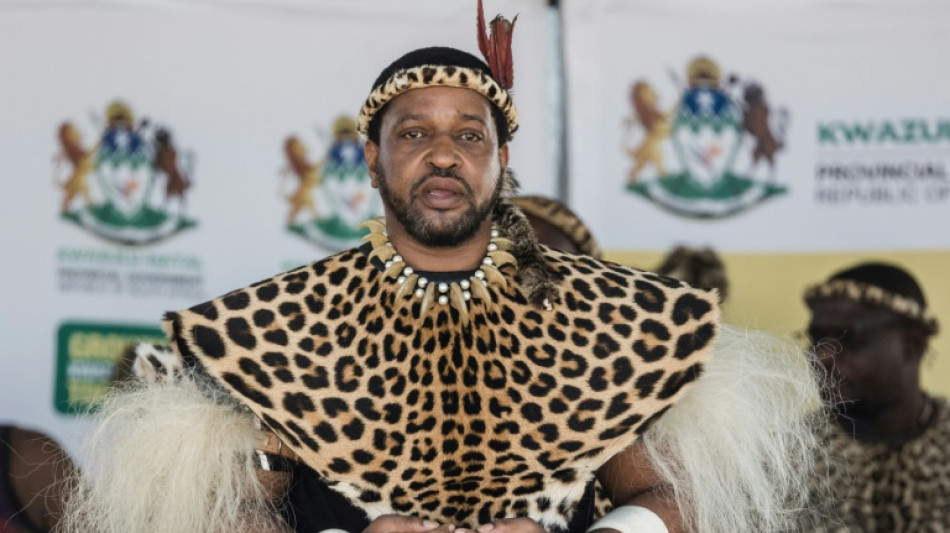
Zulu nation faces uncertainty after 'unlawful' king ruling / Photo: RAJESH JANTILAL - AFP/File

 Kenya's economy faces climate change risks: World Bank

 US Fed dissenters call for rate hikes over sustained inflation

 New York sues online prediction markets giant Kalshi

 Profits surge at US oil giant amid Iran war supply shock
 Stock markets rally on tech rebound

 France, Spain assess scorched terrain as new wildfires threaten other regions

 Chipmaker Kioxia reports AI-driven 45-fold surge in quarterly net profit

 Far right and far left battle for power in polarised Berlin

 The last trio: S.Africa's zoo elephants await their fate
 Oil industry sees war windfall but girds for political blowback

 Amazon beats expectations with cloud and AI growth

 Blowout Microsoft results lift US stocks as oil retreats
 'Beginning of the end': Relief but no party as French wildfire winds down

 Southern Europe 'becoming more flammable' in hotter climate, experts say

 Mammoth bones found on parched bed of Danube in Bulgaria
 MEXC Lists Grvt (GRVT) with $60,000 Worth of GRVT and 10,000 USDT in Airdrop+ Rewards
 George and Amal Clooney flee French home due to wildfire

 MEXC Ventures Supports Alpha Arena's APAC Debut at Coinfest Bali
 AI data centre supplier Zhongji InnoLight slips on Hong Kong debut

 May, June heatwaves caused 2,877 extra deaths in England: govt

 BMW profit down a third as carmaker plans job cuts

 Seoul extends losses as most Asian markets drop, oil rises again

 Gambling.com Group Is Now Grandstand

 Meet the astronomer digging into the Milky Way's 'fossils'
 AI data centre supplier Zhongji InnoLight falls on Hong Kong debut

South Africa's president and Zulu monarch have been stunned by a court ruling that the state's recognition of King Misuzulu Zulu was "unlawful" in a move that risks reopening old succession wounds.
Experts are divided on the impact of Monday's ruling on Misuzulu Zulu but say it shows that South Africa has not yet learned how to handle the country's traditional customs.
The 49-year-old king's older brother, Prince Simakade, was behind the latest royal showdown.
He sought the ruling by the Pretoria high court which said that President Cyril Ramaphosa was "unlawful" to recognise the king at an elaborate ceremony in October last year.
The court ordered Ramaphosa to set up an investigation into whether Misuzulu Zulu's tumultuous accession was in line with customary laws.
Ramaphosa's spokesman told AFP: "The legal team is carefully studying the judgement.
"Only once they've completed their thorough study of the judgement will a determination on the way forward be made".
- Mysterious deaths -
The monarch's office said in a statement that the king would also be "studying the judgement" with his legal team and senior members of the royal family.
They would be "applying their minds as to (the) correct course of action".
Misuzulu Zulu was named after King Goodwill Zwelithini died in 2021 at the age of 72. He ruled the Zulu nation for 52 years.
A bitter feud between rival claimants delayed the traditional coronation until August 2022. Two months later, Ramaphosa held his grand ceremony to recognise the king.
Misuzulu Zulu faced several court challenges before his coronation.
And Prince Simakade, born out of wedlock but the late king's eldest son, has been publicly championed by some dissenting relatives.
Last year Misuzulu Zulu called for "peace and unity" after a series of unexplained deaths just before his coronation.
In July, Misuzulu Zulu denied that he had been poisoned, after the sudden death of a close adviser who ingested a toxic substance.
According to historian and cultural analyst Pitika Ntuli, the AmaZulu nation "have no king... because the state does have to recognise the king according to the law."
University of KwaZulu-Natal African languages professor and cultural expert Gugu Mazibuko backed the monarch.
"By the time the president recognised the king, all traditional processes had been observed, even if the court rules that the recognition is invalid, the king will remain the king," she told AFP.
- Land and money -
Although recognised by South Africa's constitution, the Zulu monarch has no executive powers, but exercises profound moral authority.
"Obviously this situation is going to escalate because there is a lot at stake... there are resources involved as well, such as the Ingonyama Trust and land," Ntuli told AFP.
"We are not just looking at the individuals battling in court but there are other people behind those individuals" who have their own "interests", he said.
Misuzulu Zulu inherited nearly 30,000 square kilometres of land -- almost the area of Belgium -- which is managed by a trust from which he can receive revenues.
Misuzulu's mother, the favourite third wife of the late king, was from the Swati royal family.
Her dowry was paid for by the Zulu nation which, according to experts, gives her children precedence for the throne.
"Zulu succession nowadays is viewed in a very western way," Mazibuko said. "We can't be compared to England where there is a clear line of succession, our culture is vastly different."
While the traditional coronation determines the Zulu ruler, state recognition is required to access government support and resources.
Known for his lavish lifestyle, King Goodwill Zwelithini received about $82,000 a year for himself -- in a country where the average annual salary stands at just $16,000 and unemployment hovers at roughly 30 percent -- along with a budget of $4.2 million to run his kingdom.
The state also pays several hundred traditional chiefs, including a dozen kings and queens.
"We also need to look at the idea of traditional courts because another concern is the ruling being made by a judge who... does not understand how the Zulu culture works," Mazibuko said.
According to Ntuli, South Africa failed to properly process customary laws at the advent of democracy in 1994, leaving many "loopholes".
"This is not the first or the last time the Zulu throne is contested, Misuzulu's father was contested, so was Shaka Zulu, the difference is modern courts were not involved," Mazibuko said.
"This will be a case study for the government to iron out how to deal with these kind of customary issues to avoid uncertainty."
X.Cheung--CPN