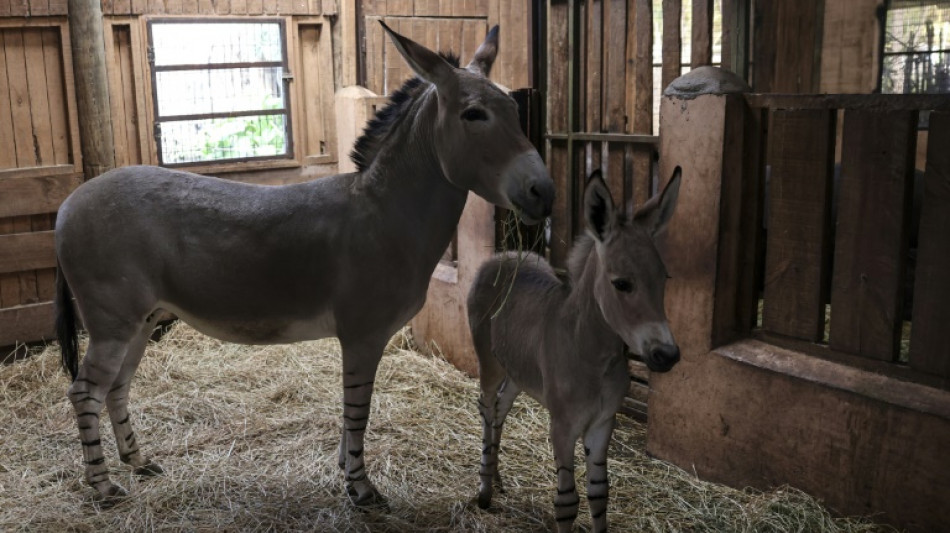
Rare Somali wild ass born Chile zoo / Photo: MARTIN BERNETTI - AFP

 French firm Safran helps build aircraft wings of the future in UK factory

 World Bank warns of worsening food insecurity as commodity prices soar

 Billionaire Ambani's Jio soars in market debut after India's biggest IPO
 AI chip giant SK hynix posts seven-fold surge in quarterly operating profit

 S.African activists push back on data centre rush

 Billionaire Ambani's Jio to debut after record India IPO

 UK set for cautious budget as borrowing costs climb

 US Fed expected to hold rates steady ahead of key midterm elections

 AI chip giant SK hynix says quarterly operating profit soars 630%

 GA-ASI and Saab Perform Advanced AEW Flight Testing on Uncrewed MQ-9B

 Storied Paris department store seeks bankruptcy protection

 Boeing shares tumble after it releases cautious growth forecast
A rare Somali wild ass has been born in a zoo in Chile, the fourth specimen of the critically endangered species to be born in the South American country, the zoo owner said.
The foal, named Julieta, was born in a private zoo on June 19, said Ignacio Idalsoaga, a veterinarian and founder of the zoo.
With white, striped legs similar to those of a zebra, the Somali wild ass is critically endangered in its native East Africa.
There are less than 200 left in the wild, and a similar number in captivity. Seven of the latter are in South America, all at the Buin Zoo in Santiago, according to the International Union for Conservation of Nature (IUCN).
Hunting and crossbreeding with the common domestic donkey have reduced the populations of this animal to the point of placing it at a critical level of extinction, the last category on the IUCN register before extinction.
"In non-traditional medicine, their bones are used for soup that is said to improve rheumatism, tuberculosis, despite the fact that it has not been scientifically proven," said Idalsoaga, the zoo founder.
Females can only have young approximately every two years, and the ass can live for about 30 years and weigh about 250 kilos (550 lbs).
C.Peyronnet--CPN