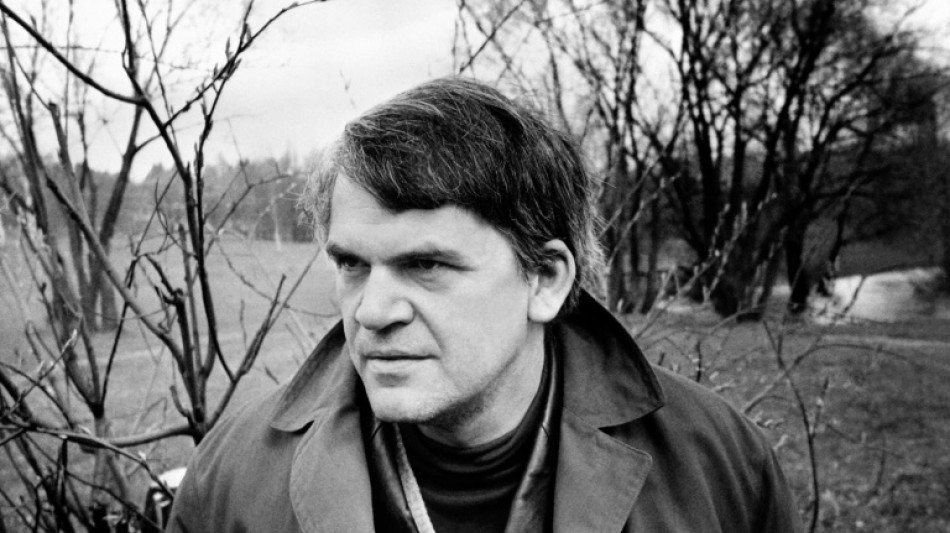
Satire and poetry: Milan Kundera took on life's absurdity / Photo: - - AFP/File

 Kenya's economy faces climate change risks: World Bank
 British oil giant BP aims to sell North Sea business
 China factory activity slides as leaders seek spending boost
 Tech rebound fuels record-breaking rally in South Korean stocks
 Cables and cooling bring AI windfall to Indian suppliers
 Anthropic's models gained unauthorized 'real-world' access during testing

 Apple tops estimates in CEO Cook's final quarter, but shares fall

 Milei demands expulsion of foreigners expressing 'hate' against Argentina

 Italy's Po River valley on drought alert

 Prada profits pinched as growth hard to chase

 Stocks climb on earnings and rates, oil retreats

 US economic growth slows in second quarter, missing expectations

 Russia adds Telegram founder Durov to 'terrorist' blacklist

 Stocks diverge on earnings, as oil steadies

 Eurozone economy grows despite Middle East war

 Singapore group will develop 'most promising' Ebola vaccine

 Shell profit surges as Mideast war fuels oil prices

 Car maker Stellantis says back in profit in second quarter

 Samsung quarterly operating profit up 1,800% on AI boom

 South Korean stocks bounce after rout, oil holds gains on Mideast woes

 South Korea's women web sleuths fight AI deepfake porn

 Anything but programmable: New cost-efficient EC-power-supply-series for the DIN rail by CAMTEC PS

 Meta misses profit expectations, sticks to massive AI spending

 Campari - king of the spritz - hopes to conquer American heartland

 Air France-KLM and Lufthansa bid for Portugal's TAP airline

Milan Kundera, the author of "The Unbearable Lightness of Being" whose dark, provocative novels delved into the enigma of the human condition, has died, a spokeswoman for the Milan Kundera Library in his native city of Brno said on Wednesday. He was 94.
"Unfortunately I can confirm that Mr Milan Kundera passed away yesterday (Tuesday) after a prolonged illness," she told AFP.
Kundera died at his apartment in Paris, France, his adoptive country where he had lived since his emigration from Communist-ruled Czechoslovakia in 1975.
"Not only Czech literature, but world literature as well has lost one of the greatest contemporary writers, and one of the most translated writers too," Tomas Kubicek, director of the Kundera library, told the public Czech TV.
Czech Prime Minister Petr Fiala said Kundera was able to "appeal to whole generations of readers across all continents" with his work.
Kundera was frequently touted as a favourite to win the Nobel Prize for literature, but he never claimed the coveted honour.
Through his characteristic satire and poetic prose, Kundera had sought to express all that is compelling and absurd about life, drawing on his own experiences of being stripped of his Czech nationality for dissent.
Life, he said in his work of criticism "Art of the Novel" (1986), "is a trap we've always known: we are born without having asked to be, locked in a body we never chose, and destined to die."
- Young rebel -
Kundera was born on April 1, 1929, in the town of Brno, in what was then Czechoslovakia. His father was a famous pianist.
He studied in Prague, where he joined the Communist Party, translated the French poet Apollinaire and wrote poetry of his own.
He also taught at a film school where his students included the future Oscar-winning director Milos Forman.
Although he professed faithfulness to Communism, the independent spirit of Kundera's writing soon got him into trouble.
He was expelled from the party in 1950, re-joined in 1956 and was expelled a second time in 1970 after the Prague Spring reform movement -- in which he was seen as playing a role -- was crushed.
- Locked out -
Kundera's first novel "The Joke", a work of dark humour about the one-party state published in 1967, led to a ban on his writing in Czechoslovakia while also making him famous in his homeland.
In 1975, he and his wife Vera went into exile in France, where he worked for four years as an assistant professor at the University of Rennes. They were stripped of their Czech nationality in 1979.
In his adopted home, where he became a citizen in 1981, his reputation and success grew as translations of his novels appeared, such as "Life is Elsewhere" (1973) set in Czechoslovakia about a poet entrapped by the Communist regime.
"The Book of Laughter and Forgetting" (1979) playfully explored through seven interlinked narratives the nature of forgetting in politics, history and daily life.
The novel was "brilliant and original," said the New York Times in 1980, "written with a purity and wit that invite us directly in; it is also strange, with a strangeness that locks us out."
Kundera was an author "fascinated by sex, and prone to sudden, if graceful, skips into autobiography, abstract rumination, and recent Czech history," said the Times reviewer, John Updike.
By far his most famous work, "The Unbearable Lightness of Being" was published in 1984 and turned into a film starring Juliette Binoche and Daniel Day-Lewis in 1987.
The novel is a morality tale about freedom and passion, on both an individual and collective level, set against the Prague Spring and its aftermath in exile.
- No going back? -
Kundera's critics say he turned his back on fellow Czechs and dissidents following his exile in France and for his decision to ban the translation of his French books into Czech.
In 2008, a Czech magazine accused him of being a police informer under Communist rule, which he denied as "pure lies".
In 2013, Kundera published his first novel after a 13-year hiatus.
"The Festival of Insignificance", about five friends in Paris, received mixed reviews, with The Atlantic noting its "near-impenetrable irony" and The Guardian deeming it a "stinker".
What Kundera "has to tell us seems to have less relevance", said the New York Times. "You can’t help wondering what his evolution would have been like if he had stayed, or stayed longer, in Czechoslovakia."
In 2019, the Czech Republic restored his nationality and in 2023 the Milan Kundera Library opened in his hometown of Brno.
P.Petrenko--CPN