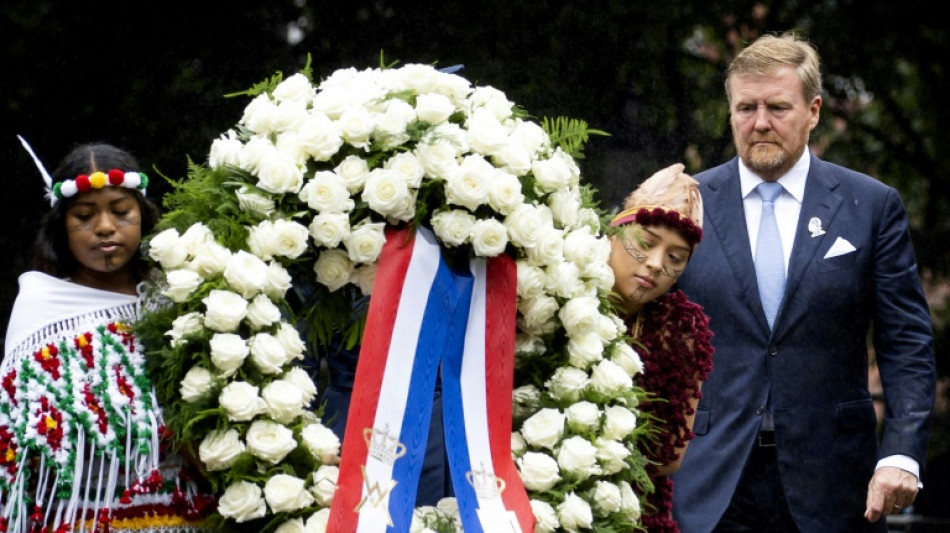
Dutch king makes historic apology for slavery / Photo: Remko de Waal - ANP/AFP

 Kenya's economy faces climate change risks: World Bank

 British oil giant BP aims to sell North Sea business

 China factory activity slides as leaders seek spending boost

 Tech rebound fuels record-breaking rally in South Korean stocks

 Cables and cooling bring AI windfall to Indian suppliers

 Anthropic's models gained unauthorized 'real-world' access during testing

 Apple tops estimates in CEO Cook's final quarter, but shares fall

 Milei demands expulsion of foreigners expressing 'hate' against Argentina

 Italy's Po River valley on drought alert

 Prada profits pinched as growth hard to chase

 Stocks climb on earnings and rates, oil retreats

 US economic growth slows in second quarter, missing expectations

 Russia adds Telegram founder Durov to 'terrorist' blacklist

 Stocks diverge on earnings, as oil steadies

 Eurozone economy grows despite Middle East war

 Singapore group will develop 'most promising' Ebola vaccine

 Shell profit surges as Mideast war fuels oil prices

 Car maker Stellantis says back in profit in second quarter

 Samsung quarterly operating profit up 1,800% on AI boom

 South Korean stocks bounce after rout, oil holds gains on Mideast woes

 South Korea's women web sleuths fight AI deepfake porn

 Anything but programmable: New cost-efficient EC-power-supply-series for the DIN rail by CAMTEC PS

 Meta misses profit expectations, sticks to massive AI spending

 Campari - king of the spritz - hopes to conquer American heartland

 Air France-KLM and Lufthansa bid for Portugal's TAP airline

Dutch King Willem-Alexander issued a historic royal apology Saturday for the Netherlands' involvement in slavery, saying he felt "personally and intensely" affected.
His speech before thousands of descendants of slaves from the South American nation of Suriname and the Caribbean islands of Aruba, Bonaire and Curacao got a positive reception, but many said they wanted the Netherlands to pay compensation.
"Today I'm standing here in front of you as your king and as part of the government. Today I am apologising personally," Willem-Alexander said to loud cheers.
"I am intensely experiencing this with my heart and soul," the monarch said.
The "Keti Koti" ("breaking the chains" in Surinamese) event to commemorate 150 years of the abolition of slavery in former Dutch colonies, was held under a light drizzle in the capital's Oosterpark gardens.
Many of the participants wore colourful Surinamese clothes.
Dutch Prime Minister Mark Rutte had officially apologised in December on behalf of the government.
It was not certain whether the monarch would follow suit for a trade that had brought vast riches to his ancestors in the House of Orange.
But the king said: "Slave trading and slavery is recognised as a crime against humanity."
"The monarchs and rulers of the House of Orange took no steps against it," he said.
"Slavery illustrates the injustices of these laws," prevalent at the time which allowed trade in human beings, the king said in his speech, aired live on television.
"Today, I am asking for forgiveness for the crystal-clear lack of action".
- 'We need reparations' -
Those present widely welcomed the apology.
"He told the people from Suriname he was sorry," said Abmena Ryssan, 67, who was dressed in bright robes and exotic headgear -- a three-legged cooking pot adorned with Surinamese flags.
"Maybe he can now do something for black people," Ryssan told AFP.
"We need reparations," added Lulu Helder, a teacher whose ancestors were slaves.
"He took responsibility, so I forgive him," said Arnolda Vaal, 50, dressed in a slave woman's traditional outfit.
Since the Black Lives Matter movement emerged in the United States, the Netherlands has embarked on an often difficult debate about its colonial and slave trading past that turned it into one of the world's richest countries.
Dutch royals have often found themselves at the centre of the debate.
A study released in June found that the royal family earned 545 million euros ($595 million) in today's terms between 1675 and 1770 from the colonies, where slavery was widespread.
The current king's ancestors, Willem III, Willem IV and Willem V, were among the biggest earners from what the Dutch report called the state's "deliberate, structural and long-term involvement" in slavery.
- Slavery funded Dutch 'Golden Age' -
In 2022 King Willem-Alexander announced that he was ditching the royal Golden Coach that traditionally transported him on state occasions because it had images of slavery on the sides.
One side panel had a picture called "Tribute of the Colonies" depicting kneeling black people handing over produce like cocoa and sugarcane to their white masters.
Rutte in December also described slavery as a "crime against humanity" when he delivered the long-awaited apology, and Dutch ministers travelled to seven former colonies.
The king said days later, in his Christmas address, that the government apology was the "start of a long journey".
Slavery was formally abolished in Suriname and other Dutch-held lands on July 1, 1863, but only ended in 1873 after a 10-year "transition" period.
The Dutch funded their "Golden Age" of empire and culture in the 16th and 17th centuries by shipping around 600,000 Africans as part of the slave trade, mostly to South America and the Caribbean.
H.Meyer--CPN