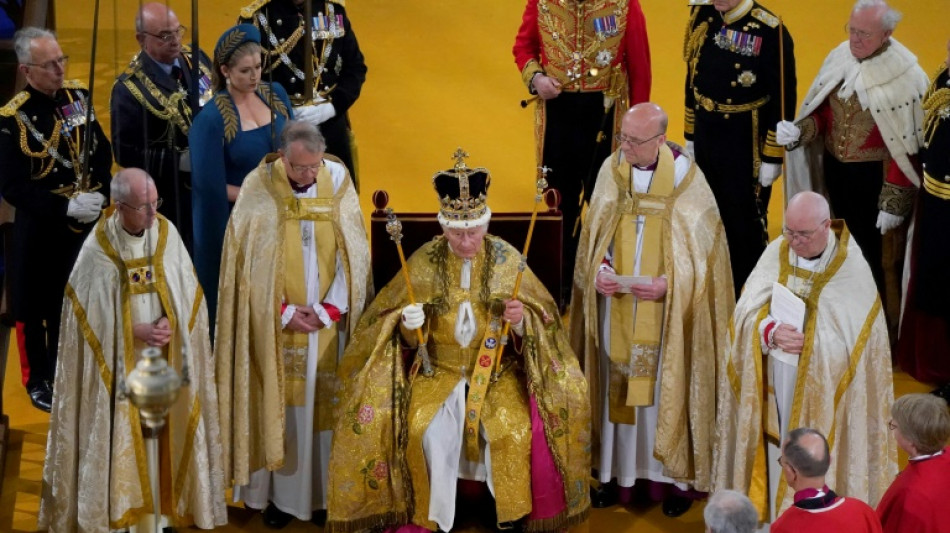
King Charles III crowned in UK's first coronation since 1953 / Photo: Andrew Matthews - POOL/AFP

 Kenya's economy faces climate change risks: World Bank

 Far right and far left battle for power in polarised Berlin

 The last trio: S.Africa's zoo elephants await their fate

 Oil industry sees war windfall but girds for political blowback

 Amazon beats expectations with cloud and AI growth

 Blowout Microsoft results lift US stocks as oil retreats

 'Beginning of the end': Relief but no party as French wildfire winds down

 Southern Europe 'becoming more flammable' in hotter climate, experts say

 Mammoth bones found on parched bed of Danube in Bulgaria

 MEXC Lists Grvt (GRVT) with $60,000 Worth of GRVT and 10,000 USDT in Airdrop+ Rewards

 George and Amal Clooney flee French home due to wildfire

 MEXC Ventures Supports Alpha Arena's APAC Debut at Coinfest Bali

 AI data centre supplier Zhongji InnoLight slips on Hong Kong debut

 May, June heatwaves caused 2,877 extra deaths in England: govt

 BMW profit down a third as carmaker plans job cuts

 Seoul extends losses as most Asian markets drop, oil rises again

 Gambling.com Group Is Now Grandstand

 Meet the astronomer digging into the Milky Way's 'fossils'

 AI data centre supplier Zhongji InnoLight falls on Hong Kong debut

 Samsung operating profit up 1,800% in second quarter on AI boom

 Japanese population below 120 million for first time in decades

 US actor Jared Leto denies latest accusations of sexual assault

 Danube drops to 'historic lows' as fresh heatwave hits

 BTS pulls out of Grammys after Asian pop category introduction

 OpenAI says rogue AI agent attack hit other companies
Charles III was crowned monarch of the United Kingdom and 14 Commonwealth realms on Saturday at Britain's first coronation for 70 years, during a ceremony steeped in a millennium of ritual and spectacle.
After a lifetime as heir to his late mother Queen Elizabeth II, Charles, 74, became the oldest sovereign yet to be crowned at London's Westminster Abbey.
At 12:02 pm (1102 GMT), Archbishop of Canterbury Justin Welby placed the solid-gold St Edward's Crown on Charles's head as a sacred and ancient symbol of the monarch's authority.
Welby also crowned Charles's wife, Queen Camilla, 75.
Cries of "God Save the King" rang out from the 2,300-member congregation, which included foreign royalty and political leaders.
US President Joe Biden, represented at the abbey by First Lady Jill Biden, tweeted his congratulations and paid tribute to the "enduring friendship" between the United States and Britain.
Trumpet fanfares sounded along with gun salutes across Britain and beyond.
Returning to Buckingham Palace in the day's second horse-drawn parade, the royal family appeared on the balcony to applause and more chants of approbation from tens of thousands of well-wishers braving a spring downpour.
Some had camped out for days. A ceremonial fly-past was scaled down due to the weather.
Not everyone joined in the celebration, however.
Shortly before the coronation, London police arrested dozens of protesters using new powers rushed onto the statute book to crack down on direct action groups.
The anti-monarchy movement Republic -- which wants an elected head of state -- said six of its organisers were detained, while climate activists Just Stop Oil said 19 of its number were held.
Nevertheless, dozens of Republic activists held aloft banners on the route of the procession route, declaring: "Not My King."
Human Rights Watch, Amnesty International and other campaign groups condemned the arrests. "This is something you would expect to see in Moscow, not London," HRW said.
The Metropolitan Police deployed some 11,500 officers for one of its biggest ever security operations.
The force had warned that it would have an "extremely low threshold" for protests, and controversially planned to use mass facial recognition technology to monitor the crowds.
As well as being the first coronation since that of Queen Elizabeth II in 1953, it was the first of a king since 1937. It was only the second to be televised and the first in colour and streamed online.
- Changes -
Much of the Anglican service, in which Charles pledged "I come not to be served but to serve", would have been recognisable to the 39 other monarchs crowned at Westminster Abbey since William the Conqueror in 1066.
But while many of the intricate rituals and ceremony to recognise Charles as his people's "undoubted king" remained, the sovereign sought to bring other aspects of the service up to date.
Female bishops and choristers participated for the first time, as did leaders of Britain's non-Christian faiths, while its Celtic languages -- Welsh, Scottish Gaelic and Irish Gaelic -- featured prominently.
A gospel choir sang for the first time at a coronation while a Greek choir intoned a psalm in tribute to Charles's late father, Prince Philip, who was born on the island of Corfu.
As king, Charles is supreme governor of the Protestant Church of England and has described himself as a "committed Anglican Christian".
But he heads a more religiously and ethnically diverse country than the one his mother inherited in the shadow of World War II.
As such, he sought to make the congregation more reflective of British society, inviting ordinary members of the public to sit alongside the VIPs.
In another change, the coronation themes mirrored his lifelong interest in biodiversity and sustainability.
Seasonal flowers and foliage were brought from the wind-battered Isle of Skye in northwest Scotland to Cornwall at the tip of England's southwest coast to fill the abbey.
Ceremonial vestments from previous coronations were reused, and the anointing oil -- created from olives on groves on the Mount of Olives and perfumed with essential oils -- was vegan.
Charles was anointed out of sight of the congregation behind a three-sided screen in front of the abbey's High Altar, to the strains of Handel's soaring anthem "Zadok the Priest", sung at every coronation since 1727.
- Opposition -
Rishi Sunak, a Hindu who is Britain's first prime minister of colour, gave a reading from the Bible at the service and has described the coronation as "a proud expression of our history, culture and traditions".
But polling indicates waning support for the monarchy, particularly among younger people.
Charles's younger brother Prince Andrew -- sidelined due to his friendship with the late convicted paedophile Jeffrey Epstein -- was booed as he headed to the abbey.
Another royal exile, Prince Harry, who has criticised the family since leaving for the United States in 2020, attended the coronation on his own.
Overseas, Charles's position as the hereditary monarch and head of state of 14 Commonwealth countries looks increasingly fragile.
Jamaica and Belize both signalled this week that they are moving toward becoming republics, while Australia, Canada and others may eventually follow suit.
Britons struggling with the soaring cost of living have meanwhile questioned why taxpayers should stump up for the coronation, with the bill estimated to be over £100 million ($126 million).
- Support -
Yet the huge crowds of royal fans that have been building all week on The Mall outside Buckingham Palace indicate that the royals still have a central role in British culture and history.
"I'm very excited to be here, to be part of this history," said Wilen, wearing a visor and sweatshirt in Canadian colours.
"It's just too good an opportunity to miss," said Nick Demont, 60, outside the abbey. "There's a good chance I won't see another one."
O.Hansen--CPN