
Horses part of Native American life earlier than thought: study / Photo: DAVID MCNEW - AFP/File

 Kenya's economy faces climate change risks: World Bank

 Far right and far left battle for power in polarised Berlin

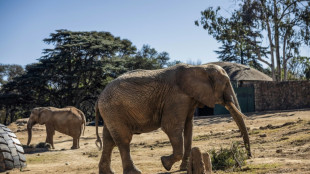 The last trio: S.Africa's zoo elephants await their fate

 Oil industry sees war windfall but girds for political blowback

 Amazon beats expectations with cloud and AI growth

 Blowout Microsoft results lift US stocks as oil retreats

 'Beginning of the end': Relief but no party as French wildfire winds down

 Southern Europe 'becoming more flammable' in hotter climate, experts say

 Mammoth bones found on parched bed of Danube in Bulgaria

 MEXC Lists Grvt (GRVT) with $60,000 Worth of GRVT and 10,000 USDT in Airdrop+ Rewards

 George and Amal Clooney flee French home due to wildfire

 MEXC Ventures Supports Alpha Arena's APAC Debut at Coinfest Bali

 AI data centre supplier Zhongji InnoLight slips on Hong Kong debut

 May, June heatwaves caused 2,877 extra deaths in England: govt

 BMW profit down a third as carmaker plans job cuts

 Seoul extends losses as most Asian markets drop, oil rises again

 Gambling.com Group Is Now Grandstand

 Meet the astronomer digging into the Milky Way's 'fossils'

 AI data centre supplier Zhongji InnoLight falls on Hong Kong debut

 Samsung operating profit up 1,800% in second quarter on AI boom

 Japanese population below 120 million for first time in decades

 US actor Jared Leto denies latest accusations of sexual assault

 Danube drops to 'historic lows' as fresh heatwave hits

 BTS pulls out of Grammys after Asian pop category introduction

 OpenAI says rogue AI agent attack hit other companies

Native American people integrated horses into their communities much earlier than European colonial records suggest, according to an innovative study Thursday that combined archaeological and genetic analysis with Indigenous oral traditions.
The study is the first using both Western science and traditional knowledge to be published in the prestigious Science journal, the researchers said.
Based on European records from colonial times, historians have long contended that Native American people did not interact much with horses in the American West until the late 1600s.
Scholars often say the turning point was the Pueblo Revolt of 1680, when Indigenous people staged an uprising against Spanish colonisers in what is now New Mexico, releasing many European horses in the process.
However the new research, which traces the spread of horses from the American Southwest into the Great Plains and Rocky Mountains regions, contradicts this widely accepted theory.
The team analysed hundreds of horse remains using radiocarbon dating, DNA sequencing and other tools to demonstrate that the animals had spread widely across the American West in the early 1600s.
They also showed that the horses were raised, received veterinary care, and used for transport by Indigenous communities during that time.
This meant that horses were part of Native American social and ceremonial traditions "before any documented European presence in the Rockies or the Central Plains," the study said.
- 'Historic' -
The findings are consistent with a range of Indigenous oral histories that have long challenged the European account.
"Before this study, there was literally no place for Indigenous peoples in the Americas, or the horses we lived alongside and protected, in this conversation," said Yvette Running Horse Collin, a member of the Oglala Lakota Nation and co-author of the paper.
"This is due to the systems put in place by colonisation," she told a press conference in the southern French city of Toulouse.
Rather than one "scientific system dominating another," the research showed that "science can be utilised to heal and to unite rather than divide," she added.
William Taylor, an archaeologist at the University of Colorado and the study's first author, said that "a myopic, narrow focus on European perspectives has unfortunately limited our understanding collectively of the integration of horses into Indigenous societies".
Ludovic Orlando, a study co-author and paleogeneticist at France's national scientific research centre CNRS, said the research was "historic".
"We've brought traditional science to the cover" of Science, he told the press conference.
- 'Mutual language' -
While horses are known to have inhabited the Americas more than 12,000 years ago, Orlando said there is an "absence of fossils" between that time and the 1600s, the reason for which is not known.
The fossils from the 1600s covered by the research had Spanish or Portuguese ancestry, genetic analysis showed.
That would "fit well with acquisition from the conquistadors," Orlando said, adding that the discovery of more fossils could disprove this theory.
Orlando, who has previously used genetic analysis to disprove longstanding theories about the history of horses, was contacted by Lakota researchers in 2018.
Running Horse Collin then moved to the south of France for two years to work at the Centre for Anthropobiology and Genomics of Toulouse.
"I, as an Oglala Lakota scientist, was not asked to change my methods, methodology and conclusions," she said.
Orlando said that different theoretical approaches sometimes led him to reflect on how he communicated, which "was really not easy at several moments".
But he said they found "a mutual language" and intend to continue their scientific collaboration.
Study co-author Carlton Shield Chief Gover, a member of the Pawnee Nation, said in a statement that admiration for horses extends across borders.
"We can talk to one another through our shared love of an animal," he said.
P.Petrenko--CPN