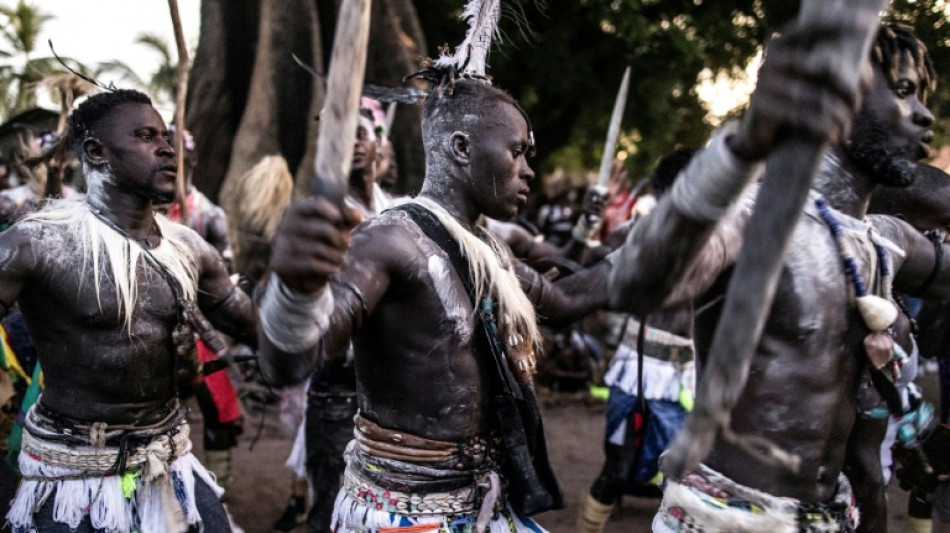
In Senegal, ancient male rite collides with modern times / Photo: JOHN WESSELS - AFP

 US House faces test on sweeping Russia sanctions bill

 British PM says to make 'difficult decisions' as inflation rises

 Global fuel price demos: a round-up

 Leverate Launches MCP for Traders to Connect AI Assistants With Trading Platforms

 MEXC Launches $1M "Discover Your Wall Street DNA" Campaign to Help Traders Find Their Market Fit

 Stocks edge higher ahead of US Fed rate call

 BASIS.pro Expands On-Chain Infrastructure with XDC Network Partnership and Zypher DAO as Auto Earn Goes Live

 Pickle-flavoured tart? AI inspires Japan's convenience stores

 EU chief hosts Canada's Carney in push to 'deepen' alliance

 Meta chief pushes back on AI slowdown calls

 US Fed to deliver rate decision with markets betting on hike

 Sanders, Bannon warn of AI dangers in rare US left-right alignment

 Empty benches as schools reopen in Venezuela's quake-hit Guaira

 Tiny English village holds 'independence' vote over asylum seeker housing

 US Treasury chief says to meet Chinese counterpart at weekend

 BingX Evolves into a Multi-Asset Trading Platform, Connecting Users to Global Opportunities

 International Trading Institute Expands Professional Trader Development Beyond the Master’s in Trading

 Lake Energy Secures $80 Million for U.S. Renewable Energy Expansion

 Stocks drop, oil climbs and Treasury yields hit 19-year high

 SkySail Strategies Outperforms Wall Street's 30-Year Risk Standard With Proprietary AI Inference Model

 Just add fish: Scientists pursue more rice, less disease in Senegal paddies

 Belgium completes outer structure of offshore energy island

 China retail sales growth weakens further in August

 In Kashmir, lake weeds mix with traditional art

 'Widow's Bay' and 'The Pitt' take key Emmy awards

The dancers are a blaze of colour, swirling amid a deafening, pounding noise.
In their midst, a young man stands up.
Wearing a beaded necklace and clad in a tight red shirt with multi-coloured scarves hanging from his waist, with his arms outstretched, he makes a long cry to the heavens.
This is an important moment for Cedric Djikila Diatta, 21, on his path towards the coveted status of manhood.
According to the traditions of the Diola people in Senegal's southern region of Casamance, he has entered the period of "Youth" -- the intermediate chapter between adolescence and adulthood.
To prepare for the next step, a phase that may take half a dozen years, he and other young men of the same age have spent the past month together.
They have been working in the rice fields and listening to the elders recount secret rites of passage and inculcate the values of hospitality and discipline.
"Once you have been initiated, you change status," said Cedric.
"You are free to travel, get married, take decisions that affect the entire community."
- Combat -
Central to the transition to adulthood is the notion of warriorhood -- "Life is a fight," said Cedric. "You always have to fight."
And this where the dance comes in: it is designed to strengthen them spiritually for combat, which in the Diola culture is conveyed through wrestling, Senegal's national sport.
As tomtoms and the bombolong, a traditional elongated drum, echo around the village of Kabrousse, the young initiates leap from side to side, their metal armbands rubbing against each other.
Some are bare-chested, others are wearing tunics, feathers or magic charms called grigris -- those men who are due to marry in the coming year are dressed as women.
The dancers swirl around, some brandishing swords or staves, and even fake snakes.
Evening starts to fall and a gentle light, filtered by the emerald fronds of two giant kapok trees, bathes the dancers.
Young women arrive, gathering around the young men, swinging their hips, their makeup and hair perfect, crooning their support for their champions and rubbing powder on the sculpted male bodies.
Children are there, and the elderly too. The mothers look adoringly at their sons on the brink of manhood -- "he's so handsome!" cries Cedric's mother, Angele Antessey Diatta, a proud smile illuminating her face.
- Threatened tradition -
The party marking the end of these important rites coincides with the end of the rainy season each year in late September.
Lower Casamance is part of Senegal's southernmost region, and almost separated from the rest of the country by the tiny state of Gambia.
The rituals, teaching and secrets conveyed from generation to generation vary from village to village, said Abdou Ndukur Kacc Ndao, an anthropologist.
"But these practices are under threat today," he said.
"In a hundred, two hundred years, it may well be that they no longer exist."
Pressures on animist-rooted traditions range from the growing place of Islam in Senegal, greater mixing among ethnic groups, and migration towards other regions within the country or abroad.
Those who return bring back different perspectives, fashions and tastes.
Cedric praised the ancient traditions, but he also had his eye on distant horizons.
He showed off his small house, which had no furniture, toilet or running water or even a floor.
He stopped school at the age of 12 to help his parents in the field. His father fell ill and two of his brothers also died of sickness, lacking treatment.
He trained as a cook, working in one of the hotels in Casamance's Cap Skirring tourist resort, leaving for work at 4:30 am and returning in the afternoon to work in the rice fields.
He said he earned 80,000 CFA (around $120) a month.
His dream was to get a job at the Club Med, an upmarket French vacation village at Cap Skirring.
"When you get hired there, you make contacts enabling you to head off and live elsewhere," he said.
Y.Ibrahim--CPN

