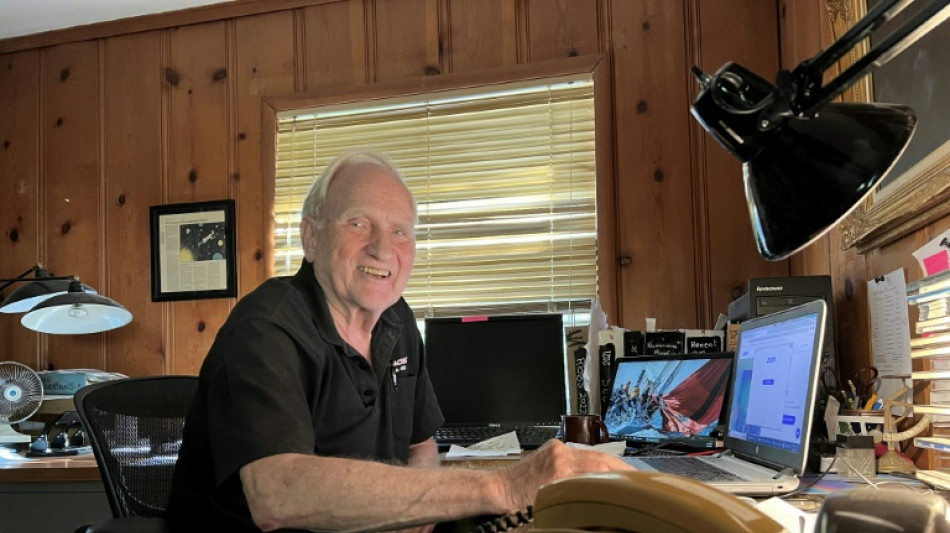
Nobel physics winner wanted to topple quantum theory he vindicated / Photo: Remi Vorano - AFP

 US House faces test on sweeping Russia sanctions bill

 British PM says to make 'difficult decisions' as inflation rises

 Global fuel price demos: a round-up

 Leverate Launches MCP for Traders to Connect AI Assistants With Trading Platforms

 MEXC Launches $1M "Discover Your Wall Street DNA" Campaign to Help Traders Find Their Market Fit

 Stocks edge higher ahead of US Fed rate call

 BASIS.pro Expands On-Chain Infrastructure with XDC Network Partnership and Zypher DAO as Auto Earn Goes Live

 Pickle-flavoured tart? AI inspires Japan's convenience stores

 EU chief hosts Canada's Carney in push to 'deepen' alliance

 Meta chief pushes back on AI slowdown calls

 US Fed to deliver rate decision with markets betting on hike

 Sanders, Bannon warn of AI dangers in rare US left-right alignment

 Empty benches as schools reopen in Venezuela's quake-hit Guaira

 Tiny English village holds 'independence' vote over asylum seeker housing

 US Treasury chief says to meet Chinese counterpart at weekend

 BingX Evolves into a Multi-Asset Trading Platform, Connecting Users to Global Opportunities

 International Trading Institute Expands Professional Trader Development Beyond the Master’s in Trading

 Lake Energy Secures $80 Million for U.S. Renewable Energy Expansion

 Stocks drop, oil climbs and Treasury yields hit 19-year high

 SkySail Strategies Outperforms Wall Street's 30-Year Risk Standard With Proprietary AI Inference Model

 Just add fish: Scientists pursue more rice, less disease in Senegal paddies

 Belgium completes outer structure of offshore energy island

 China retail sales growth weakens further in August

 In Kashmir, lake weeds mix with traditional art

 'Widow's Bay' and 'The Pitt' take key Emmy awards

American physicist John Clauser won the 2022 Nobel Prize for a groundbreaking experiment vindicating quantum mechanics -- a fundamental theory governing the subatomic world that is today the foundation for an emerging class of ultra-powerful computers.
But when he carried out his work in the 1970s, Clauser was actually hoping for the opposite result: to upend the field and prove Albert Einstein had been right to dismiss it, he told AFP in an interview.
"The truth is that I strongly hoped that Einstein would win, which would mean that quantum mechanics was giving incorrect predictions," the 79-year-old said, speaking by telephone from his home in Walnut Creek, just outside San Francisco.
Born in Pasadena in 1942, Clauser credits his father, an engineer who designed planes in the war and founded the aeronautics department at Johns Hopkins University in Baltimore, for instilling in him a lifelong love of science.
"I used to wander around his laboratory and say 'Wow, oh boy, when I grow up I want to be a scientist so I can play with these fun toys too.'"
As a graduate student at Columbia in the mid-1960s, he grew interested in quantum physics alongside his thesis work on radio astronomy.
- Quantum entanglement -
According to quantum mechanics, two or more particles can exist in what's called an entangled state -- what happens to one in an entangled pair determines what happens to the other, no matter their distance.
The fact that this occurred instantly contradicted Einstein's theory of relativity which held that nothing -- including information -- can travel faster than the speed of light.
In 1935 he dismissed this element of quantum entanglement -- called nonlocality -- as "spooky action at a distance."
Einstein instead believed that "hidden variables" that instructed the particles what state to take must be at play, placing him at odds with his great friend but intellectual adversary Niels Bohr, a founding father of quantum theory.
In 1964, the Northern Irish physicist John Bell proposed a theoretical way to measure whether there were in fact hidden variables inside quantum particles. Clauser realized he could resolve the long standing Bohr-Einstein debate if he could create the right experiment.
"My thesis advisor thought it was a distraction from my work in astrophysics," he recalled, but undeterred, he wrote to Bell, who encouraged him to take up the idea.
It wasn't until Clauser had completed his doctorate and taken up a job at UC Berkeley that he was actually able to start working on the experiment, along with collaborator Stuart Freedman.
They focused a laser on calcium atoms, making it emit particles of entangled photon pairs that shot off in opposite directions, and used filters set to the side to measure whether they were correlated.
After hundreds of thousands of runs, they found the pairs correlated more than Einstein would have predicted, proving the reality of "spooky action" with hard data.
At the time, leading lights of the field were unimpressed, said Clauser, including the renowned physicist Richard Feynman who told him the work was "totally silly, you're wasting everybody's time and money" and threw him out his office.
Questioning the foundation of quantum mechanics was deemed unnecessary.
- Quantum computing -
That wasn't the view of the Nobel committee, who awarded Clauser, Alain Aspect of France, and Anton Zeilinger of Austria the world's most prestigious science prize for their pioneering work in advancing the field.
"It took a long time for people to realize the importance of the work," chuckled Clauser.
"But I suppose it is a certain vindication, everyone was telling me it was silly."
Einstein's theory had more appeal to Clauser than Bohr's, which he confessed to not fully grasping.
But over time, he came to realize the true value of his and his co-winners' experiments. Demonstrating that a single bit of information can be distributed through space is today at the core of quantum computers.
Clauser pointed to China's quantum-encrypted Micius communications satellite, which relies on entangled photons thousands of kilometers apart.
"We did not prove what quantum mechanics is -- we proved what quantum mechanics isn't," he said, "and knowing what it is not then has practical applications."
P.Petrenko--CPN

