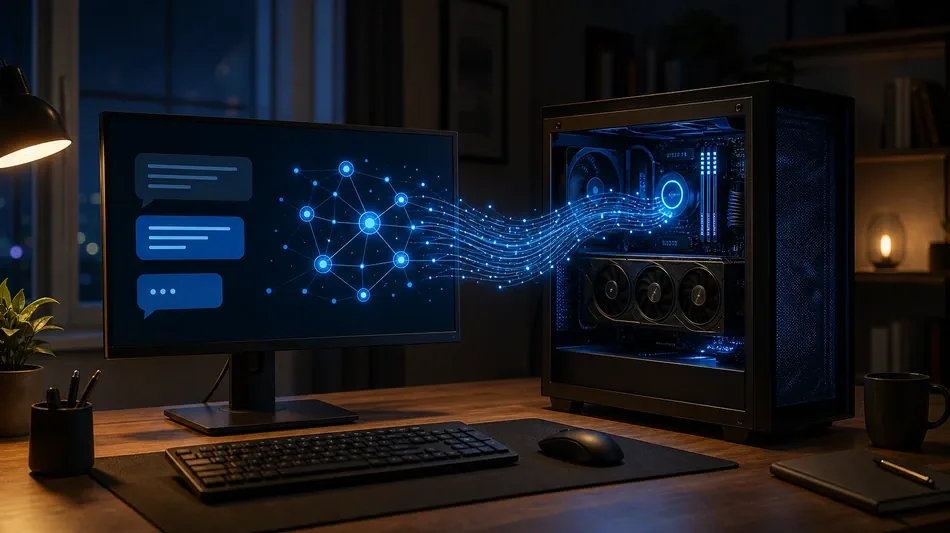
Running a Local Language Model Offers Privacy With Hardware Trade-Offs

 Vietnamese coffee farmers ride China's durian wave
 Educators keep 9/11 memory alive for next generation, 25 years on

 US deports right-wing provocateur Milo Yiannopoulos

 Tamil Nadu and NUS agree to expand postgraduate and research links
 Norway's King Haakon VIII pays tribute to late father in first speech

 Chennai Sets ₹100 Crore Flood-Readiness Plan for Vulnerable Areas

 Apple Raises TV Streaming Price to $14.99 a Month

 Pennsylvania Coal-Waste Power Subsidies Rise as Solar Remains a Smaller Source

 Los Angeles County Rapper Among Three Charged in $8.1 Million Stolen-Check Case

 NHAI Starts Removing Temporary Cooum River Bunds Ahead of Northeast Monsoon

 Nepal warns of climate threat after deadly floods

 Norway, in mourning, enters a new era under King Haakon VIII

 Three Students Die, Four Injured in Madurantakam Car Crash

 SUV Tyre Failure Kills Three Chennai College Students

 Running a Local Language Model Offers Privacy With Hardware Trade-Offs

 Nepalis cling to hope for missing, three days after disaster

 Fatal Sign Collapse Ends Big Church Festival Early

 Former Surbiton Teacher Barred Indefinitely for Sexual Misconduct

 UK Moves 2026 Boxing Day Bank Holiday to Monday

 Former Pleasure Island Site Proposed as Cleethorpes Holiday Resort

 £120 Autumn Throw Discounted to £35 in Seasonal Sale

 Apprenticeship Awards Name Derbyshire and Nottinghamshire Finalists

 Muse Honolulu Site Moves Toward October Demolition Preparations

 State Seeks Tips After Vandalism at Maui High Restroom Project

 PSBB K.K. Nagar Pair Wins Madras Quiz

Free language models can run on personal computers without sending prompts to the cloud, though performance depends heavily on memory, graphics hardware and model size.
Large language models do not have to run through cloud services such as ChatGPT, Claude or Perplexity. A growing range of models can be downloaded and operated on a personal computer, keeping prompts and documents on the device and allowing the software to work without an internet connection after installation.
Local operation can eliminate subscription fees and service usage limits. Models from developers including Meta and Google are available without charge, although downloadable systems are often slower or less capable than leading paid cloud products. Users also assume responsibility for installation, updates, storage and troubleshooting, trading some convenience for greater control and privacy.
Windows, macOS and Linux can all host local models. Macs are popular among enthusiasts because Apple controls the hardware and software platform and Apple Silicon combines processor, graphics and memory resources in a way that suits AI workloads. Windows systems can perform well, particularly when equipped with a dedicated Nvidia graphics card.
Memory is a central constraint. Eight gigabytes of RAM is a practical lower boundary but restricts model size and speed. Sixteen gigabytes provides more flexibility, while 32 gigabytes or more is useful for larger and faster systems. A discrete graphics processor with more than 8 gigabytes of video memory can materially improve performance because GPUs are designed for highly parallel computation and provide additional optimized memory.
A complete setup requires both a model and an application that loads it and provides an interface. LM Studio Bionic is a free and approachable option for Windows and macOS. More technical alternatives include vLLM, llama.cpp, Ollama and GPT4All. Model catalogs inside these applications can guide users, while Hugging Face hosts more than 3 million models.
One example begins by installing LM Studio Bionic on Windows, selecting Create Project and naming the project. The program opens an empty conversation. Choosing a model and then selecting the local-model catalog displays available options with their size, popularity and descriptive information. Staff selections can help new users, while smaller models download more quickly, consume less disk space and require fewer computing resources.
Once a model is installed, the chat interface resembles a conventional AI service. A model selector appears in the prompt area when several systems are available. A plus control can attach images or files if the active model supports those formats. Projects are organized through the navigation pane, and the settings area controls matters including interface elements and treatment of deleted conversations.
The Library section manages installed models, while Explore provides access to additional choices. Users who want to analyze pictures and documents need a multimodal model, a system that extends text-model capabilities to other types of input. The right sidebar manages project files and, when authorized, access to locations on the computer’s file system.
Model size affects more than download time. Larger systems require more working memory and usually respond more slowly on modest computers, while small models can be practical for basic drafting, summarization and question answering. The catalog information allows users to compare these demands before committing storage space. Keeping several models installed also makes it possible to choose a lighter system for routine work and reserve a more demanding one for tasks that benefit from additional capability.
Dedicated video memory is particularly useful because model calculations can remain on the graphics card instead of moving repeatedly between components. On computers without a discrete GPU, the processor and system memory can still run suitable models, but output may arrive more slowly. Apple’s unified-memory design changes that division by allowing CPU and GPU resources to draw from the same pool, one reason the platform has become common for local experimentation.
Privacy also depends on configuration. Running inference locally prevents prompts from being sent to a hosted chatbot by default, but users still need to consider any optional integrations, update services or file permissions they enable. LM Studio’s project and file controls let the user decide which documents a model can reach, and those permissions should be limited to material required for the task.
Selecting an appropriate model therefore involves balancing capability against download size, memory use and speed. Local AI is not maintenance-free, but modern desktop tools have reduced the technical barrier. For users whose priorities include offline availability, predictable costs and keeping sensitive material away from third-party servers, the additional setup can be worthwhile.
M.Anderson--CPN