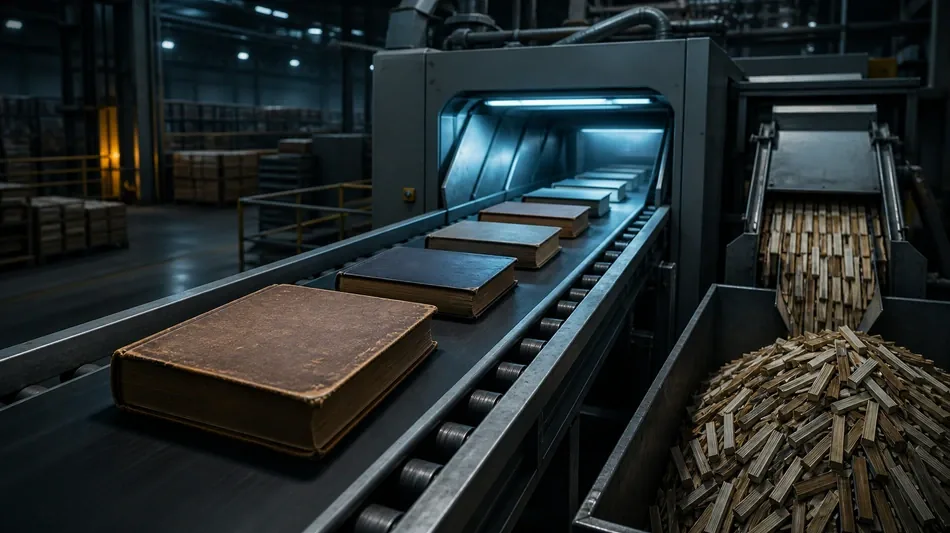
Bulk book purchases feed AI training through destructive scanning

 ستاندرد آند بورز تثبت تصنيف السعودية عند A+

 Lights out in Laos as electricity exports surge

 Steven Strogatz weighs AI mathematics advances and their consequences for researchers

 Anthropic boss calls for AI slowdown, Altman and Musk agree

 French IT giant Capgemini sells subsidiary after row over ICE links

 Quebec Brokerage Qubit Insurance Announces New Data on Coverage Shortfalls as Rebuilding Costs Rise

 Lady Gaga welcomes first child with fiance: US media

 Bhutan business bets on hazelnuts for farming future

 'Widow's Bay' and 'The Pitt' are favorites for Emmys night

 Coastal erosion forces cancellation of California music festival

 Argentina's Dirty War rears its head in Venice film

 UK lawmakers throw out bill to legalise assisted dying

 US inflation steady in August, fueling Fed rate hike expectations

 New York marks 25th anniversary of 9/11 attacks

 Nepal flood reconstruction bill to be $4.78 bn: foreign ministry

 JUMO and Standard Bank launch Social Finance Framework to scale inclusive finance in Africa

 Doomsday tech: could AI really kill us all?

 French comedy show 'Call my agent' makes film comeback

 It's all coming back: Celine Dion fans gear up for Paris return

 Researchers eye AI revolution in natural disaster forecasts

 US braces for inflation report that may push Fed to hike rates

 Musk threatens legal action over documentary

 Latin America fact-check group asks Meta not to replace verification practice

 AI Risks to Enter 60–80% of Liability and Cyber Insurance Underwriting by 2028, ScienceSoft Predicts

 Tribal Launches Campfire, Letting Business and Technical Teams Build on Salesforce Together

British booksellers have reported unusual bulk orders as technology companies acquire physical books, remove their bindings and scan the pages to expand artificial-intelligence training data.
Second-hand booksellers in Britain have reported large and unusually varied orders for non-fiction titles, raising concern that physical books are being acquired for artificial-intelligence training through a process known as destructive scanning. The method removes a book’s spine, separates and scans its pages, and then discards the original.
Lucy Hingston of Compass Books in Dartmouth, Devon, began comparing notes with other dealers after receiving an order for unrelated works covering subjects including Peruvian geology, South African history, railways, cheese and Hong Kong jewellery. Dealers in York and Felixstowe described similar orders, often involving obscure or out-of-print books and overseas buyers. Online catalogues appeared to make the shops easier to target.
Court records showed that Anthropic, developer of the Claude chatbot, began buying and scanning millions of print books in early 2024 under an initiative called Project Panama. The company had previously used more than seven million digitised books obtained from pirate websites, including five million from one source. A federal judge in San Francisco approved a $1.5 billion, or £1.1 billion, settlement this month in a class action filed by three authors in California in 2024.
Buying physical copies engages the US first-sale doctrine, which generally allows owners to dispose of purchased goods. The records said Anthropic spent millions of dollars on millions of books, stripped their bindings and scanned the pages. Anthropic said Claude is trained on publicly available web material, commercially acquired datasets and internally generated data, and said its programmes do not buy and destroy rare or antiquarian books.
An investigation by 404Media also linked an Amazon warehouse near Las Vegas, known as VGT3, to large-scale book scanning. Amazon said it purchases books through commercial channels to develop and improve customer products and services. Elon Musk said his SpaceXAI team had been told to preserve rare books and scan them by turning pages rather than cutting their spines.
Dealers said many orders appeared to favour non-fiction published before 2022, when generative AI entered widespread use. Oxford University associate professor Yarin Gal said repeatedly training models on AI-generated material can produce a feedback problem known as model collapse, increasing demand for reliably human-written work.
Zoom Books, named by several sellers as a purchaser, denied involvement in destructive scanning. Booksellers remain divided because bulk sales can help businesses operating on narrow margins, while publishers and dealers warn that destruction may eliminate scarce copies and that authors and other creators receive no additional compensation when the text is used for AI training.
A.Levy--CPN