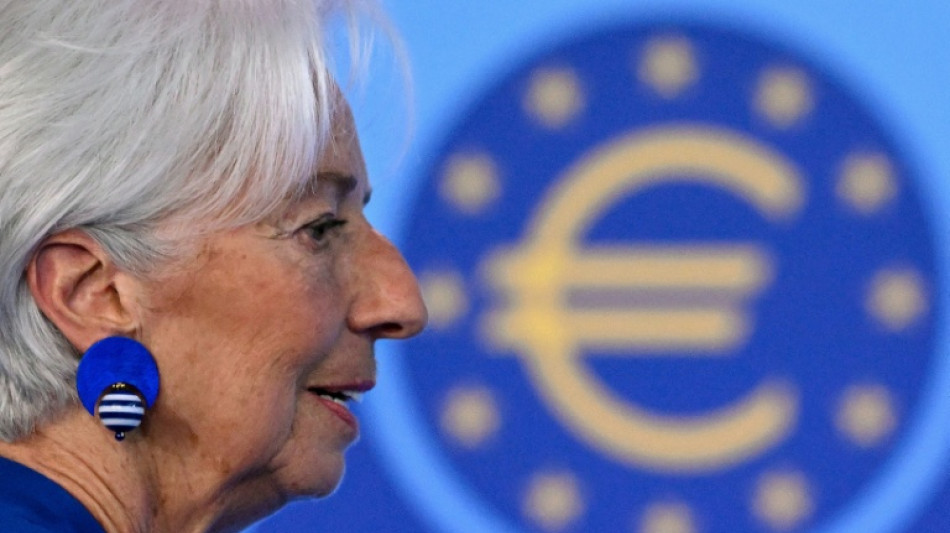
Europe can't afford to miss AI revolution: ECB chief / Photo: Kirill KUDRYAVTSEV - AFP

 Alex Bodi appointed Vice President of SCANDIC FINANCE GROUP

 Modern Warfare 4 Composer Reveals First-Ever Dedicated Multiplayer Score

 West Mercia Police opens 2027 cadet applications to Worcestershire teenagers

 Goa plans relationship-readiness course amid concern over divorces

 BHEL wins Adani Power projects valued at up to ₹28,000 crore

 India seeks threefold increase in coal stocks to prevent summer power shortages

 Indus Towers expands solar-powered network to 50,000 telecom sites

 Equitas Small Finance Bank rebounds after naming interim chief executive

 Titan quarterly profit seen rising as jewellery business drives growth

 Kuwait finance minister holds economic cooperation talks at COMCEC

 Kuwait marks key events and anniversaries from national history
European Central Bank chief Christine Lagarde said Wednesday that the continent could not afford to miss out on the artificial intelligence revolution as the continent's growth model comes under increasing pressure.
The United States and China are seen leading the AI race, with their companies producing the most advanced large language models and rapidly building vast new data centres.
"Europe largely missed out on the first digital revolution, as the commercial gains from the spread of information and communication technologies were captured disproportionately elsewhere," Lagarde said at a World Economic Forum event in Geneva.
"We cannot afford to repeat that experience with artificial intelligence, the second digital revolution," she said.
While European companies are investing heavily in AI, barriers in the eurozone are hindering them from scaling up their operations, she said.
The "fragmentation" of EU markets means firms are not competing enough across the whole eurozone and also struggled to raise funds, particular when compared to US peers, Lagarde said.
"The result is fewer firms growing to global size and slower diffusion of new technologies across the economy."
She added that scale is particularly important for Europe to be able to compete in AI and other new technologies at a time when Europe's post-war growth model faces major challenges.
She noted that Europe had long benefitted from "three pillars" -- a rules-based global order underpinned by US security guarantees, cheap energy and expanding global trade.
"All three are weakening as the international environment changes," she said.
"These shifts suggest that Europe's post-war growth model is eroding. And it is unlikely to return to the form we once knew."
The return of US President Donald Trump to the White House, in particular, has shaken relations between the United States and Europe.
He has imposed hefty tariffs on European Union imports and questioned long-standing US commitments to the continent's security.
D.Philippon--CPN
