New space object 'black hole star' discovered by astronomers / Photo: - - NASA TV/AFP/File

 Kenya's economy faces climate change risks: World Bank

 Brazil orders suspension of Discord livestreams after teen suicide

 Europe looks to the skies as solar eclipse cast its shadow

 New space object 'black hole star' discovered by astronomers

 Google unveils finder tag, new AI smartphone features

 Erdogan eyes expansion of regional defence pact

 Former Chinese premier Zhu Rongji dies aged 97
 WHO says Trump vaccine shake-up goes against evidence
 China's C919 jet makes first international commercial flight

 Foxconn posts quarterly profit surge on AI server demand

 Art or medicine? Japan's cosmetic tattoo artists in limbo

 2.4 million girls banned from Afghan schools since Taliban return: UNESCO
 California calls Paramount's threat to leave state 'blackmail'

 Heatwave hits evicted families sleeping rough in Rome

 ForumPay Expands Payment Infrastructure with New Card and Bank Transfer Acceptance Solution

 Sphere 3D Corp. (Nasdaq: ANY) Attracts 6.5% Stake from Turnaround Bitcoin-Mining Investor

 ChargeAfter Powers BYLD Finance Expansion into Consumer Financing for Equipment Retailers

 MEXC Upgrades RealStocks With Three New Features to Enhance U.S. Stock Trading Experience

 Jellyfish force shutdown of three reactors at French nuclear plant

 PrimeXBT Launches MT5 Cent Account for Beginners and Risk-Conscious Traders

 Too hot to live? French buyers rethink housing choices after heatwaves

 Demeter Tactical Investments (ME) Limited bolsters governance with two board appointments

 Memphis AI data center fuels pollution fight in Black neighborhood

 Return of displaced Syrian Kurds to hometown suspended after violence

 Global stocks mixed while oil prices jump on Hormuz

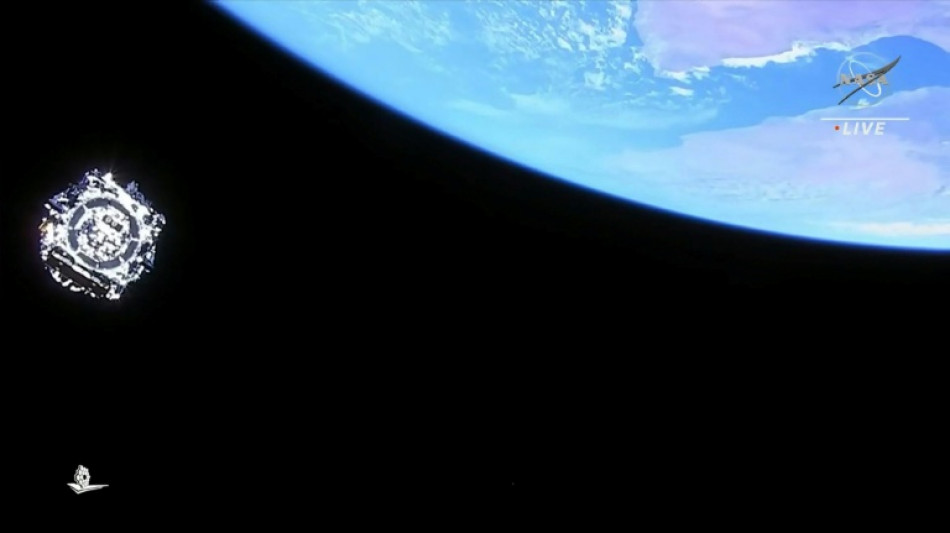
Astronomers announced Wednesday they had discovered a new type of astronomical object called a "black hole star", potentially solving a mystery involving strange red dots spotted in the early universe.
The object looks like a star the size of our solar system, but produces 100 billion times more energy than any star -- a mighty blast of power closer to what is produced by a black hole.
The black hole star, which dates from 660 million years after the Big Bang, was spotted by a US-led team of astronomers using the James Webb Space Telescope, according to a study published in the journal Nature.
Since history's most powerful telescope went online in 2022, it has been spotting many extremely bright cosmic objects dubbed "little red dots" in the early universe that have baffled scientists.
"What exactly these objects are has been one of the most debated topics of the JWST era," lead study author Rohan Naidu of Hawaii University said in a statement.
The team had been trying to find clues for a different mystery: why JWST keeps finding bright galaxies in the universe's infancy, when it was thought to have been too early for them to have become so huge.
But while looking through the images, they spotted a little red dot.
- 'Pure black hole star light' -
"When we see something very red in the universe, we often assume that it is surrounded by dust, like soot or ash," said Robert Simcoe, a study co-author from the Massachusetts Institute of Technology.
"The same way that the wildfire smoke from Canada recently made the sky in Boston look bright red, astronomical objects can also appear redder than their intrinsic colour when you see them through a veil of dust," he added.
However when the team sifted through their data, they found that at certain wavelengths, the object's light simply disappeared.
To their surprise, this suggested that it is not dust making this object appear red -- it is hydrogen gas.
This explained the object's colour, but not how it could be pumping out so much energy.
"You can't be powering this by nuclear fusion, which is the energy source that sits at the heart of all the stars," Naidu explained.
Using modelling simulations, they determined the most likely scenario was that the object is powered by a central black hole surrounded by a cocoon of gas that makes it resemble a star.
The team named the object MoM-BH*-1. The BH and asterix is for black hole star -- and the number one suggests they believe there are more out there.
"Every little red dot is consistent with being a black hole star," Naidu said.
"What is special about MoM-BH*-1 is, the black hole star is essentially completely outshining its surrounding host galaxy, such that we're seeing pure black hole star light."
M.Anderson--CPN