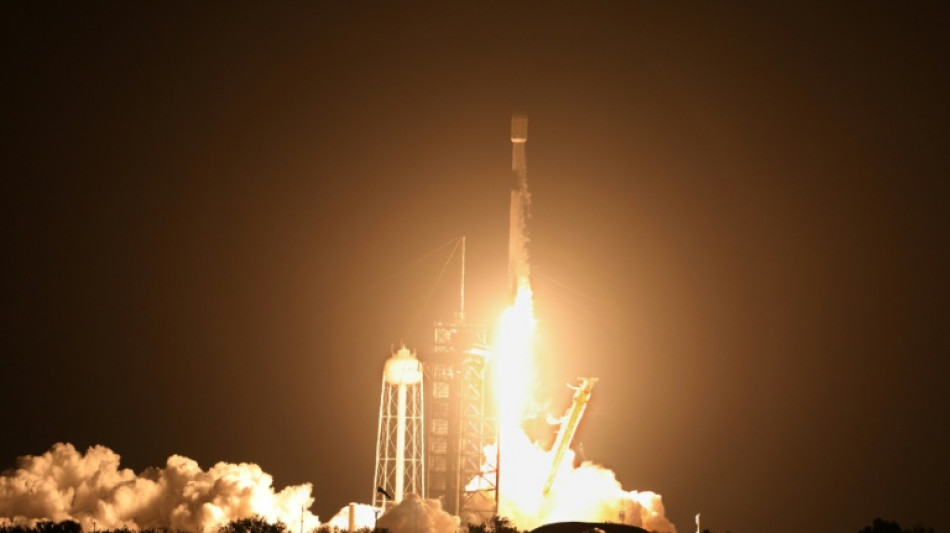
SpaceX rocket stage expected to slam into Moon / Photo: Gregg Newton - AFP/File

 Alex Bodi appointed Vice President of SCANDIC FINANCE GROUP

 Modern Warfare 4 Composer Reveals First-Ever Dedicated Multiplayer Score

 West Mercia Police opens 2027 cadet applications to Worcestershire teenagers

 Goa plans relationship-readiness course amid concern over divorces

 BHEL wins Adani Power projects valued at up to ₹28,000 crore

 India seeks threefold increase in coal stocks to prevent summer power shortages

 Indus Towers expands solar-powered network to 50,000 telecom sites

 Equitas Small Finance Bank rebounds after naming interim chief executive

 Titan quarterly profit seen rising as jewellery business drives growth

 Kuwait finance minister holds economic cooperation talks at COMCEC

 Kuwait marks key events and anniversaries from national history
A SpaceX rocket's upper stage is set to unintentionally crash into the Moon on Wednesday, a collision that poses no danger to Earth but will leave behind a lunar crater.
Scientists and amateur stargazers alike are looking forward to observing the sunlit plume of rubble and debris that is expected after the Falcon 9 upper stage strikes the lunar surface at approximately 2:35 am Eastern (0635 GMT.)
"It might be possible for folks with a telescope to observe the plume of ejecta created by the impact," said Benjamin Fernando of Los Alamos National Laboratory in New Mexico, the lead author on a recent paper on the anticipated impact.
"It is unclear how bright it will be, which is one of the reasons why we are looking to study this event," the researcher told AFP.
Assuming all of the propellant is spent, authors of the paper estimate the spacecraft weighs approximately 8,800 pounds (4,000 kilograms).
It is expected to slam into the Moon's northern hemisphere near the Einstein Crater, at some 5,400 miles per hour (8,690 kilometers per hour).
"There is no danger to Earth," said NASA spokesperson Jimi Russell in a statement.
"NASA will continue to track the booster for training purposes, as well as later observe the impact site for scientific purposes."
The Falcon 9 rocket took off last January, carrying two lunar landers. The booster returned to Earth, but the upper stage stayed in space to push the landers onward.
Generally, for such "high-energy missions," SpaceX performs a maneuver to make sure the second stage "is safe per the appropriate rules and regulations," said Julianna Scheiman, director of NASA Science and Dragon Programs at SpaceX, at a Monday news conference.
"We did that," she continued, but "what has happened is essentially a mixture of solar activity and gravity forces have put it on a path towards the Moon."
Like many scientists, Scheiman added that "I also am very excited to see the observation."
The paper authors encouraged both professional and amateur astronomers to attempt viewing or recording the collision.
"This event provides an opportunity to test a pipeline for localizing impacts on the lunar surface for future seismic experiments, investigating the dust and plume dynamics from impact events on the Moon, and considering hazards from artificial space debris impacts," wrote the research team.
NASA hopes to soon establish a sustained human presence on the Moon, making it critical to better understand space debris in lunar orbit.
The Moon routinely weathers impact from space debris including meteoroids. Artificial collisions are less common.
In the 1970s, the US space agency carried out deliberate crashes during its Apollo program to collect seismic data.
U.Ndiaye--CPN
