
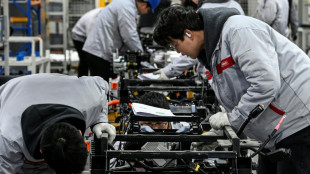
World Bank warns developing countries to embrace AI or be left behind / Photo: Martin LELIEVRE - AFP

 Kenya's economy faces climate change risks: World Bank

 US hopeful Hormuz strait deal will be done 'today or tomorrow'

 Gazans hold mass funeral for those killed during war

 World Bank warns developing countries to embrace AI or be left behind
 Man Utd sign reported record £20mn sponsorship deal for training kit

 BP profit soars as Mideast war roils energy prices

 Most stock markets gain, while oil prices edge up after plunge

 Heat kills 16 in South Korea this summer: interior ministry

 Rockets, Starlink, AI: SpaceX faces its first Wall Street grilling

 Stocks mixed as Seoul stabilises, oil prices rise with eyes on Mideast

 Last Scottish island bird hunt banned after almost 500 years

 Dow hits fresh record as oil prices tumble

 Iran denies negotiating with US, drawing Trump backlash

 Key dates for the Boeing 737 MAX

 England, Wales had driest July on record: Met Office

 Oil prices slide on hopes of deal to end Mideast war

 BitMart、説明を迫られる:SNC SCANDIC COINの出金は8日経っても依然としてTXIDなし

 Seoul issues first 'severe heatwave warning' under new system

 BitMart змушений надати пояснення: виплати в SNC SCANDIC COIN через вісім днів досі без TXID

 BitMart 面臨解釋壓力:SNC SCANDIC COIN 提現八天後仍無 TXID

 Iran denies negotiating with US after Trump announces talks

 US, Japan join forces to boost yen

 Oil prices sink on Middle East hopes, yen extends gains after joint intervention

 Trump says US support for Japanese yen a 'signal of friendship'

 Handbag tosses and high-heeled sprints: Amsterdam celebrates Drag Olympics

The World Bank on Tuesday called on developing countries to embrace artificial intelligence technology tools to deliver better governance outcomes, warning that they risked being left behind if they failed to do so.
"AI has thrown developing economies a lifeline, and they should seize it," Indermit Gill, chief economist of the World Bank Group, said as the organization launched its annual World Development Report.
"They do not need large models or big data centers to reap its benefits," he added, advocating for the adaptation of lower-cost AI tools to local conditions to deliver results in the health, education, justice and agricultural sectors.
Advanced AI models -- largely developed in the United States and China -- offer the ability to quickly analyze data and automate many tasks that otherwise take skilled humans longer to do.
These AI models, however, require huge data centers and large amounts of complex computing power, using massive amounts of electricity and water -- with implications for climate change.
"Developing economies today are in the midst of their weakest average growth performance in three decades," said a World Bank statement accompanying the report.
"AI could significantly boost that performance before the end of the 2020s while delivering tangible benefits to people."
The report calls for countries to use AI to "help extend otherwise costly medical, legal, educational, and agricultural services to underserved billions -- doing in a decade what might otherwise take a century."
- Shock after shock -
Lower-income countries have struggled through the 2020s, hit by a series of successive shocks that saw the World Bank earlier this year dub it a "lost decade" for their economic growth.
The Bank has lowered its 2026 global growth forecast to its lowest level since the pandemic, with the economic fallout of the Iran war battering countries around the world.
The shock has hit low-income and developing countries hardest, with Asia the worst-affected region.
The Bank's new report advocates for developing countries to start working with localized AI tools and solutions now, and to invest in electricity generation and distribution; expand access to computing power; and improve the availability of local data.
"The window to get this right is narrow," said Gaurav Nayyar, director of the report.
"AI presents a once-in-a-lifetime opportunity to solve problems that have resisted solutions for generations," he added.
For the 6.8 billion people -- 83 percent of humanity -- who live in low-income and developing countries, AI tools will need to be adapted to meet their needs.
The report shares examples of AI applications in governance, such as to increase diabetes screening volumes in Bangladesh, or in reducing costs for Indian farmers through advanced weather forecasts.
The solutions, the report stresses, will need to meet people where they are.
"For example, AI solutions will need to be delivered through voice calls on basic mobile phones for those who cannot read or afford smartphones," it says.
"Simply importing an AI model does not mean it will work well locally."
- Stark warning -
The report calls for policymakers to also build public trust as they expand AI use.
"Improved public services and better learning outcomes in schools will reinforce trust -- but if AI embeds bias in government decisions or erodes data privacy, that trust will be difficult to recover," said the statement.
The report delivers a stark warning, too: "AI could widen gaps between countries, increase inequality within them, concentrate market power, weaken trust in public institutions, and create new risks for safety, rights, and social cohesion."
And while risks to employment in developing countries are low at the moment, it warns that in the long run AI tools could cut off economic mobility by eliminating many of the middle-class jobs that enable it.
The report was written with the aid of several of the world's most advanced AI tools, including offerings from OpenAI, DeepSeek, Google and Anthropic, according to a disclosure.
D.Avraham--CPN