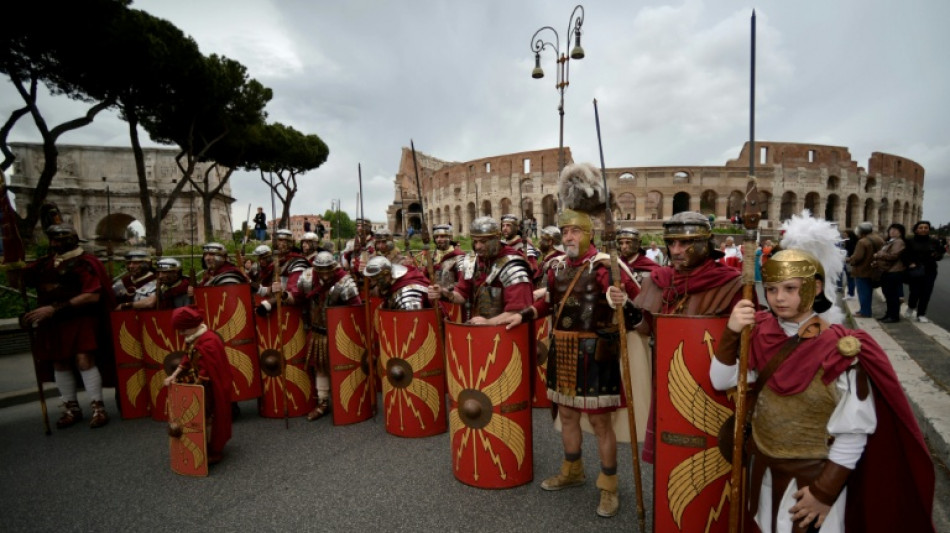
Study points to likely route for Hannibal's legendary Alpine crossing / Photo: FILIPPO MONTEFORTE - AFP

 Tech firms hit by AI slowdown call with Fed expected to hike rates

 South Korea aims to save seniors lost in digital age

 Russia's Stalin-admiring provincial leader waging an ultra-conservative crusade

 'Widow's Bay' and 'The Pitt' tipped for success at Emmy Awards

 Leftwing opposition seen leading Sweden election, far-right losing ground

 Trump administration reluctant to slow AI, Democrats see urgent need

 Can We Predict Volcanic Eruptions Like Weather? Scientists Seek Unified Physics

 اليورو يستقر في البنوك المصرية وأعلى سعر للبيع 59.85 جنيه

 ستاندرد آند بورز تثبت تصنيف السعودية عند A+

 Lights out in Laos as electricity exports surge

 Steven Strogatz weighs AI mathematics advances and their consequences for researchers

 Anthropic boss calls for AI slowdown, Altman and Musk agree

 French IT giant Capgemini sells subsidiary after row over ICE links

 Quebec Brokerage Qubit Insurance Announces New Data on Coverage Shortfalls as Rebuilding Costs Rise

 Lady Gaga welcomes first child with fiance: US media

 Bhutan business bets on hazelnuts for farming future

 'Widow's Bay' and 'The Pitt' are favorites for Emmys night

 Coastal erosion forces cancellation of California music festival

 Argentina's Dirty War rears its head in Venice film

 UK lawmakers throw out bill to legalise assisted dying

 US inflation steady in August, fueling Fed rate hike expectations

 New York marks 25th anniversary of 9/11 attacks

 Nepal flood reconstruction bill to be $4.78 bn: foreign ministry

 JUMO and Standard Bank launch Social Finance Framework to scale inclusive finance in Africa

 Doomsday tech: could AI really kill us all?

Just how Hannibal managed to lead war elephants and a full army over the Alps to attack the Romans remains a mystery, but a new modern biology study points to a potential route.
The bold and legendary crossing in 218 BC, which allowed the ancient Carthaginian leader to strike Rome from the north, has long remained one of the most astounding and celebrated achievements in warfare.
Calculations about the energy requirements of Hannibal's force -- especially the elephants -- points to the Col de la Traversette as the most likely route, according to a study released on Monday by a group of German and British researchers.
The Col de la Traversette is a high-altitude mountain pass in the Cottian Alps at 2,947 metres (9,669 feet) on the border between modern-day France and Italy.
Researchers from the German Centre for Integrative Biodiversity Research (iDiv), the University of Jena and the University of Oxford used route models and elevation data to weigh the physical demands on Hannibal's army of roughly 40,000 men, thousands of horses and a reported 37 war elephants, using body mass data from modern African elephants.
"The new analysis does not eliminate all ambiguity, but it does strengthen the case for the Traversette route by demonstrating that it would better accommodate the demands of moving a large army that included elephants through extremely difficult alpine terrain," said co-author Emilio Berti of iDiv and the University of Jena.
Other routes considered -- such as the Col de Montgenevre, the Col du Clapier, and the Col du Mont Cenis -- would have required 11 percent, 16 percent, and 19 percent more energy, respectively, for the army to traverse.
The study also highlighted the immense physical strain the march through the Alps almost certainly imposed on Hannibal's army.
According to the models, the soldiers on the Traversette route would have lost around 19 percent of their body fat reserves, which could explain the high death toll.
In contrast, calculations for the war elephants indicated a loss of only about four percent of their energy reserves.
Many of the animals reportedly survived the mountain crossing.
The successful crossing of the Alps allowed Hannibal to bypass Roman defences and pull off a string of stunning victories on the Italian peninsula during the Second Punic War.
Rome, however, managed to weather the setbacks and defeat Carthage in the conflict as well as the subsequent Third Punic War.
D.Philippon--CPN