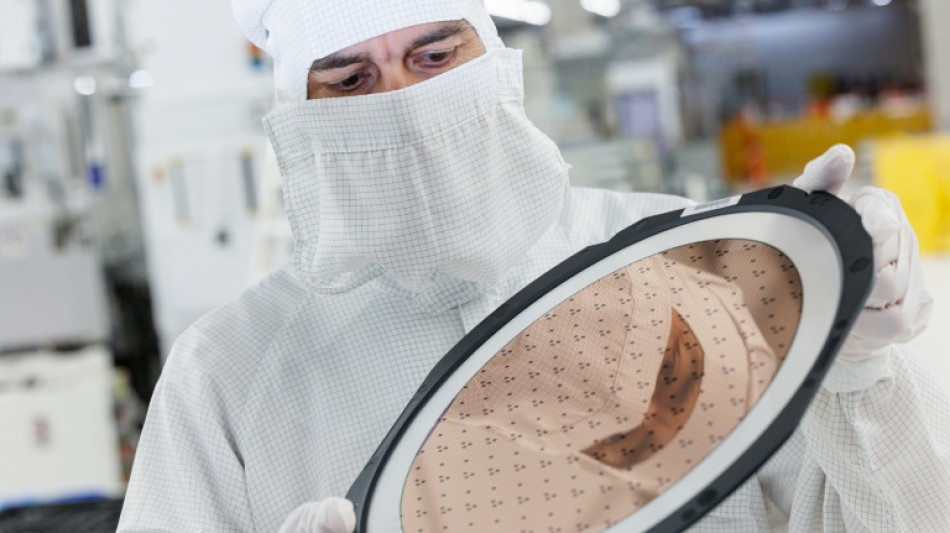
Germany's Infineon opens major chip plant as EU seeks tech autonomy / Photo: Jens SCHLÜTER - AFP

 J-VISIONS Vol. 4 Now Online: Read English Articles on Japanese Corporate IR

 Surfer hospitalised after shark attack in Western Australia

 US hosts G20 'energy abundance' talks amid Iran war shock

 Migrant workers flock to Indian Kashmir despite militant threats
 Canada's Carney seeks closer Europe ties to counter hostile US

 Dozens arrested in major anti-LGBTQ raids in Turkey

 Poland, Ukraine slam Russian strikes near border as 'escalation'

 iPhone 18預購後出現可疑扣款 四間銀行調查未授權交易

 Galaxy Tab S12系列效果圖曝光 Ultra擬配雙鏡頭及瀏海螢幕

 Altman tells Fortune OpenAI will not go public in 2026

 ستاندرد آند بورز تثبت تصنيف السعودية عند A+

 Anthropic details Claude misuse as US targets major illicit online marketplace

 Venezuelans outside Caracas say capital not sharing blackout burden

 Anthropic boss calls for slowing pace of AI development

 BRICS nations urge 'maximum restraint' in Middle East war

 Europe eyes battle over 'pervert' AI glasses

 Children in flood-hit Nepal grapple with loss, cling to hope

 Venice Film Festival: A look back on the highlights

 DR Congo school fire stampede death toll rises to 26: UNICEF

 Dance Fitness Tempe Announces Expansion of Accessible Digital Movement Programs

 Europe saw record summer air traffic despite Mideast war: Eurocontrol

 Relatives of 9/11 victims hit out at Saudi Arabia -- and US leaders

 Relative of 9/11 victim unleashes searing attack on Saudi Arabia

 Czech antitrust office lets Turkey's Pegasus Airlines buy Smartwings

 Investors on edge as energy costs, surging bond yields roil markets

German semiconductor giant Infineon opened a five-billion-euro ($5.7 billion) microchip plant Thursday, at a time Europe seeks to bolster its high-tech autonomy.
The "Smart Power Fab" in the eastern city of Dresden, completed three months ahead of schedule, has been hailed as a symbol of an EU push to reduce dependency for crucial parts on Asia and the United States.
The factory will produce chips for intelligent power management that are used in everything from electric vehicles, wind turbines and solar panels to data centres crucial for artificial intelligence.
The facility was backed by the EU's Chips Act with one billion euros in subsidies, part of a broader policy aimed at doubling the EU's share of global semiconductor production from 10 to 20 percent by 2030.
Work on the new plant began in May 2023, and represents both the largest single investment in Infineon's history and a major strategic pivot for the technology firm based outside of Munich.
The company has moved away from being primarily a supplier to the automotive industry and instead sought to capitalise on the massive AI investment boom.
The plant is located in the heart of Germany's "Silicon Saxony", which boasts one of Europe's most dynamic clusters for the microchip industry.
Dresden, home to nine universities, has a large number of trained engineers who are sought after by the roughly 2,500 companies in the sector operating in the area.
While constructing the "Smart Power Fab" came at a high cost, the subsequent unit production cost of the microchips will be minimal, say experts.
"The chip industry is a business driven by extreme economies of scale," Wolfgang Weber, head of the German electronics association ZVEI, told AFP.
"The first chip is incredibly expensive because you have to build a factory first -— an investment that can run into the billions of euros. Once production is up and running, unit costs drop sharply."
M.P.Jacobs--CPN