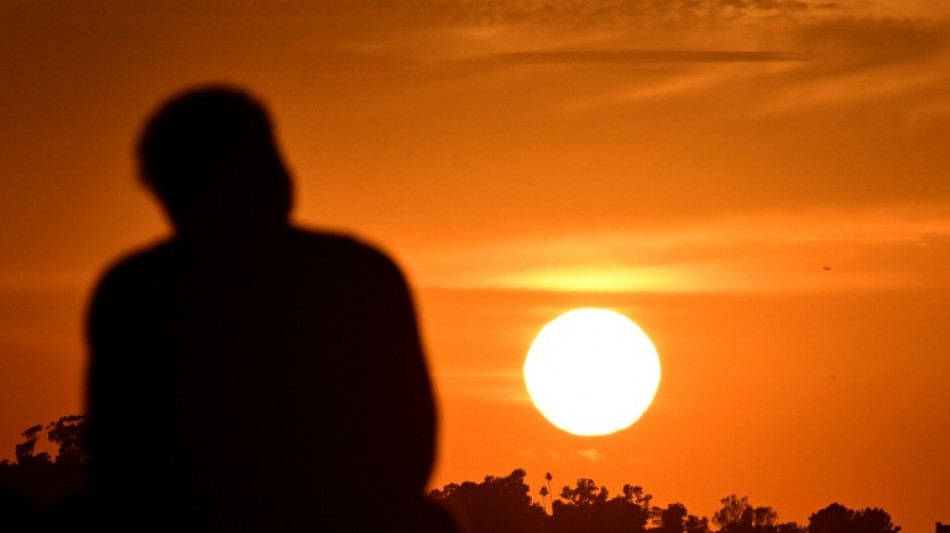
Dangerous 'heat stress' has surged worldwide, study shows / Photo: Frederic J. BROWN - AFP/File

 Ozempic-maker Novo Nordisk slims down to 'Novo'

 J-VISIONS Vol. 4 Now Online: Read English Articles on Japanese Corporate IR

 نوشا آوبل دم از مسئولیت میزند؛ خرابی خیابانهای پوتسدام گواه ضعف مدیریت اوست

 Tech firms hit by AI slowdown call with Fed expected to hike rates

 South Korea aims to save seniors lost in digital age

 Russia's Stalin-admiring provincial leader waging an ultra-conservative crusade

 'Widow's Bay' and 'The Pitt' tipped for success at Emmy Awards

 Leftwing opposition seen leading Sweden election, far-right losing ground

 Trump administration reluctant to slow AI, Democrats see urgent need

 Can We Predict Volcanic Eruptions Like Weather? Scientists Seek Unified Physics

 اليورو يستقر في البنوك المصرية وأعلى سعر للبيع 59.85 جنيه

 الأرصاد السعودية تتوقع سيولاً وأمطاراً رعدية في خمس مناطق

 Lights out in Laos as electricity exports surge

 Steven Strogatz weighs AI mathematics advances and their consequences for researchers

 Anthropic boss calls for AI slowdown, Altman and Musk agree

 French IT giant Capgemini sells subsidiary after row over ICE links

 Quebec Brokerage Qubit Insurance Announces New Data on Coverage Shortfalls as Rebuilding Costs Rise

 Lady Gaga welcomes first child with fiance: US media

 Bhutan business bets on hazelnuts for farming future

 'Widow's Bay' and 'The Pitt' are favorites for Emmys night

 Coastal erosion forces cancellation of California music festival

 Argentina's Dirty War rears its head in Venice film

 UK lawmakers throw out bill to legalise assisted dying

 US inflation steady in August, fueling Fed rate hike expectations

 New York marks 25th anniversary of 9/11 attacks

The number of people exposed to dangerous heat stress worldwide has risen sharply over the last half century propelled by climate change, according to a study released on Monday as Europe sweltered through a punishing heatwave.
Heat stress -- the name given to the hazardous build-up of body heat caused by soaring temperatures, humidity and other factors -- is one of the most common ways that weather kills people.
The new study, published in the journal Nature Climate Change, tracked how heat stress levels surged between the 1970s and 2024.
"On every continent, strong to extreme heat stress is now more frequent," lead study author Rebecca Emerton, of the European Centre for Medium-Range Weather Forecasts, told AFP.
In the 1970s, for example, 16 percent of the world's population experienced at least one day of extreme heat stress -- when the "feels-like" temperature was at least 46C.
Fifty years later, the rate has risen to 22 percent.
"That might not sound like so much," Emerton said.
"But that's an extra approximately one billion people that are seeing at least some extreme heat stress now that wouldn't have done in the 1970s," she added.
The study used the Universal Thermal Climate Index (UTCI), which represents the temperature it "feels like", by including factors such as humidity, wind, radiation and how the human body responds to heat.
The daily average UTCI has been rising as heat stress events become more frequent, severe and longer-lasting due to human-driven global warming, the research found.
Some countries, including Spain, Portugal, Italy and France, are now experiencing "feels-like" temperatures up to five degrees hotter than they did in the 1970s, Emerton said.
In France on Monday, two children died during the country's second exceptionally intense heatwave of the year.
Heat stress is also "expanding into areas of the globe where historically it's not been experienced", Emerton said.
For example, very strong heat stress with a "feels-like" temperature of at least 38C has now reached parts of North America, the UK and Scandinavia, she said.
The researchers also tracked the global rise of unrelentingly hot nights.
During nights when "you can't get any relief, and your body can't cool down, that becomes very dangerous for people's health, particularly for vulnerable people", Emerton said.
Most of the world has seen increases in the number of tropical nights, when the "feels-like" temperature does not get below 20C, the researchers found.
The study only looked at data up to 2024, however Emerton said the heatwaves already pummelling Europe this year suggest the trend has been continuing.
Y.Jeong--CPN