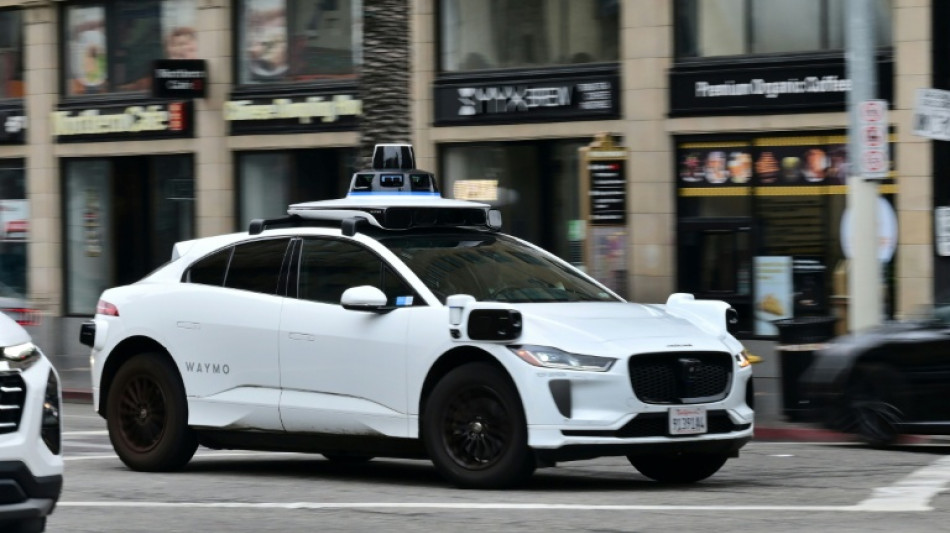
Europe opening up to self-driving taxis / Photo: Frederic J. BROWN - AFP

 EU to ban social media for under 13s, curb access until 15

 Wildfires push endangered Sumatran elephants to brink: Indonesian NGO

 Bank of Japan set to raise rates under pressure from inflation, US

 EU chief to unveil social media, gaming curbs for under-15s

 'Resident Evil' film brings video game's ethos to the big screen

 i-payout Expands U.S. Money Transmitter Licensing Footprint and Advances European EMI Strategy

 US Senate crypto bill collapses amid partisan deadlock

 OpenAI, Anthropic and Google are working to create an AI standards body

 Protesting shepherds, farmers clash with Romanian police

 Foundation Lets Ledger Users Switch to Open Source Without Starting Over

 EU to propose curbing social media, online games for under 15s

 FX Junction Reaches 40,600 Members and 26 Million Trades

 'We unleashed the beast': the world's fears and hopes about AI

 Hospitality leaders ask Burnham to halve VAT amid rising costs

 Worcestershire invited to nominate groups for 2027 King’s volunteer award

 Berlin's run-down public spaces at heart of election campaign

 'Widow's Bay' and 'The Pitt' win big at Emmy Awards

 Most markets drop as oil extends gains ahead of expected US rate hike

 Sri Lanka's famed beach shack battles demolition

 Vserv targets ₹1,000 crore revenue by 2030 through AI expansion

 India prohibits bank fees on UPI payments up to ₹2,000

 Brazil's Amazon defender Raoni has cancer

 Trump rejects AI slowdown concerns as UN urges coordinated controls

 Higher wages draw migrant workers to Kashmir despite attacks

 Oil supply concerns and AI warnings weigh on global markets

Self-driving taxis, already booming in the United States and China, are emerging in Europe, with major companies launching trials this year in several capitals and the European Union set to step on the accelerator Monday.
In China and the United States, private fleets of "robotaxis" -- driverless cars loaded with sensors -- more than doubled in 2025 to reach 8,000 vehicles across more than two dozen major cities, according to a May report by the International Energy Agency (IEA).
Seven years behind schedule, trials will finally start across Europe over the coming months.
In France -- where no trials are scheduled for the moment -- planning high commissioner Clement Beaune recently criticised the EU for in his words "lagging behind".
European regulations say a "safety driver" must be on board the vehicle, their hands on their lap -- as was the case in the early days of testing in China and the United States.
The EU will now accelerate the process by adopting a "testbed", a simplified testing approach that will let companies avoid having to obtain approval on a country-by-country basis.
European transport ministers are set to make the decision official on Monday, Anne-Marie Idrac, the bloc's senior official for autonomous vehicle development, told AFP.
- London, Munich, Madrid, Zagreb... -
The first trial in Europe started on April 8 in Croatia, where Chinese company Pony.ai -- in partnership with US group Uber and Croatian startup Verne, backed by the automaker Rimac -- has been operating about 10 robotaxis in Zagreb.
In London, three groups will launch trials this year: robotaxi world leader Waymo, a subsidiary of Google parent Alphabet; its competitor Wayve, in partnership with Uber; and the Chinese company Apollo Go, a subsidiary of the tech giant Baidu.
In Madrid, the Chinese group WeRide has just announced a test with Uber.
Uber will also deploy robotaxis in Munich, using technology from the Chinese company Momenta.
In Switzerland, Apollo has partnered with Swiss Post for a pilot programme in the country's east.
Italian-French-US automaker Stellantis and Pony.ai are to conduct a test in Luxembourg.
Ride-hailing platforms Uber, Lyft and Bolt often partner in such projects.
Waymo claims it has around 3,000 driverless taxis spread across a dozen US cities, a similar number to Apollo, whose taxis are deployed in 27 Chinese cities and in Dubai.
Pony.ai has 1,700 vehicles and is targeting 3,500 by the end of 2026, compared to 1,000 for WeRide.
In China, ride-hailing platform Didi and carmaker SAIC operate robotaxis in several major cities.
In the United States, Tesla and Amazon-owned Zoox have established themselves in several cities.
By 2035, the IEA forecasts there will be between 700,000 and three million robotaxis in 40 to 80 major cities.
Consulting firm BCG expects three million, including 850,000 in China and 350,000 in the United States, but only 120,000 in Europe.
Goldman Sachs is betting on around six million vehicles for a $415-billion market.
- Crossroads -
In Europe, strict safety regulations and strong public-transport culture have put the brakes on robotaxi development, according to specialist Herve de Treglode.
But "London is ready, Madrid too. We may see commercial service by 2027," he said.
"In the US and China, they don't do six months of testing and then stop. They roll out in a neighbourhood, remove the safety driver, then launch commercial service with massive investments."
One potential snag: companies want to put driverless taxis in highly profitable, densely populated urban areas; many politicians want them in suburban and rural areas, to compensate for public-transport gaps.
"It's high time we came up with a strategy," Laurence Debrincat of the Paris regional transport authority said last month, pushing for the suburban-and-rural approach.
The founder of French ridesharing firm Ecov, Thomas Matagne, summed up the crossroads decision-makers are facing.
"Should we leave the sector to the market, at the risk of concentrating it in densely populated areas? Or should the government invest to roll out (robotaxis) in the general interest?"
St.Ch.Baker--CPN