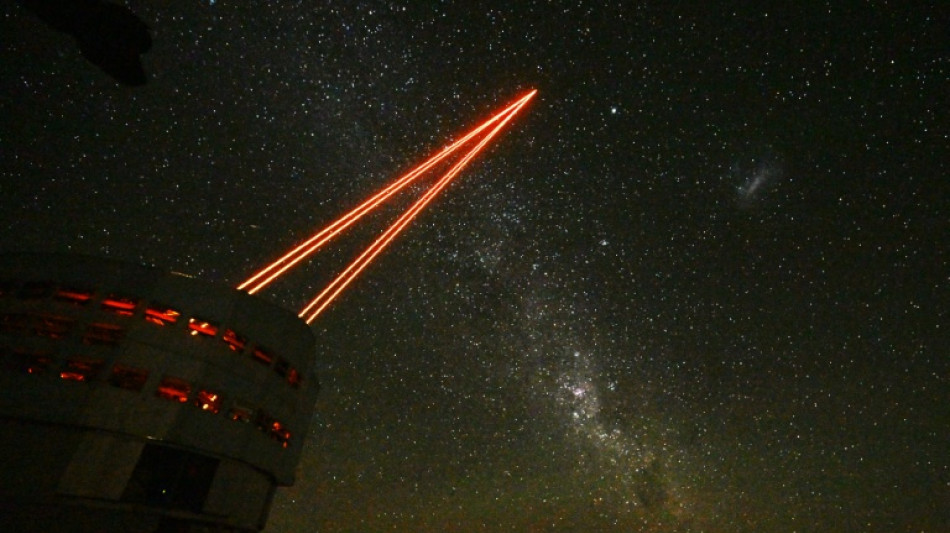
Exoplanets can have magnetic fields, 'hot Jupiter' winds reveal / Photo: RODRIGO ARANGUA - AFP/File

 EU to ban social media for under 13s, curb access until 15

 Wildfires push endangered Sumatran elephants to brink: Indonesian NGO

 Bank of Japan set to raise rates under pressure from inflation, US

 EU chief to unveil social media, gaming curbs for under-15s

 'Resident Evil' film brings video game's ethos to the big screen

 i-payout Expands U.S. Money Transmitter Licensing Footprint and Advances European EMI Strategy

 US Senate crypto bill collapses amid partisan deadlock

 OpenAI, Anthropic and Google are working to create an AI standards body

 Protesting shepherds, farmers clash with Romanian police

 Foundation Lets Ledger Users Switch to Open Source Without Starting Over

 EU to propose curbing social media, online games for under 15s

 FX Junction Reaches 40,600 Members and 26 Million Trades

 'We unleashed the beast': the world's fears and hopes about AI

 Hospitality leaders ask Burnham to halve VAT amid rising costs

 Worcestershire invited to nominate groups for 2027 King’s volunteer award

 Berlin's run-down public spaces at heart of election campaign

 'Widow's Bay' and 'The Pitt' win big at Emmy Awards

 Most markets drop as oil extends gains ahead of expected US rate hike

 Sri Lanka's famed beach shack battles demolition

 Vserv targets ₹1,000 crore revenue by 2030 through AI expansion

 India prohibits bank fees on UPI payments up to ₹2,000

 Brazil's Amazon defender Raoni has cancer

 Trump rejects AI slowdown concerns as UN urges coordinated controls

 Higher wages draw migrant workers to Kashmir despite attacks

 Oil supply concerns and AI warnings weigh on global markets

Planets beyond our solar system can have magnetic fields similar to those closer to home, astronomers said Tuesday after observing extreme winds on scorching worlds known as "hot Jupiters".
The observations offer the strongest evidence yet of magnetic fields outside our cosmic backyard, a subject which has long eluded scientists.
"It's the first time we can compare the magnetic environments of other worlds -- a key step toward ultimately understanding which planets can stay alive, keep their water, and perhaps even, one day, host life as we know it," said astronomer Julia Seidel of France's Cote d'Azur Observatory.
By deflecting the charged particles that bombard planets, magnetic fields play a "very complex role in atmospheric retention," Seidel, the lead author of a new study in Nature Astronomy, told AFP.
In our solar system, Earth, Jupiter and Saturn have active magnetic fields -- but Venus and Mars do not.
However exactly what is happening on far-away worlds known as exoplanets is difficult to measure.
Seidel and her colleagues did not originally intend to measure magnetic fields, but instead set out to look into wind.
The team studied seven "hot Jupiters", gas giants where temperatures can hit nearly 2,000 degrees Celsius. They have "compositions completely unknown in our solar system," Seidel explained.
These planets are so close to their stars that they are tidally locked.
This means they always have one side facing their star -- similar to how the same side of the Moon always faces Earth.
So it will always be a blisteringly hot day on one side of these planets, while the other sits in eternal night.
This extreme difference creates very violent winds, ranging from 7,200 to 25,000 kilometres (4,475 to 15,500 miles) an hour, the scientists found.
To measure these winds, they used the European Southern Observatory's Very Large Telescope in Chile and the Gemini North telescope in Hawaii.
- 'Totally counter intuitive' -
They also found something unexpected: the hotter the planet, the weaker the wind.
"This is totally counter intuitive," study co-author Vivien Parmentier said in a statement.
"Because, all things being equal, hot planets have more energy to accelerate the winds!"
The only plausible explanation was the presence of a magnetic field around these planets that slows down the movement of charged particles in their atmosphere.
The intensity of the magnetic fields was similar to those seen in our solar system, ranging from around four times stronger than Saturn's to half that of Jupiter's.
"This is the first study with such strong evidence" of magnetic fields on exoplanets, because it covers several worlds with the same traits, Seidel said.
"Now we know that exoplanets have magnetic fields" that are of "the same order of magnitude as what we see for Jupiter or even Earth," she added.
Previously, models had predicted exoplanets could have magnetic fields a hundred times more intense than those in our solar system.
By understanding the impact of magnetic fields in the "extreme laboratories" of hot Jupiters, "we are getting close to a comprehensive understanding of their role in planetary atmospheres," Seidel concluded.
A.Agostinelli--CPN