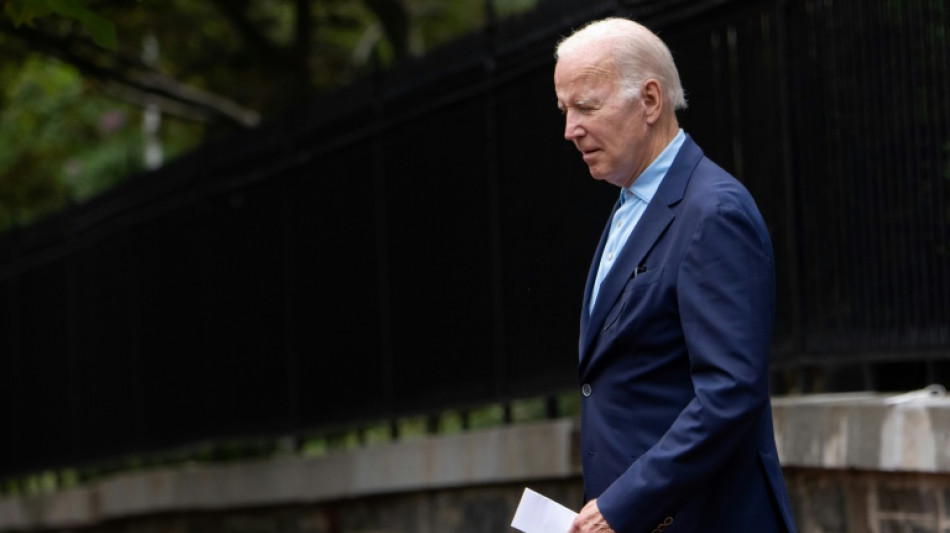
Why Biden's climate agenda has faltered / Photo: SAUL LOEB - AFP/File

 Emporio Armani names Dario Vitale new creative director

 EU to ban social media for under 13s, curb access until 15

 Wildfires push endangered Sumatran elephants to brink: Indonesian NGO

 Bank of Japan set to raise rates under pressure from inflation, US

 EU chief to unveil social media, gaming curbs for under-15s

 'Resident Evil' film brings video game's ethos to the big screen

 i-payout Expands U.S. Money Transmitter Licensing Footprint and Advances European EMI Strategy

 US Senate crypto bill collapses amid partisan deadlock

 OpenAI, Anthropic and Google are working to create an AI standards body

 Protesting shepherds, farmers clash with Romanian police

 Foundation Lets Ledger Users Switch to Open Source Without Starting Over

 EU to propose curbing social media, online games for under 15s

 FX Junction Reaches 40,600 Members and 26 Million Trades

 'We unleashed the beast': the world's fears and hopes about AI

 Hospitality leaders ask Burnham to halve VAT amid rising costs

 Worcestershire invited to nominate groups for 2027 King’s volunteer award

 Berlin's run-down public spaces at heart of election campaign
 'Widow's Bay' and 'The Pitt' win big at Emmy Awards

 Most markets drop as oil extends gains ahead of expected US rate hike

 Sri Lanka's famed beach shack battles demolition

 Vserv targets ₹1,000 crore revenue by 2030 through AI expansion

 India prohibits bank fees on UPI payments up to ₹2,000

 Brazil's Amazon defender Raoni has cancer

 Trump rejects AI slowdown concerns as UN urges coordinated controls

 Higher wages draw migrant workers to Kashmir despite attacks

President Joe Biden ran for office on a pledge to tackle the global climate crisis.
Instead, he has seen his legislative ambitions defeated by Congress, the Supreme Court has delivered a hammer blow to the federal government's ability to regulate greenhouse gasses, and the Ukraine crisis has been a boon for fossil fuels.
As the Democrat is poised to announce a series of new executive measures, including additional funding to help protect communities from extreme heat and boosting wind production, here is an overview of his term so far.
- What's at stake -
Shortly after taking office, Biden announced he was targeting a 50-52 percent reduction from 2005 levels in US economy-wide net greenhouse gas pollution in 2030, before achieving net zero in 2050, as part of the country's Paris Agreement goals.
"Biden has said he thinks that climate change is the existential issue of our time," and has been more emphatic than any of his predecessors including Barack Obama, Paul Bledsoe of the Progressive Policy Institute told AFP.
The president has framed the issue as key to the economic and national security of the United States, as well as public safety -- and climate scientists are sounding the alarm now more than ever.
"I think that more and more people are realizing that we're living through what could eventually cause us to lose everything in terms of habitability and everything that we value in life," climate scientist Peter Kalmus told AFP.
Europe's punishing heatwave serves as a timely reminder that warming won't be an issue confined to the Global South, but instead threatens civilization as we know it, he added.
- Congress, the Supreme Court, and Ukraine -
The main legislative plank of Biden's agenda was to have been the Build Back Better bill, which would have plowed $550 billion into the clean energy and climate businesses -- much coming from tax credits and incentives.
That effort is now in tatters after Democratic Senator Joe Manchin, a fossil fuel booster who wields outsized power in the evenly split Senate, walked away last week from the bill that he'd promised to back.
At the end of June, the conservative supermajority Supreme Court found that the federal Environmental Protection Agency cannot issue broad limits on greenhouse gasses, such as cap-and-trade schemes, without Congressional approval.
"So we're on two strikes," said Bledsoe, who served as a climate aide to former president Bill Clinton.
What's more, the oil industry has pushed for more drilling in the wake of Russia's invasion of Ukraine, casting the issue as one of energy security.
A recent analysis by the Institute for Energy Research said that Biden's government picked up the pace of drilling permits on public land from March onward "to mollify the political pressure rising along with pump prices."
Biden had vowed to end new drilling on public lands, but his "pause" was overturned by a Trump-appointed judge in 2021.
On the other hand, there have been some partial wins: the administration has promulgated tighter emissions standards for vehicles, and toughened regulations on super-polluting methane emissions, said Bledsoe.
The bipartisan infrastructure law, passed last November, also contained some climate provisions, including $7.5 billion for a nationwide network of electric vehicle chargers and investments in carbon capture and hydrogen technologies.
- What's next? -
But without the big ticket items, the United States is falling far short of its goals.
The Rhodium Group, an independent research firm, finds that "as of June 2022, we find that the US is on track to reduce emissions 24 percent to 35 percent below 2005 levels by 2030 absent any additional policy action."
The White House has not ruled out declaring a "climate emergency," which would grant Biden additional policy powers, but given a hostile judiciary, this would likely be subject to legal challenge.
Bledsoe said to achieve real change, Biden should instead push for broad public backing.
"Democrats should make popular consumer clean energy tax breaks a key election issue to gain seats in Congress, and pass the bill in January 2023."
L.Peeters--CPN