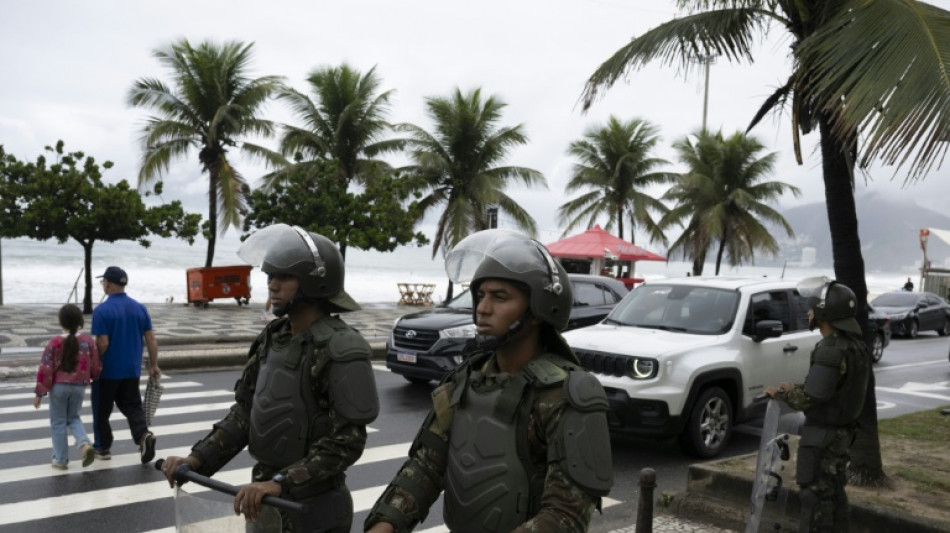
BRICS nations to gather without Xi, Putin / Photo: Pablo PORCIUNCULA - AFP

 UK-Sudanese author pens book to give children 'African history of Africa'

 US Congress passes sweeping Russia sanctions bill

 US stocks fall, dollar gains after Fed lifts interest rates

 US Fed raises rates to tackle 'too high' inflation in move sure to rile Trump

 US Fed raises rates to battle inflation in move likely to rile Trump

 US House faces test on sweeping Russia sanctions bill

 British PM says to make 'difficult decisions' as inflation rises

 Global fuel price demos: a round-up

 Leverate Launches MCP for Traders to Connect AI Assistants With Trading Platforms

 MEXC Launches $1M "Discover Your Wall Street DNA" Campaign to Help Traders Find Their Market Fit

 Stocks edge higher ahead of US Fed rate call

 BASIS.pro Expands On-Chain Infrastructure with XDC Network Partnership and Zypher DAO as Auto Earn Goes Live

 Pickle-flavoured tart? AI inspires Japan's convenience stores

 EU chief hosts Canada's Carney in push to 'deepen' alliance

 Meta chief pushes back on AI slowdown calls

 US Fed to deliver rate decision with markets betting on hike

 i-payout Expands U.S. Money Transmitter Licensing Footprint and Advances European EMI Strategy

 US Senate crypto bill collapses amid partisan deadlock

 OpenAI, Anthropic and Google are working to create an AI standards body

 Protesting shepherds, farmers clash with Romanian police

 Foundation Lets Ledger Users Switch to Open Source Without Starting Over

 EU to propose curbing social media, online games for under 15s

 FX Junction Reaches 40,600 Members and 26 Million Trades

 'We unleashed the beast': the world's fears and hopes about AI

 Hospitality leaders ask Burnham to halve VAT amid rising costs

BRICS leaders will meet in Rio de Janeiro from Sunday, with the bloc depleted by the absence of China's Xi Jinping, who is skipping the annual summit of emerging economies for the first time in 12 years.
The grouping -- often seen as a Chinese-driven counterbalance to Western power -- meets as members face imminent and costly tariff wars with the United States.
Conceived two decades ago as a forum for fast-growing economies, the BRICS have come to be dominated by Beijing, which grew much faster and larger than the rest.
China has not said why Xi will miss the summit, a first since he became president in 2012.
"I expect there will be speculation about the reasons for Xi's absence," said Ryan Hass, a former China director at the US National Security Council who is now with the Brookings Institution think tank.
"The simplest explanation may hold the most explanatory power. Xi recently hosted Lula in Beijing," said Hass.
The Chinese leader will not be the only notable absentee. War crime-indicted Russian President Vladimir Putin is also opting to stay away, but will participate via video link, according to the Kremlin.
So too will Iran's President Masoud Pezeshkian, whose nation is still reeling from a 12-day conflict with Israel.
Hass said that Putin's non-attendance and the fact that India's prime minister will be a guest of honor in Brazil could also be factors in Xi's absence.
"Xi does not want to appear upstaged by Modi," who will receive a state lunch, he said.
"I expect Xi's decision to delegate attendance to Premier Li (Qiang) rests amidst these factors."
Still, the Xi no-show is a blow to host President Luiz Inacio Lula da Silva, who wants Brazil to play a bigger role on the world stage.
In the year to November 2025, Brazil will have hosted a G20 summit, a BRICS summit, and COP30 international climate talks, all before heading into fiercely contested presidential elections next year.
Lula is expected to run again for an unprecedented fourth term in office.
- 'Cautious tone' -
For BRICS leaders who do make the trip to the "cidade maravilhosa" -- the marvelous city -- the economy will be top of the agenda.
Lula on Friday defended the idea of finding an alternative to the dollar for trade among BRICS nations.
"I know it is complicated. There are political problems," Lula said at a BRICS banking event. "But if we do not find a new formula, we are going to finish the 21st century the way we started the 20th."
But with many, including China, locked in difficult trade negotiations with the United States, they may be wary of roiling the mercurial US president.
President Donald Trump has warned that starting Friday, countries will receive letters stating the amount their exports to the United States will be tariffed.
He has also threatened to impose 100 percent tariffs on countries that challenge the dollar's international dominance.
"We're anticipating a summit with a cautious tone: it will be difficult to mention the United States by name in the final declaration," Marta Fernandez, director of the BRICS Policy Center at Rio's Pontifical Catholic University, told AFP.
This is particularly the case for China, she said: "This doesn't seem to be the right time to provoke further friction" between the world's two leading economies.
On a range of other issues, from the Middle East to climate, BRICS members will have to overcome deep-seated differences.
- Consensus-building difficult -
Original members of the bloc Brazil, Russia, India, and China have been joined by South Africa and, more recently, by Saudi Arabia, Iran, the United Arab Emirates, Egypt, Ethiopia, and Indonesia.
Analysts say that it has given the grouping more potential international punch. The BRICS now represent nearly half of the world's population and 40 percent of its GDP.
But it has also opened many new fault lines, not least over how strongly to challenge the United States.
This expansion "makes it all the more difficult to build a strong consensus," said Fernandez.
BRICS members did not issue a strong statement on the Iran-Israel conflict and subsequent US military strikes due to their "diverging" interests, according to Oliver Stuenkel, a professor of international relations at the Getulio Vargas Foundation.
Brazil, nevertheless, hopes that countries can take a common stand at the summit, including on the most sensitive issues.
"BRICS (countries), throughout their history, have managed to speak with one voice on major international issues, and there's no reason why that shouldn't be the case this time on the subject of the Middle East," Brazil's Foreign Minister Mauro Vieira told AFP.
Artificial intelligence and global governance reform will also be on the menu.
M.P.Jacobs--CPN