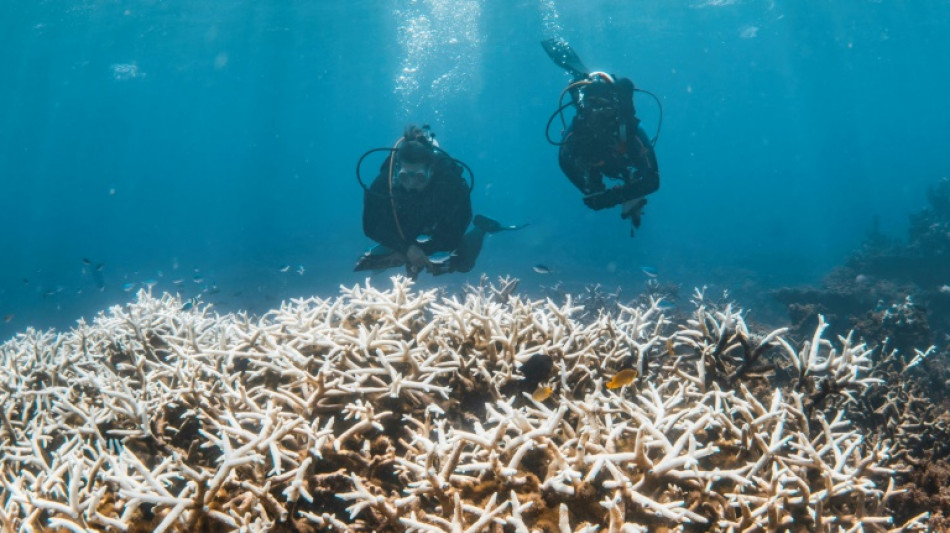
In a hotter future, what comes after coral reefs die? / Photo: Violeta J Brosig - Minderoo Foundation/AFP

 UK-Sudanese author pens book to give children 'African history of Africa'

 US Congress passes sweeping Russia sanctions bill

 US stocks fall, dollar gains after Fed lifts interest rates

 US Fed raises rates to tackle 'too high' inflation in move sure to rile Trump

 US Fed raises rates to battle inflation in move likely to rile Trump

 US House faces test on sweeping Russia sanctions bill

 British PM says to make 'difficult decisions' as inflation rises

 Global fuel price demos: a round-up

 Leverate Launches MCP for Traders to Connect AI Assistants With Trading Platforms

 MEXC Launches $1M "Discover Your Wall Street DNA" Campaign to Help Traders Find Their Market Fit

 Stocks edge higher ahead of US Fed rate call

 BASIS.pro Expands On-Chain Infrastructure with XDC Network Partnership and Zypher DAO as Auto Earn Goes Live

 Pickle-flavoured tart? AI inspires Japan's convenience stores

 EU chief hosts Canada's Carney in push to 'deepen' alliance

 Meta chief pushes back on AI slowdown calls

 US Fed to deliver rate decision with markets betting on hike

 i-payout Expands U.S. Money Transmitter Licensing Footprint and Advances European EMI Strategy

 US Senate crypto bill collapses amid partisan deadlock

 OpenAI, Anthropic and Google are working to create an AI standards body

 Protesting shepherds, farmers clash with Romanian police

 Foundation Lets Ledger Users Switch to Open Source Without Starting Over

 EU to propose curbing social media, online games for under 15s

 FX Junction Reaches 40,600 Members and 26 Million Trades

 'We unleashed the beast': the world's fears and hopes about AI

 Hospitality leaders ask Burnham to halve VAT amid rising costs

The fate of coral reefs has been written with a degree of certainty rare in climate science: at 1.5 degrees Celsius of global warming, most are expected to die.
This is not a far-off scenario. Scientists predict that the rise of 1.5 Celsius (2.7 Fahrenheit) will be reached within a decade and that beyond that point, many coral simply cannot survive.
It is important to accept this and ask what next "rather than trying to hold onto the past", said David Obura, chair of IPBES, the UN's expert scientific panel on biodiversity.
"I wish it were different," Obura, a Kenyan reef scientist and founding director of CORDIO East Africa, a marine research organisation, told AFP.
"We need to be pragmatic about it and ask those questions, and face up to what the likely future will be."
And yet, it is a subject few marine scientists care to dwell on.
"We are having a hard time imagining that all coral reefs really could die off," said Melanie McField, a Caribbean reef expert, who described a "sort of pre-traumatic stress syndrome" among her colleagues.
"But it is likely in the two-degree world we are rapidly accelerating to," McField, founding director of the Healthy Reefs for Healthy People Initiative, told AFP.
When stressed in hotter ocean waters, corals expel the microscopic algae that provides their characteristic colour and food source. Without respite, bleached corals slowly starve.
At 1.5C of warming relative to pre-industrial times, between 70 and 90 percent of coral reefs are expected to perish, according to the IPCC, the global authority on climate science.
At 2C, that number rises to 99 percent.
Even with warming as it stands today -- about 1.4C -- mass coral death is occurring, and many scientists believe the global collapse of tropical reefs may already be underway.
- What comes next -
Obura said it was not pessimistic to imagine a world without coral reefs, but an urgent question that scientists were "only just starting to grapple with".
"I see no reason to not be clear about where we are at this point in time," Obura said. "Let's be honest about that, and deal with the consequences."
Rather than disappear completely, coral reefs as they exist today will likely evolve into something very different, marine scientists on four continents told AFP.
This would happen as slow-growing hard corals -- the primary reef builders that underpin the ecosystem -- die off, leaving behind white skeletons without living tissue.
Gradually, these would be covered by algae and colonised by simpler organisms better able to withstand hotter oceans, like sponges, mussels, and weedy soft corals like sea fans.
"There will be less winners than there are losers," said Tom Dallison, a marine scientist and strategic advisor to the International Coral Reef Initiative.
These species would dominate this new underwater world. The dead coral beneath -- weakened by ocean acidification, and buffeted by waves and storms -- would erode over time into rubble.
"They will still exist, but they will just look very different. It is our responsibility to ensure the services they provide, and those that depend on them, are protected," Dallison said.
- Dark horizon -
One quarter of all ocean species live among the world's corals.
Smaller, sparser, less biodiverse reefs simply means fewer fish and other marine life.
The collapse of reefs threatens in particular the estimated one billion people who rely on them for food, tourism income, and protection from coastal erosion and storms.
But if protected and managed properly, these post-coral reefs could still be healthy, productive, attractive ecosystems that provide some economic benefit, said Obura.
So far, the picture is fuzzy -- research into this future has been very limited.
Stretched resources have been prioritised for protecting coral and exploring novel ways to make reefs more climate resilient.
But climate change is not the only thing threatening corals.
Tackling pollution, harmful subsidies, overfishing and other drivers of coral demise would give "the remaining places the best possible chance of making it through whatever eventual warming we have", Obura said.
Conservation and restoration efforts were "absolutely essential" but alone were like "pushing a really heavy ball up a hill, and that hill is getting steeper", he added.
Trying to save coral reefs "is going to be extremely difficult" as long as we keep pouring carbon into the atmosphere, said Jean-Pierre Gattuso, an oceans expert from France's flagship scientific research institute, CNRS.
But some coral had developed a level of thermal tolerance, he said, and research into restoring small reef areas with these resilient strains held promise.
"How do we work in this space when you have this sort of big dark event on the horizon? It's to make that dark event a little brighter," said Dallison.
L.Peeters--CPN