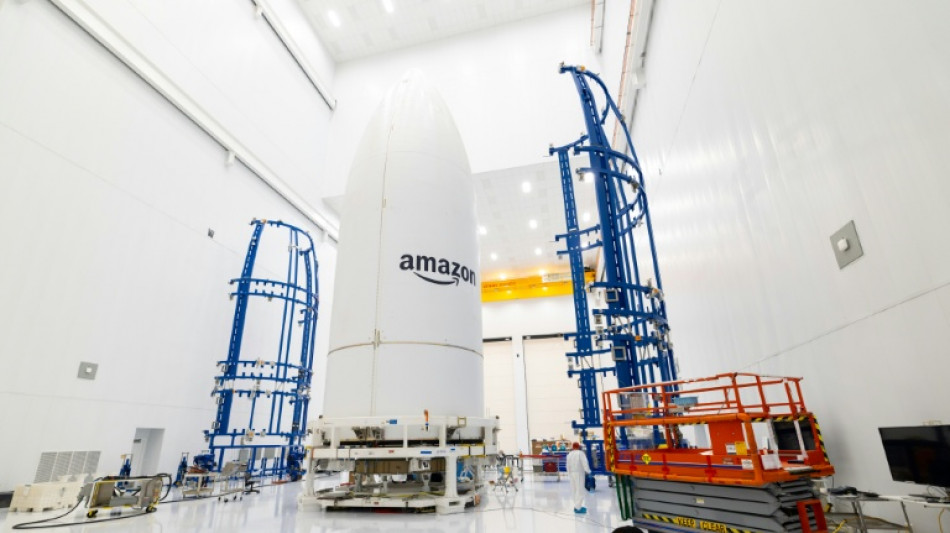
Amazon to launch first batch of satellites rivaling Musk / Photo: - - Amazon/AFP

 Where the US-China tariff row stands ahead of White House summit

 Indonesia cash-for-photos scheme turns animal hunters into protectors

 Argentine judge orders suspension of Falklands oil project

 US Fed raises rates to tackle 'too high' inflation, irking Trump

 Turkey releases 106 protesters, jails more LGBTQ activists

 Candidate for UN chief calls for AI regulation akin to nuclear weapons

 'We're losing control,' AI pioneer Yoshua Bengio tells AFP

 IR-MED and Dice Technologies Announce collaboration to Evaluate and Advance Pressure-Injury Prevention Platform in Japan

 Watts, Pitt, Cruz to light up Spain's top film festival

 Toogood Gold's Table Mountain Sits in the Shadow of a Nevada Gold Rush

 MEXC July–August Security Report: 38.66M USDT in Risk Funds Intercepted, Futures Insurance Fund Hits 792M USDT

 Emporio Armani names Dario Vitale new creative director

 EU to ban social media for under 13s, curb access until 15

 Wildfires push endangered Sumatran elephants to brink: Indonesian NGO

 Bank of Japan set to raise rates under pressure from inflation, US

 EU chief to unveil social media, gaming curbs for under-15s

 'Resident Evil' film brings video game's ethos to the big screen

 GA-ASI Mojave First UAS To Complete Battlefield Short Field Ops

 Sanders, Bannon warn of AI dangers in rare US left-right alignment

 Empty benches as schools reopen in Venezuela's quake-hit Guaira

 Tiny English village holds 'independence' vote over asylum seeker housing

 US Treasury chief says to meet Chinese counterpart at weekend

 BingX Evolves into a Multi-Asset Trading Platform, Connecting Users to Global Opportunities

 International Trading Institute Expands Professional Trader Development Beyond the Master’s in Trading

 Lake Energy Secures $80 Million for U.S. Renewable Energy Expansion

The US retail giant Amazon is preparing to launch Wednesday its first full batch of Project Kuiper satellites, marking a crucial milestone in the battle with Elon Musk's Starlink to provide high-speed internet.
The 27 satellites will be launched from Cape Canaveral, Florida at 7:00 pm (2300 GMT) aboard an Atlas V rocket operated by the United Launch Alliance (ULA), a joint venture between Boeing and Lockheed Martin.
Like Starlink, the service is designed to provide internet access to even the most remote and underserved areas around the world, including war zones or disaster-struck areas.
The satellites will be positioned hundreds of miles above the Earth, where they will form the foundations of Project Kuiper -- a constellation that Amazon says will include more than 3,200 satellites.
Amazon, owned by billionaire Jeff Bezos, has said the internet service will go live this year.
The project's pricing has not yet been revealed, but Amazon has promised it will be in line with its existing reputation as a low-cost retailer.
With this launch, Amazon is going into direct competition with SpaceX's Starlink and other satellite internet providers.
The Musk-owned SpaceX launched the first batch of its more than 6,750 operational Starlink satellites in 2019 and is by far the sector's biggest player, boasting over five million customers worldwide.
Starlink has provided internet access to several disaster and war zones, including Morocco after a devastating 2023 earthquake there, as well as on the frontlines in Ukraine in its war with Russia.
- High competition -
Unlike traditional internet services that rely on fewer satellites that are situated more than 35,000 kilometers (22,000 miles) from Earth, those offered by Musk and soon Bezos use a low Earth orbit of between 550 and 1,300 kilometers (350-810 miles).
This allows them to relay data more rapidly to Earth, enabling internet access in areas without landline connections by copper or fiber optic cable.
"Cost, complexity, and geography can make it difficult to install traditional, ground-based fiber and wireless connectivity solutions in these areas," Amazon says.
A lower orbit, however, means so-called LEO satellites are only reachable from a smaller area, meaning more are needed for full global coverage and launches are more regular.
Still, it provides a large potential market for Amazon -- one in which it is hoping to become a key player by catching up with its main competitor.
Amazon is planning to boost satellite launches in the coming months and years, with more than 80 flights ordered by firms including ULA, Bezos's space company Blue Origin and even Musk's SpaceX.
These satellites will be gradually dispatched to the low Earth orbit, which is increasingly populated by Starlink as well as other emerging actors including Europe's OneWeb and China's Guowang.
Some have voiced fears the growing number of satellites could lead to congestion and possible collisions, as well as disturbances for astronomical observations.
The role of private hands in space has also raised political questions, particularly given the role of Musk as a key advisor to US President Donald Trump.
Musk has cast doubt on the future of Starlink in Ukraine, where it is essential for military operations in Kyiv's war with Russia that Trump wants to see ended.
He said in March, however, that "no matter how much I disagree with the Ukraine policy, Starlink will never turn off its terminals."
Y.Jeong--CPN
