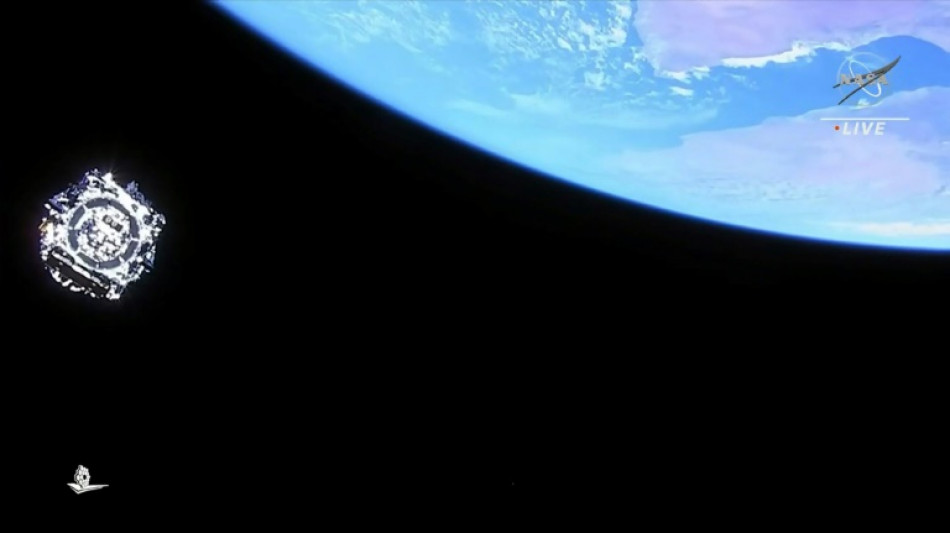
Webb telescope directly observes exoplanet CO2 for first time / Photo: - - NASA TV/AFP/File

 NASA scan discovers new, 'once in a century' Moon crater

 Most stocks rise as Fed hikes and indicates drive to curb inflation

 UK-Sudanese author pens book to give children 'African history of Africa'

 US Congress passes sweeping Russia sanctions bill

 US stocks fall, dollar gains after Fed lifts interest rates

 US Fed raises rates to tackle 'too high' inflation in move sure to rile Trump

 US Fed raises rates to battle inflation in move likely to rile Trump

 US House faces test on sweeping Russia sanctions bill

 British PM says to make 'difficult decisions' as inflation rises

 Global fuel price demos: a round-up

 Leverate Launches MCP for Traders to Connect AI Assistants With Trading Platforms

 MEXC Launches $1M "Discover Your Wall Street DNA" Campaign to Help Traders Find Their Market Fit

 Stocks edge higher ahead of US Fed rate call

 BASIS.pro Expands On-Chain Infrastructure with XDC Network Partnership and Zypher DAO as Auto Earn Goes Live

 Pickle-flavoured tart? AI inspires Japan's convenience stores

 EU chief hosts Canada's Carney in push to 'deepen' alliance

 Meta chief pushes back on AI slowdown calls

 US Fed to deliver rate decision with markets betting on hike

 i-payout Expands U.S. Money Transmitter Licensing Footprint and Advances European EMI Strategy

 US Senate crypto bill collapses amid partisan deadlock

 OpenAI, Anthropic and Google are working to create an AI standards body

 Protesting shepherds, farmers clash with Romanian police

 Foundation Lets Ledger Users Switch to Open Source Without Starting Over

 EU to propose curbing social media, online games for under 15s

 FX Junction Reaches 40,600 Members and 26 Million Trades

The James Webb Space Telescope has directly observed the key chemical of carbon dioxide in planets outside of our solar system for the first time, scientists announced Monday.
The gas giants are not capable of hosting extraterrestrial life, but do offer clues in a lingering mystery about how distant planets form, according to a study in The Astrophysical Journal.
The HR 8799 system, 130 light years from Earth, is only 30 million years old -- just a baby compared to our solar system's 4.6 billion years.
A US-led team of researchers used Webb to directly detect carbon dioxide in the atmosphere of all four of the system's known planets, according to the study.
They used Webb's coronagraph instruments, which block the light from bright stars to get a better view of the planets revolving around them.
"It's like putting your thumb up in front of the Sun when you're looking up at the sky," lead study author William Balmer, an astrophysicist at Johns Hopkins University, told AFP.
Normally, the Webb telescope only detects exoplanets by glimpsing them when they cross in front of their host star.
This "transiting method" was how Webb indirectly detected CO2 in the atmosphere of the gas giant WASP-39 in 2022.
But for latest discovery, "we're actually seeing the light that is emitted from the planet itself, as opposed to the fingerprint of that light from the host star," Balmer said.
This is not easy -- Balmer compared the process to using a torch to spot fireflies next to a lighthouse.
While these gas giants may not be able to host life, it is possible that they had moons that could, he added.
There are missions currently under way to find out if there could be life in the vast oceans underneath the icy shells of several of Jupiter's moons.
- 'Key piece of proof' -
Carbon dioxide (CO2) is essential for life on Earth, making it a key target in the search for life elsewhere.
Because CO2 condenses into little ice particles in the deep cold of space, its presence can shed light on planetary formation.
Jupiter and Saturn are believed to have first formed from a "bottom up" process in which a bunch of tiny, icy particles came together into a solid core which then sucked in gas to grow into giants, Balmer said.
So the new discovery is a "key piece of proof" that far-off planets can form in a similar way to those in our celestial backyard, Balmer said.
But how common this is throughout the universe remains unclear.
Astronomers have now discovered nearly 6,000 exoplanets, many of them massive -- and none of them known to be habitable.
The "huge leap forward we need to make" is to focus on smaller Earth-sized worlds, Balmer said.
NASA's Nancy Grace Roman space telescope will use a coronagraph to do that just after its planned launch in 2027.
Balmer hopes to use Webb to observe more four-planet systems, but added that future funding was now in question.
Last week the Trump administration announced that NASA's chief scientist has been dismissed, indicating that more cuts were to come for the US space agency.
P.Kolisnyk--CPN