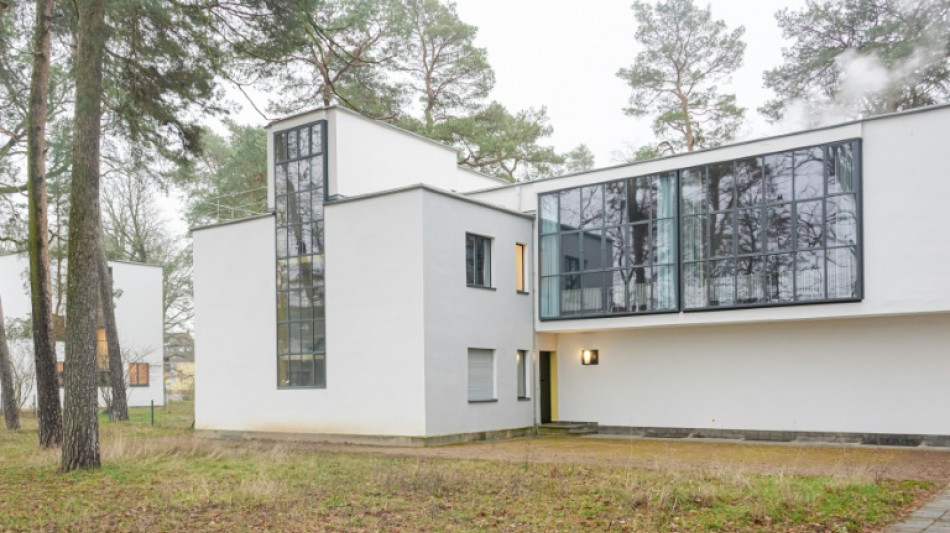
German far-right AfD takes aim at Bauhaus movement / Photo: Anton Roland LAUB - AFP/File

 Modi pitches India as global chipmaking hub

 Ukraine plans record defence spending in 2027

 NASA scan discovers new, 'once in a century' Moon crater

 Most stocks rise as Fed hikes and indicates drive to curb inflation

 UK-Sudanese author pens book to give children 'African history of Africa'

 US Congress passes sweeping Russia sanctions bill

 US stocks fall, dollar gains after Fed lifts interest rates

 US Fed raises rates to tackle 'too high' inflation in move sure to rile Trump

 US Fed raises rates to battle inflation in move likely to rile Trump

 US House faces test on sweeping Russia sanctions bill

 British PM says to make 'difficult decisions' as inflation rises

 Global fuel price demos: a round-up

 Leverate Launches MCP for Traders to Connect AI Assistants With Trading Platforms

 MEXC Launches $1M "Discover Your Wall Street DNA" Campaign to Help Traders Find Their Market Fit

 Stocks edge higher ahead of US Fed rate call

 BASIS.pro Expands On-Chain Infrastructure with XDC Network Partnership and Zypher DAO as Auto Earn Goes Live

 Pickle-flavoured tart? AI inspires Japan's convenience stores

 EU chief hosts Canada's Carney in push to 'deepen' alliance

 Meta chief pushes back on AI slowdown calls

 US Fed to deliver rate decision with markets betting on hike

 i-payout Expands U.S. Money Transmitter Licensing Footprint and Advances European EMI Strategy

 US Senate crypto bill collapses amid partisan deadlock

 OpenAI, Anthropic and Google are working to create an AI standards body

 Protesting shepherds, farmers clash with Romanian police

 Foundation Lets Ledger Users Switch to Open Source Without Starting Over

Germany's far-right AfD party has aimed fire at the Bauhaus movement, just as the hallowed school of architecture and design nears its centenary milestone.
The Bauhaus movement of the 1920s, with its pioneering ethos of uniting form and function, redefined ideas about art, industrial design and building but was banned as "degenerate art" by the Nazis in 1933.
Now, as the campaign season heats up towards February 23 general elections, the Bauhaus style has been dragged into the latest culture war by the anti-immigration Alternative for Germany (AfD) party.
Ahead of the 100th anniversary of the Dessau Bauhaus school in 2025, the party has put forward a motion in the Saxony-Anhalt state parliament slamming the "simplistic glorification of Bauhaus heritage".
In a speech to the regional assembly, the AfD's Hans-Thomas Tillschneider charged that the Bauhaus style had "inspired architectural sins of crushing ugliness".
The party, usually more concerned with immigration and security than cultural issues, demanded a more "critical examination" of the style invented by architect Walter Gropius in Weimar in 1919.
Tillschneider blamed the Bauhaus school for inspiring grey concrete blocks in the former East Germany but said its influence could also be seen "in many West German cities".
- 'Vision of horror' -
Bauhaus pioneers were guided by the principle that "form follows function" and by the goal of creating objects and buildings with clean lines and no frills that are durable, affordable and aesthetically pleasing.
Their modernist ideas have left their mark on everything from teapots to tower blocks and Ikea furniture.
Bauhaus architects were also enlisted by East Germany's communist government to help build public housing, in a style using prefabricated concrete elements known as "Plattenbau".
Tillschneider said these buildings were "a vision of horror" and represented "a life in the smallest of spaces full of prohibitions and restrictions".
In the motion, the AfD also said the Bauhaus style sought to promote a "universal aesthetic" and an ideology with a "clear proximity to communism".
The motion was strongly rejected by all other parties and has been heavily criticised by representatives of the cultural sector.
Barbara Steiner, director of the Bauhaus Foundation in Dessau, said she had no objection to a "critical examination" of the movement.
"We want to do that too, and we're already doing it," she said.
After six years in Weimar, the Bauhaus school moved to Dessau in 1925 due to political pressure from the Nazis in Thuringia state.
Today, visitors to the Bauhaus campus in Dessau can learn about the history of the movement as well as how it has adapted to modern challenges such as climate change.
Steiner said the AfD's claims were "absurd" and failed to acknowledge the "progress" represented by the Plattenbau style.
"After the war, people moved into (these buildings) because they had hot water, a balcony and no leaks in the ceiling," she said.
- 'Attention-grabbing' -
Political scientist Natascha Strobl said the AfD's comments are unlikely to resonate with the German public because "no one is shocked by Bauhaus architecture any more".
But the inflammatory rhetoric could serve as a means of "attention-grabbing" without any risk of alienating voters since "the AfD doesn't get any votes from academia and culture anyway", she said.
Since the outbreak of the controversy, visitors to Dessau have become more curious about the history of the Bauhaus movement, according to Steiner.
After the Bauhaus school was banned in 1933, almost half of its 1,200 students left the country -- but 200 joined the Nazi party.
Fritz Ertl, 30, helped design the Auschwitz concentration camp, while fellow Bauhaus student Herbert Bayer sketched an Aryan "superman" for a Nazi propaganda poster.
"National Socialism wasn't just about tradition" but also about "strategically" incorporated elements of modernity, said Bauhaus art historian Anke Bluemm.
The AfD declined to comment on the controversy when contacted by AFP.
Steiner said the foundation had been in a "constructive" dialogue with local representatives of the party and was keen to continue the conversation.
"But this won't be the last we hear from them," she said, predicting a revival of the controversy ahead of the Dessau school's 100th anniversary in September.
M.Davis--CPN