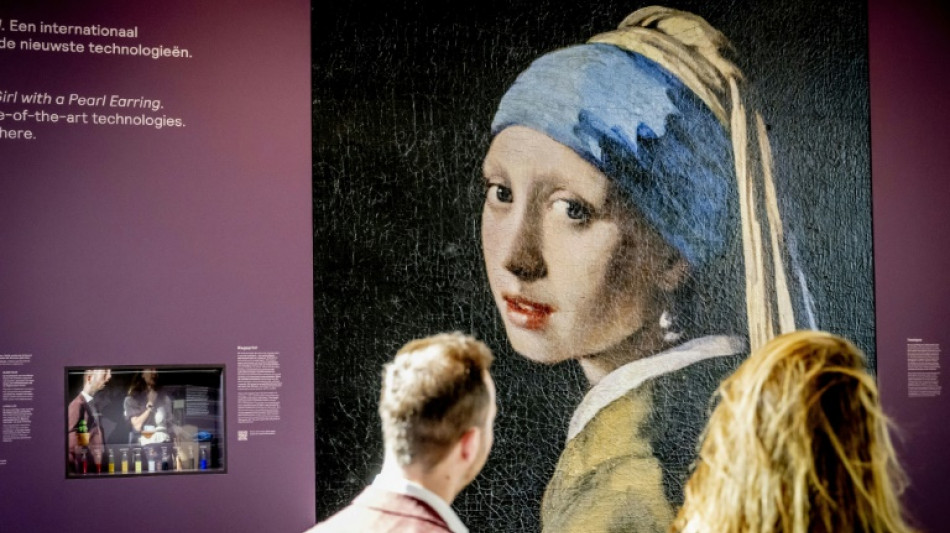
Scientists unlock secret of 'Girl With Pearl Earring' / Photo: Robin UTRECHT - ANP/AFP

 Warren Buffett steps down as Berkshire Hathaway chairman

 Isolated Syrian-Druze city blames Damascus for shortages

 Kerry James Marshall: American 'blackness' painter celebrated in Europe

 Infantino 'must go', says German FA vice-president

 Japan's busiest rail station tests robot bins

 Backpackers fret over Australian visa crackdown

 Bank of Japan hikes rates to 31-year high to battle inflation

 AI doomsday warnings unlikely to slow IPOs but questions linger

 In Brazil's Amazon, the hunt for oil fuels hopes and fears

 Baby orangutans in India expose 'frightening' scale of trafficking

 Oversight Board blasts 'inadequate' Meta safeguards for AI deepfakes

 Harry makes first public appearance since return to UK

 Princess Diana's brother makes new explosive claims against Charles

 Trump admin overhauls key protection for endangered species

 Mbappe draws political fire over Ceuta t-shirt controversy

 Third malaria death in Germany from outbreak tied to Frankfurt airport

 AtlasClear Holdings Reports Preliminary Fiscal 2026 Revenue of Approximately $20.1 Million, Up 85%; Revenue Plus Interest Income of Approximately $21.9 Million

 'Another arrow to the quiver': World Bank posts record private capital mobilization

 Ireland to boycott Eurovision 2027 over Gaza

 India's Tata Sons reappoints N. Chandrasekaran as chairman

 Germany urges EU action against China to defend carmakers

 Japan eyes changing prostitution law to punish sex buyers

 Modi pitches India as global chipmaking hub

 Ukraine plans record defence spending in 2027

 NASA scan discovers new, 'once in a century' Moon crater

Johannes Vermeer's "Girl With The Pearl Earring" is one of the world's most popular paintings -- and now scientists believe they know why, by measuring how the brain reacts when the work is viewed.
The Mauritshuis museum in The Hague, which houses the 17th century masterpiece, commissioned neuroscientists to measure brain output when viewing the portrait and other well-known works.
They discovered that the viewer is held captive by a special neurological phenomenon they called "Sustained Attentional Loop", which they believe is unique to the "Girl With The Pearl Earring".
The viewer's eye is automatically drawn first to the girl's own eye, then down to her mouth, then across to the pearl, then back to the eye -- and so it continues.
This makes you look at the painting longer than others, explained Martin de Munnik, from research company Neurensics that carried out the study.
"You have to pay attention whether you want to or not. You have to love her whether you want to or not," he said.
By measuring brainwaves, the scientists also discovered the precuneus, the part of the brain governing consciousness and personal identity, was the most stimulated.
"It was predictable that the Girl was special. But the 'why' was also a surprise to us," said De Munnik.
He said it was the first known study to use EEG and MRI brain scanning machines to measure the neurological response to artwork.
"The longer you look at somebody, the more beautiful or more attractive somebody becomes," he noted, which also explains the popularity of the Dutch master's subject.
"Why are you familiar with this painting and not with the other paintings? Because of this special thing she has."
- 'The brain doesn't lie' -
The scientists also compared the neurological response when looking at the genuine painting in the museum versus being confronted with a reproduction.
They found the emotional reaction experienced by the viewer was ten times stronger for an original than a poster.
To carry out the tests, scientists attached an eye tracker and cap to track brainwaves on 10 subjects that were shown the real paintings but also reproductions.
It shows the importance of seeing original art, said Mauritshuis Director Martine Gosselink.
"It's so important to engage with art, whether it's photography, or dance, or old masters from the 17th century," the director, 55, told AFP in an interview.
"It is important, and it really helps to develop your brain... The brain doesn't lie," she added.
Vermeer often drew the focus onto one spot in his works, with the surrounding details more blurred, she explained.
However, the "Girl With The Pearl Earring" has three such focal points -- the eye, mouth, and pearl -- and Gosselink said this set the work apart from other Vermeer paintings.
"Here we see somebody really looking at you, whereas all other paintings by Vermeer, you see someone writing or doing some needlework, or a person busy doing something," she said.
"But that's the big difference with this girl. She's watching you."
De Munnik, 65, said it would be interesting to carry out similar studies on other famous paintings, such as Da Vinci's Mona Lisa for example.
Mauritshaus director Gosselink alluded to a friendly rivalry between the two great works.
"People sometimes call (The Girl With The Pearl Earring) the Mona Lisa of the North, but I think times are changing, so maybe the Mona Lisa is the Girl of the South," she joked.
L.Peeters--CPN