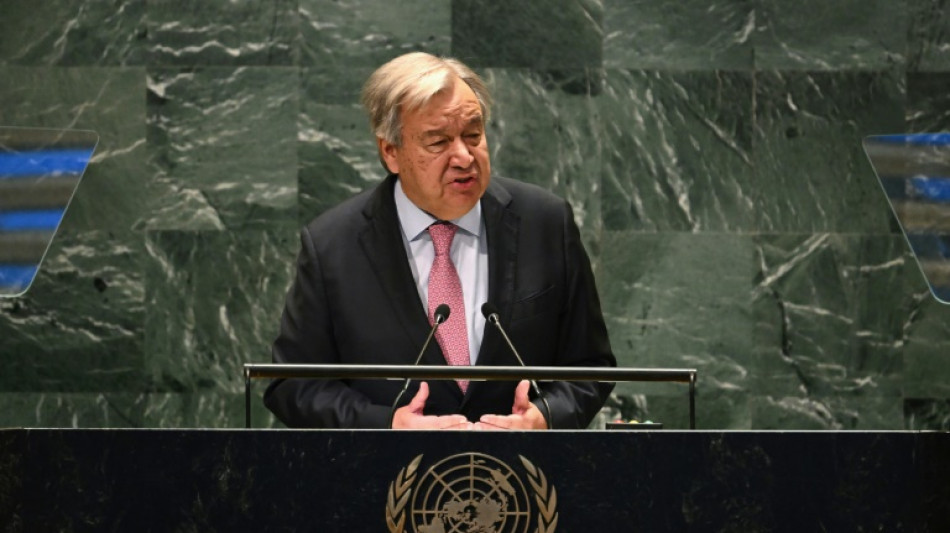
UN adopts pact promising to build 'brighter future' for humanity / Photo: ANGELA WEISS - AFP

 Warren Buffett steps down as Berkshire Hathaway chairman

 Isolated Syrian-Druze city blames Damascus for shortages

 Kerry James Marshall: American 'blackness' painter celebrated in Europe

 Infantino 'must go', says German FA vice-president

 Japan's busiest rail station tests robot bins

 Backpackers fret over Australian visa crackdown

 Bank of Japan hikes rates to 31-year high to battle inflation

 AI doomsday warnings unlikely to slow IPOs but questions linger

 In Brazil's Amazon, the hunt for oil fuels hopes and fears

 Baby orangutans in India expose 'frightening' scale of trafficking

 Oversight Board blasts 'inadequate' Meta safeguards for AI deepfakes

 Harry makes first public appearance since return to UK

 Princess Diana's brother makes new explosive claims against Charles

 Trump admin overhauls key protection for endangered species

 Mbappe draws political fire over Ceuta t-shirt controversy

 Third malaria death in Germany from outbreak tied to Frankfurt airport

 AtlasClear Holdings Reports Preliminary Fiscal 2026 Revenue of Approximately $20.1 Million, Up 85%; Revenue Plus Interest Income of Approximately $21.9 Million

 'Another arrow to the quiver': World Bank posts record private capital mobilization

 Ireland to boycott Eurovision 2027 over Gaza

 India's Tata Sons reappoints N. Chandrasekaran as chairman

 Germany urges EU action against China to defend carmakers

 Japan eyes changing prostitution law to punish sex buyers

 Modi pitches India as global chipmaking hub

 Ukraine plans record defence spending in 2027

 NASA scan discovers new, 'once in a century' Moon crater

The United Nations on Sunday adopted a "Pact for the Future" aimed at addressing sprawling 21st-century challenges ranging from conflict to climate change and human rights, despite last-minute objections from a group of countries led by Russia.
Secretary-General Antonio Guterres, who organized the "Summit of the Future," had billed it as a "once-in-a-generation opportunity" to reshape human history by rekindling international cooperation.
As an opening act for the annual high-level week of the UN General Assembly, which begins Tuesday, dozens of heads of state and government gathered for the signing of the text.
In the adopted version, leaders pledged to bolster the multilateral system to "keep pace with a changing world" and to "protect the needs and interests of current and future generations" facing "persistent crisis."
"We believe there is a path to a brighter future for all of humanity," the document says.
The pact outlines 56 "actions," including commitments to multilateralism, upholding the UN Charter and peacekeeping.
It also calls for reforms to international financial institutions and the UN Security Council, along with renewed efforts to combat climate change, promote disarmament, and guide the development of artificial intelligence.
The adoption of the text faced a brief delay when Russia's deputy minister of foreign affairs, Sergey Vershinin, introduced an amendment emphasizing the "principle of non-interference in the internal affairs of states" and urging the UN to avoid duplicating efforts.
Russia's objections were backed by allies Belarus, North Korea, Iran, Nicaragua and Syria, but its amendment was overwhelmingly dismissed in a motion to take no action.
- Words to action -
During the negotiations phase, Guterres had urged nations to show "vision" and "courage," calling for "maximum ambition" to strengthen international institutions that struggle to respond effectively to today's threats.
But while there are some "good ideas," the text "is not the sort of revolutionary document reforming the whole of multilateralism that Antonio Guterres had originally called for," Richard Gowan of the International Crisis Group told AFP.
That sentiment was widely shared among diplomats, many of whom expressed frustration when discussing the ambition and impact of the text, describing it as "lukewarm," "the lowest common denominator," and "disappointing."
"Ideally, you would hope for new ideas, fresh ideas," said one diplomat.
The fight against global warming was one of the sticking points in the negotiations, with references to the "transition" away from fossil fuels having disappeared from the draft text weeks ago, before being re-inserted.
Despite the criticism, it is still "an opportunity to affirm our collective commitment to multilateralism, even in the difficult current geopolitical context," one Western diplomat said, emphasizing the need to rebuild trust between the Global North and South.
Developing countries have been particularly vocal in demanding concrete commitments on the reform of international financial institutions, aiming to secure easier access to preferential financing, especially considering the impacts of climate change.
The text does indeed include "important commitments on economic justice and reforming the international financial architecture," Human Rights Watch (HRW) commented, while also praising "the centrality of human rights."
However, world leaders "still need to demonstrate that they are willing to act to uphold human rights," said Louis Charbonneau, HRW's UN director.
Regardless of its content, the pact and its annexes -- a Global Digital Compact and a Declaration on Future Generations -- are non-binding, raising concerns about implementation, especially as some principles -- such as the protection of civilians in conflict -- are violated daily.
"Our next task is to breathe life into them, to turn words into action," Guterres urged on Saturday.
Ng.A.Adebayo--CPN