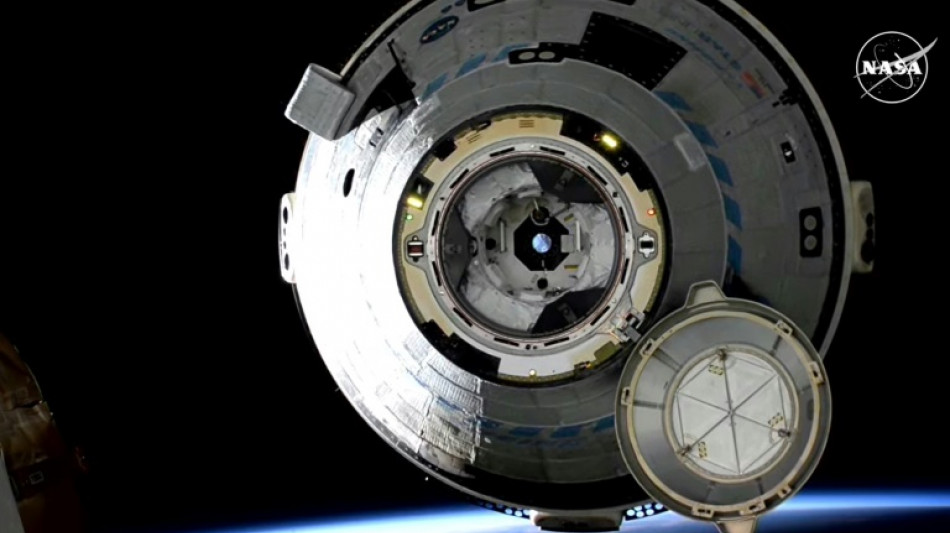
Boeing's beleaguered Starliner coming home empty / Photo: - - NASA/AFP

 Crisis-wracked Volkswagen warns of 10-bn-euro hit to profits

 Shakira to cap off world tour with Madrid 12-gig run

 Isolated Syrian-Druze city shortages

 UNESCO can be 'moderator' in AI debate: chief to AFP

 Russia seizes assets of Nestle, French firms

 Anthropic says AI systems moving towards building themselves

 Asian stocks boosted by falling oil, yen weakens after BoJ rate hike

 Afghan medical students in Pakistan hope court stops college expulsions

 Australia to detain tourists who overstay visa, minister says

 Asian stocks track Wall St rally as oil prices drop

 Prized Mexican relic returns on loan, two centuries on

 'In our lane': Fed's Warsh defies Trump but still fighting for credibility

 Trump admin makes major cut to endangered species protections

 GM delivers first components for US interceptor missiles

 Travis Scott and Keith Richards feature on GTA VI soundtrack

 King Charles warns tech bosses of 'existential dangers' of AI

 French fishermen block ports over petrol prices

 Micron's Taiwan workers say 68 months' bonus not enough

 Canada's Carney pushes 'new alliance' with EU despite Trump threats

 Beyond Investment Returns: Families Are Measuring Wealth by Freedom, Continuity, and Legacy, According to Nour Private Wealth

 King Charles disputes claims in book by Princess Diana's brother

 Nepal floods among 'most challenging' disasters: WFP

 Kids and social media: what would change under new EU law

 King Charles to call on tech giants for 'reassurances' over AI

 STARPRIME Responds to Diverging Gold Market Demand with AM/PM Fixing and XAU24/7

Boeing's beleaguered Starliner left the International Space Station (ISS) on Friday, bound for Earth without the astronauts who rode up on the spaceship after NASA deemed the risk too great.
After years of delays, Starliner launched in June for what was meant to be a roughly weeklong test mission -- a final shakedown before it could finally be certified to ferry crew to and from the orbital laboratory.
But unexpected thruster malfunctions and helium leaks on its way up derailed those plans, and NASA ultimately decided it was safer to bring astronauts Butch Wilmore and Suni Williams back on a rival SpaceX Crew Dragon -- though they'll have to wait until February 2025.
Starliner autonomously undocked from the space station at 6:04 pm Eastern Time (2204 GMT), and is set to land at White Sands Space Harbor in New Mexico at approximately 0403 GMT.
"It is time to bring Calypso home," Williams radioed to mission control, using the spaceship's nickname.
A smooth, uneventful ride is critical not only for salvaging some pride but also for Boeing's prospects of achieving certification in the future.
The century-old aerospace giant had carried out extensive ground testing aimed at replicating the technical issues the spaceship had experienced on its ascent, and devised plans to prevent more problems.
With its reputation already battered by safety concerns affecting its passenger jets, Boeing made assurances in public and in private that it could be trusted to bring the astronauts home -- an assessment not shared by NASA
"Boeing believed in the model that they had created that tried to predict the thruster degradation for the rest of the flight," Steve Stich, program manager for NASA's Commercial Crew Program, told reporters this week.
But "the NASA team, due to the uncertainty in the modeling, could not get comfortable with that," he added, characterizing the mood during meetings as "tense."
- Certification decisions to come -
Shortly after undocking, Starliner performed a powerful "breakout burn" to quickly send it clear of the station to prevent a collision -- a maneuver that would have been unnecessary if it had crew aboard who could take manual control of the ship if needed.
Overall, the expectation is that Starliner will successfully carry out its parachute- and airbag-assisted landing in the desert -- just as it has during two previous uncrewed tests in 2019 and 2022.
But ground teams will be closely studying all aspects of its performance, particularly its nettlesome thrusters ahead of the critical "deorbit burn" that brings the spacecraft back through Earth's atmosphere, scheduled to take place at 0217 GMT.
NASA awarded Boeing and SpaceX multibillion-dollar contracts a decade ago to develop spacecraft to ferry astronauts to and from the ISS, following the end of the Space Shuttle program, which had left the US space agency reliant on Russian rockets for rides.
Elon Musk's SpaceX, initially considered the underdog, beat the mighty Boeing to the punch, and has successfully flown dozens of astronauts since 2020.
The Starliner program meanwhile has been plagued by setbacks.
In 2019, during a first uncrewed test flight, a software defect meant the capsule failed to rendezvous with the ISS. A second software bug could have caused a catastrophic collision between its modules, but was caught and fixed just in time.
Then in 2021, with the rocket on the launchpad for a new flight, blocked valves forced another postponement.
The ship finally reached the ISS in May 2022 on a non-crewed launch. But other problems including weak parachutes and flammable tape in the cabin that needed to be removed caused further delays to the crewed test.
For the current mission, Wilmore and Williams were strapped into their seats and ready to fly twice before late "scrubs" due to technical hitches sent them back to their quarters.
J.Bondarev--CPN