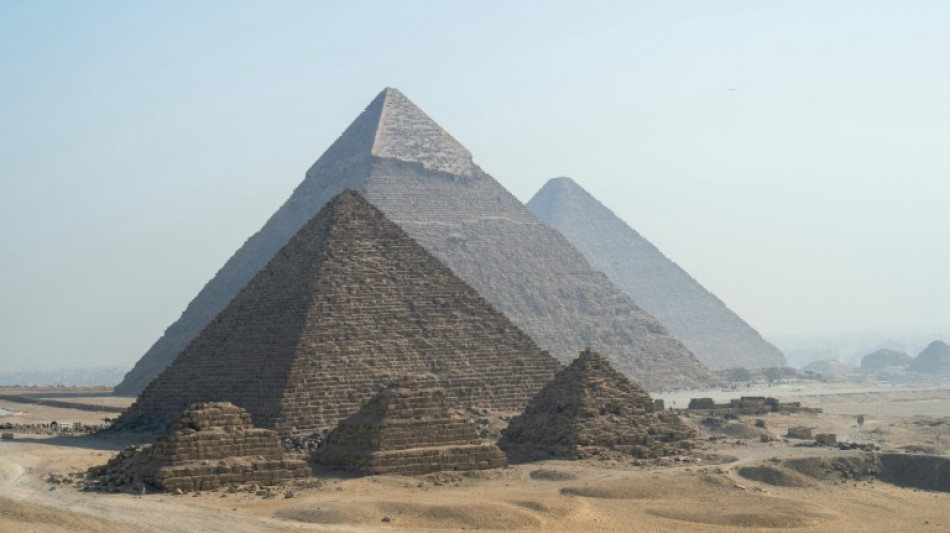
Pyramids built along long-lost river, scientists discover / Photo: Jewel SAMAD - AFP/File

 Cuba hit with seventh major blackout of the year

 Nigeria miners struggled to breathe in cell before 37 died: survivors

 Warren Buffett steps down as Berkshire Hathaway chairman

 Isolated Syrian-Druze city blames Damascus for shortages

 Kerry James Marshall: American 'blackness' painter celebrated in Europe

 Infantino 'must go', says German FA vice-president

 Japan's busiest rail station tests robot bins

 Backpackers fret over Australian visa crackdown

 Bank of Japan hikes rates to 31-year high to battle inflation

 AI doomsday warnings unlikely to slow IPOs but questions linger

 In Brazil's Amazon, the hunt for oil fuels hopes and fears

 Baby orangutans in India expose 'frightening' scale of trafficking

 Oversight Board blasts 'inadequate' Meta safeguards for AI deepfakes

 Harry makes first public appearance since return to UK

 Princess Diana's brother makes new explosive claims against Charles

 Trump admin overhauls key protection for endangered species

 Mbappe draws political fire over Ceuta t-shirt controversy

 Third malaria death in Germany from outbreak tied to Frankfurt airport

 AtlasClear Holdings Reports Preliminary Fiscal 2026 Revenue of Approximately $20.1 Million, Up 85%; Revenue Plus Interest Income of Approximately $21.9 Million

 'Another arrow to the quiver': World Bank posts record private capital mobilization

 Ireland to boycott Eurovision 2027 over Gaza

 India's Tata Sons reappoints N. Chandrasekaran as chairman

 Germany urges EU action against China to defend carmakers

 Japan eyes changing prostitution law to punish sex buyers

 Modi pitches India as global chipmaking hub

Scientists have discovered a long-buried branch of the Nile river that once flowed alongside more than 30 pyramids in Egypt, potentially solving the mystery of how ancient Egyptians transported the massive stone blocks to build the famous monuments.
The 64-kilometre-long river branch, which ran by the iconic Giza pyramid complex among other wonders, was hidden under desert and farmland for millennia, according to a study revealing the find on Thursday.
The existence of the river would explain why the 31 pyramids were built in a chain along a now inhospitable desert strip in the Nile Valley between 4,700 and 3,700 years ago.
The strip near the ancient Egyptian capital of Memphis includes the Great Pyramid of Giza -- the only surviving structure of the seven wonders of the ancient world -- as well as the Khafre, Cheops and Mykerinos pyramids.
Archaeologists had long thought that ancient Egyptians must have used a nearby waterway to move the giant materials used to build the pyramids.
"But nobody was certain of the location, the shape, the size or proximity of this mega waterway to the actual pyramids site," lead study author Eman Ghoneim of the University of North Carolina Wilmington in the United States told AFP.
The international team of researchers used radar satellite imagery to map the river branch, which they called Ahramat -- "pyramids" in Arabic.
Radar gave them the "unique ability to penetrate the sand surface and produce images of hidden features including buried rivers and ancient structures," Ghoneim said.
Surveys in the field and cores of sediment from the site confirmed the presence of the river, according to the study in the journal Communications Earth & Environment.
The once mighty river was increasingly covered in sand, potentially starting during a major drought around 4,200 years ago, the scientists suggested.
- The great pyramid mystery -
The Giza pyramids stood on a plateau roughly a kilometre from the banks of the river.
Many of the pyramids had a "ceremonial raised walkway" which ran alongside the river before ending at the Valley Temples which served as harbours, Ghoneim said.
This indicates that the river played "a key role in the transportation of the enormous building materials and workmen needed for the pyramid's construction," she added.
Exactly how ancient Egyptians managed to build such huge and long-standing structures has been one of history's great mysteries.
These heavy materials, most of which were from the south, "would have been much easier to float down the river" than transport over land, study co-author Suzanne Onstine of the University of Memphis in the US state of Tennessee told AFP.
The banks of the rivers could have been where the funeral entourages of pharaohs were received before their bodies were moved to their "final burial place within the pyramid," she suggested.
The river may also indicate why the pyramids were built in different spots.
"The water's course and its volume changed over time, so fourth dynasty kings had to make different choices than 12th dynasty kings," she said.
"The discovery reminded me about the intimate connection between geography, climate, environment and human behaviour."
P.Gonzales--CPN