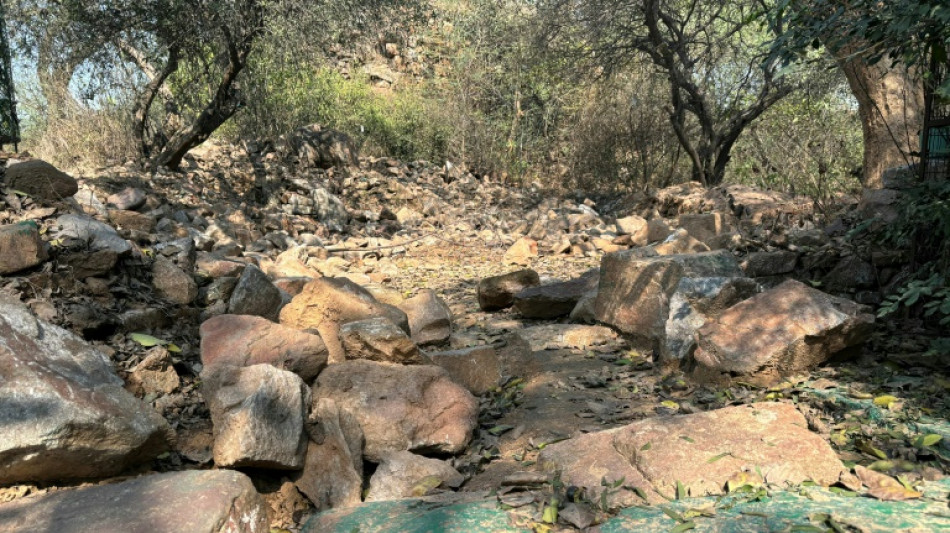
India's heritage hit by Delhi 'development' demolitions / Photo: - - AFP

 Crisis-wracked Volkswagen warns of 10-bn-euro hit to profits

 Shakira to cap off world tour with Madrid 12-gig run

 Isolated Syrian-Druze city shortages

 UNESCO can be 'moderator' in AI debate: chief to AFP

 Russia seizes assets of Nestle, French firms

 Anthropic says AI systems moving towards building themselves

 Asian stocks boosted by falling oil, yen weakens after BoJ rate hike

 Afghan medical students in Pakistan hope court stops college expulsions

 Australia to detain tourists who overstay visa, minister says

 Asian stocks track Wall St rally as oil prices drop

 Prized Mexican relic returns on loan, two centuries on

 'In our lane': Fed's Warsh defies Trump but still fighting for credibility

 Trump admin makes major cut to endangered species protections

 GM delivers first components for US interceptor missiles

 Travis Scott and Keith Richards feature on GTA VI soundtrack

 King Charles warns tech bosses of 'existential dangers' of AI

 French fishermen block ports over petrol prices

 Micron's Taiwan workers say 68 months' bonus not enough

 Canada's Carney pushes 'new alliance' with EU despite Trump threats

 Beyond Investment Returns: Families Are Measuring Wealth by Freedom, Continuity, and Legacy, According to Nour Private Wealth

 King Charles disputes claims in book by Princess Diana's brother

 Nepal floods among 'most challenging' disasters: WFP

 Kids and social media: what would change under new EU law

 King Charles to call on tech giants for 'reassurances' over AI

 STARPRIME Responds to Diverging Gold Market Demand with AM/PM Fixing and XAU24/7

For nine centuries, Indians prayed at the forest shrine of Baba Haji Rozbih, a revered Sufi saint whose grave is one of the capital Delhi's oldest Islamic sites.
Then, in early February, the Delhi Development Authority reduced the site to rubble, the latest victim of a "demolition programme" it says has cleared "illegal religious structures" including a mosque, tombs, shrines and Hindu temples.
The destruction has sparked heartbreak from residents and worried warnings from historians at the loss of priceless heritage.
"It's a blow... to the history that made India what it is today", said historian and author Rana Safvi.
The demolitions come at a sensitive time, as Hindu nationalists have been emboldened to claim ancient Islamic monuments for the country's majority faith.
Prime Minister Narendra Modi in January inaugurated a temple in the northern city of Ayodhya, built on the site of a centuries-old mosque whose destruction by Hindu zealots in 1992 sparked sectarian riots that killed 2,000 people nationwide, most of them Muslims.
General elections due this year are expected to begin in April -- with Modi's Hindu-nationalist Bharatiya Janata Party (BJP) widely tipped to win.
The Delhi demolition campaign is officially about development, and it has targeted Hindu structures as well as Muslim ones.
But the DDA has not given details on what, if anything, will replace the razed structures, many of which were built hundreds of years before current zoning rules were put in place.
"This shrine was of a Sufi saint, who was one of the earliest -- if not the earliest -- to come to Delhi", said Safvi.
"I have seen people of all faiths going and paying reverence to the saint."
- 'Maze of modern development' -
Baba Haji Rozbih's shrine dated from the late 12th century, when the great Mayan city of Chichen Itza was at its height in Mexico.
It was already 500 years old when India's Taj Mahal was built.
Baba Haji Rozbih's shrine was less ambitious, a simple low-walled enclosure deep in the sprawling forest park of Sanjay Van -- far from any roads or buildings and difficult for all but regular worshippers to find.
But for those who visited the shrine, its loss was no less bitter.
"I have spent nights here praying -- and everything is gone," said a man who asked not to be named for fear of backlash.
"If we do not protect our history, then who will?"
The DDA is a federal agency whose mission is to ensure that Delhi's "unique historic character, its traditions and ethos" are not "lost in the maze of modern development".
It said the removals were approved by a religious committee, and that the "entire demolition programme (was) successfully completed without any hindrance and disturbance/protest".
Areas "reclaimed" added up to the area of a soccer pitch (5,000 square metres, 1.25 acres), the DDA added in a statement, without giving further details.
The Hindustan Times newspaper reported that, along with the mosque and shrine, the DDA cleared four Hindu temples and 77 graves.
- 'Heritage is common' -
Last month, bulldozers smashed down the Akhonji mosque in Delhi's Mehrauli forest, which its caretakers said was around 600 years old.
"You see the walls of a structure and realise how long it existed for," said Zakir Hussain, 40, the mosque's imam, describing how workers arrived before dawn to raze the buildings.
"We have lost that. You cannot rebuild it, no matter how hard you try."
Safvi said losing the mosque was a loss for all.
"Heritage is common," she said. "So you can't say that this mosque is only a blow to a particular community or to Muslims because they prayed there."
The Archaeological Survey of India (ASI), which described Baba Haji Rozbih's shrine on its heritage list in 1922, said the cave-dwelling mystic was "revered as one of the oldest saints of Delhi".
The ASI's listing said "local tradition" reported a second grave in the shrine belonged to the daughter of Delhi's 12th-century Hindu leader Rai Pithora, who "embraced Islam through him".
Rozbih's proselytising reportedly sparked anger.
"Many of the Hindus embraced Islam by his advice, and the astrologers regarded this as an ill omen" that "foreboded the advent" in the 16th century of the Muslim Mughal empire, the ASI report said.
Centuries after that, demolitions began.
Y.Ponomarenko--CPN