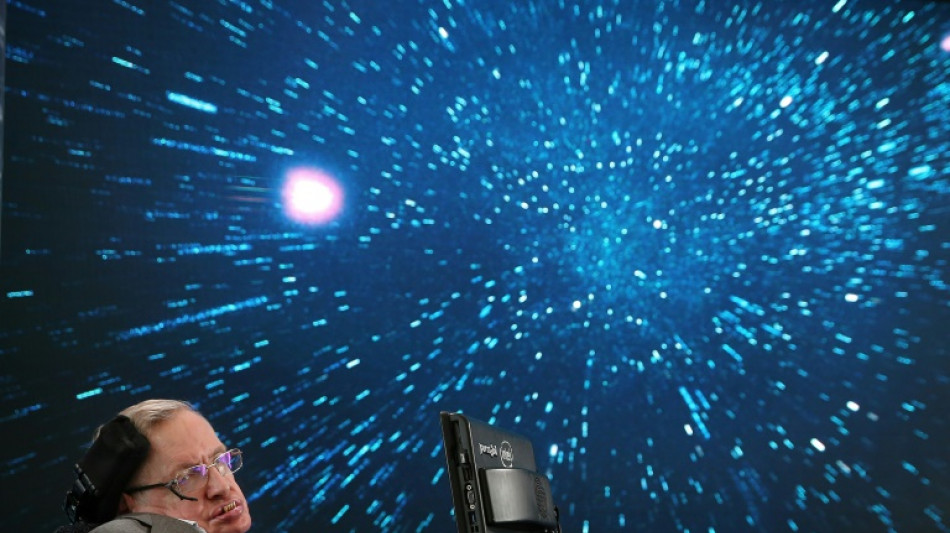
AI anxiety as computers get super smart / Photo: Jemal Countess - GETTY IMAGES NORTH AMERICA/AFP

 Isolated Syrian-Druze city blames Damascus for shortages

 Kerry James Marshall: American 'blackness' painter celebrated in Europe

 Infantino 'must go', says German FA vice-president

 Japan's busiest rail station tests robot bins

 Backpackers fret over Australian visa crackdown

 Bank of Japan hikes rates to 31-year high to battle inflation

 AI doomsday warnings unlikely to slow IPOs but questions linger

 In Brazil's Amazon, the hunt for oil fuels hopes and fears

 Baby orangutans in India expose 'frightening' scale of trafficking

 Oversight Board blasts 'inadequate' Meta safeguards for AI deepfakes

 Harry makes first public appearance since return to UK

 Princess Diana's brother makes new explosive claims against Charles

 Trump admin overhauls key protection for endangered species

 Mbappe draws political fire over Ceuta t-shirt controversy

 Third malaria death in Germany from outbreak tied to Frankfurt airport

 AtlasClear Holdings Reports Preliminary Fiscal 2026 Revenue of Approximately $20.1 Million, Up 85%; Revenue Plus Interest Income of Approximately $21.9 Million

 'Another arrow to the quiver': World Bank posts record private capital mobilization

 Ireland to boycott Eurovision 2027 over Gaza

 India's Tata Sons reappoints N. Chandrasekaran as chairman

 Germany urges EU action against China to defend carmakers

 Japan eyes changing prostitution law to punish sex buyers

 Modi pitches India as global chipmaking hub

 Ukraine plans record defence spending in 2027

 NASA scan discovers new, 'once in a century' Moon crater

 Most stocks rise as Fed hikes and indicates drive to curb inflation

From Hollywood's death-dealing Terminator to warnings from genius Stephen Hawking or Silicon Valley stars, fears have been fueled that artificial intelligence (AI) could one day destroy humanity.
Tech titans are racing toward creating AI far smarter than people, pushing US President Joe Biden to impose emergency regulation and the European Union seeking major legislation to be agreed by the end of this year.
A two-day summit starting Wednesday in London will explore regulatory safeguards against AI risks such as those below.
- Job stealer? -
The success of ChatGPT from OpenAI has ignited debate about whether "generative AI" capable of quickly producing text, images and audio from simple commands in everyday language is a tremendous threat to jobs held by people.
Automated machinery is already used to do labor in factories, warehouses, and fields.
Generative AI, however, can take aim at white-collar jobs such as lawyers, doctors, teachers, journalists, and even computer programmers.
A report from the McKinsey consulting firm estimates that by the end of this decade, as much as 30 percent of the hours worked in the United States could be automated in a trend accelerated by generative AI.
Boosters of such technology have invoked the notion of a universal basic income in which machines generate wealth that is shared with people freed of the burdens of work.
But it is also possible companies would reap profits of improved efficiencies, leaving those out of work to fend for themselves.
- Copycat? -
Artists were quick to protest software such as Dall-E, Midjourney and Stable Diffusion that are capable of creating images in nearly any style on demand.
Computer coders and writers followed suit, critiquing AI creators for "training" software on their work, enabling it to replicate their styles or skills without permission or compensation.
AI models have been taught using massive amounts of information and imagery found online.
"That's what it trains on, a fraction of the huge output of humanity," OpenAI co-founder Sam Altman said at a conference in September.
"I think this will be a tool that amplifies human beings, not replace them."
- Disinformation tools? -
Fake news and deepfakes have been around for years but being able to easily crank it out using generative AI raises fears of rampant online deception.
Elections run the risk of being won by those most adept at spreading disinformation, contends cognitive scientist and AI expert Gary Marcus.
"Democracy depends on access to the information needed to make the right decisions," Marcus said.
"If no one knows what's true and what's not, it's all over".
- Fraud? -
Generative AI makes it easier for scammers to create convincing phishing emails, perhaps even learning enough about targets to personalize approaches.
Technology lets them copy a face or a voice, and thus trick people into falling for deceptions such as claims a loved one is in danger, for example.
US President Biden called the ability of AI to imitate people's voices "mind blowing" while signing his recent executive order aimed at the technology.
There are even language models trained specifically to produce such malicious content.
- Human role models -
As with other technologies with the potential for good or evil, the main danger is posed by humans who wield it.
Since AI is trained on data put on the web by humans, it can mirror society's prejudices, biases, and injustices.
AI also has the potential to make it easier to create bioweapons; hack banks or power grids; run oppressive government surveillance, and more.
- AI overlord? -
Some industry players fear AI could become so smart that it could seize control from humans.
"It is not difficult to imagine that at some point in the future, our intelligent computers will become as smart or smarter than people," OpenAI co-founder and chief scientist Ilya Sutskever said at a recent TED AI conference.
"The impact of such artificial intelligence is going to be truly vast."
OpenAI and rivals maintain the goal is for AI to benefit humanity, solving long-intractable problems such as climate change.
At the same time, AI industry leaders are calling for thoughtful regulation to prevent risks such as human extinction.
L.Peeters--CPN