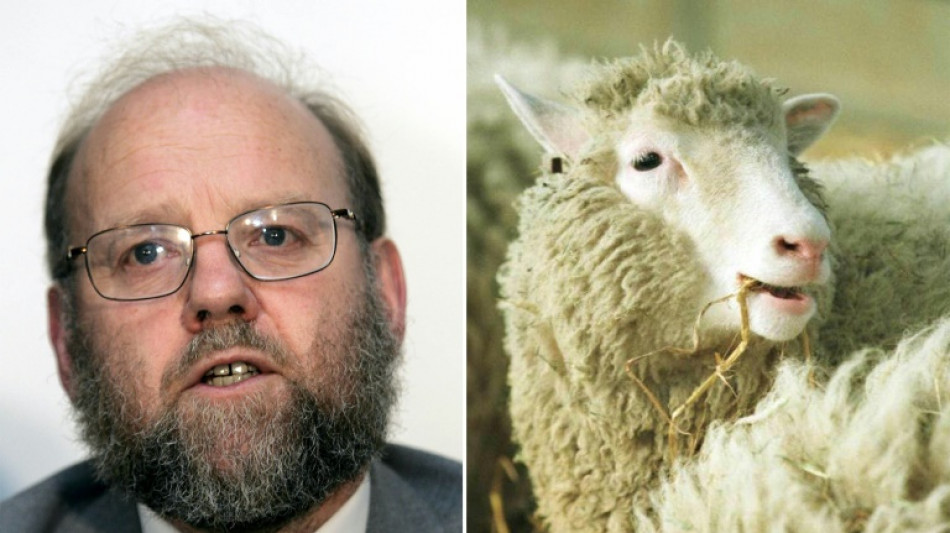
Scientist who led team that created Dolly the cloned sheep dies at 79 / Photo: © AFP/File

 Modi pitches India as global chipmaking hub

 Ukraine plans record defence spending in 2027

 NASA scan discovers new, 'once in a century' Moon crater

 Most stocks rise as Fed hikes and indicates drive to curb inflation

 UK-Sudanese author pens book to give children 'African history of Africa'

 US Congress passes sweeping Russia sanctions bill

 US stocks fall, dollar gains after Fed lifts interest rates

 US Fed raises rates to tackle 'too high' inflation in move sure to rile Trump

 US Fed raises rates to battle inflation in move likely to rile Trump

 US House faces test on sweeping Russia sanctions bill

 British PM says to make 'difficult decisions' as inflation rises

 Global fuel price demos: a round-up

 Leverate Launches MCP for Traders to Connect AI Assistants With Trading Platforms

 MEXC Launches $1M "Discover Your Wall Street DNA" Campaign to Help Traders Find Their Market Fit

 Stocks edge higher ahead of US Fed rate call

 BASIS.pro Expands On-Chain Infrastructure with XDC Network Partnership and Zypher DAO as Auto Earn Goes Live

 Pickle-flavoured tart? AI inspires Japan's convenience stores

 EU chief hosts Canada's Carney in push to 'deepen' alliance

 Meta chief pushes back on AI slowdown calls

 US Fed to deliver rate decision with markets betting on hike

 i-payout Expands U.S. Money Transmitter Licensing Footprint and Advances European EMI Strategy

 US Senate crypto bill collapses amid partisan deadlock

 OpenAI, Anthropic and Google are working to create an AI standards body

 Protesting shepherds, farmers clash with Romanian police

 Foundation Lets Ledger Users Switch to Open Source Without Starting Over

The British scientist who led the team that created Dolly the sheep, a breakthrough in cloning, has died at the age of 79, his former university said on Monday.
Ian Wilmut, who revealed in 2018 he had been diagnosed with Parkinson's disease, helmed the team at the Roslin Institute at the University of Edinburgh in Scotland, which cloned Dolly in 1996.
Dolly was the first mammal to be cloned from an adult cell, and the breakthrough garnered global headlines and led to new advances in animal and medical research.
Peter Mathieson, the vice-chancellor of Edinburgh University, hailed Wilmut as "a titan of the scientific world" whose work cloning Dolly "transformed scientific thinking at the time".
"This breakthrough continues to fuel many of the advances that have been made in the field of regenerative medicine that we see today," he said in a statement.
Bruce Whitelaw, the current head of the Roslin Institute, said it was "sad news".
"Science has lost a household name," he added.
Wilmut retired from Edinburgh University of 2012.
But in 2018, he announced support for new research into Parkinson's, revealing he had diagnosed with the uncurable, progressive brain disorder, which can cause uncontrollable movements such as shaking.
"There was a sense of clarity, well at least now we know and we can start doing things about it," Wilmut told the BBC at the time.
"As well as obviously the disappointment that it will possibly shorten my life slightly, and more particularly it will alter the quality of life."
Parkinson's is the second most common neurodegenerative disease after Alzheimer's and affects more than 8.5 million people worldwide, according to the World Health Organization (WHO).
Ch.Lefebvre--CPN