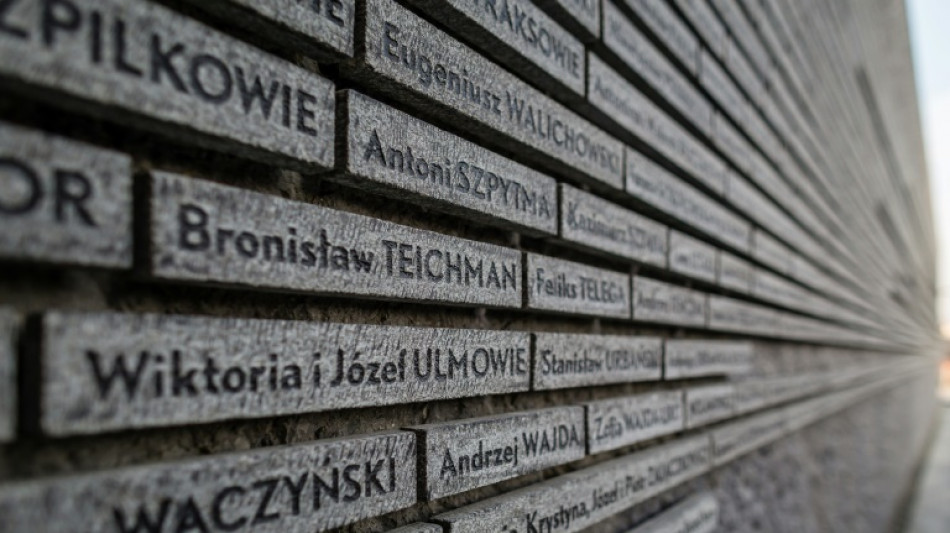
Politicians put spin on story of Poles who saved Jews: experts / Photo: WOJTEK RADWANSKI - AFP/File

 Modi pitches India as global chipmaking hub

 Ukraine plans record defence spending in 2027

 NASA scan discovers new, 'once in a century' Moon crater

 Most stocks rise as Fed hikes and indicates drive to curb inflation

 UK-Sudanese author pens book to give children 'African history of Africa'

 US Congress passes sweeping Russia sanctions bill

 US stocks fall, dollar gains after Fed lifts interest rates

 US Fed raises rates to tackle 'too high' inflation in move sure to rile Trump

 US Fed raises rates to battle inflation in move likely to rile Trump

 US House faces test on sweeping Russia sanctions bill

 British PM says to make 'difficult decisions' as inflation rises

 Global fuel price demos: a round-up

 Leverate Launches MCP for Traders to Connect AI Assistants With Trading Platforms

 MEXC Launches $1M "Discover Your Wall Street DNA" Campaign to Help Traders Find Their Market Fit

 Stocks edge higher ahead of US Fed rate call

 BASIS.pro Expands On-Chain Infrastructure with XDC Network Partnership and Zypher DAO as Auto Earn Goes Live

 Pickle-flavoured tart? AI inspires Japan's convenience stores

 EU chief hosts Canada's Carney in push to 'deepen' alliance

 Meta chief pushes back on AI slowdown calls

 US Fed to deliver rate decision with markets betting on hike

 i-payout Expands U.S. Money Transmitter Licensing Footprint and Advances European EMI Strategy

 US Senate crypto bill collapses amid partisan deadlock

 OpenAI, Anthropic and Google are working to create an AI standards body

 Protesting shepherds, farmers clash with Romanian police

 Foundation Lets Ledger Users Switch to Open Source Without Starting Over

The beatification of a Polish family who sheltered Jews during the Holocaust has given the government in Warsaw a chance to promote a one-sided narrative about attitudes of Poles in the war, experts have said.
Ahead of a ceremony on Sunday bestowing the Catholic honour on the Ulma family, who were killed by the Nazis, their story is being widely shared in Poland, with exhibitions, concerts and new books, including for children.
Presidential adviser Marcin Przydacz told Polish radio PR1 that the event has "a dimension of building up the image of Poland, and of historical truth".
Six million Polish citizens, including three million Jews, were killed by the Nazis.
The Yad Vashem memorial, which is dedicated to the memory of the Holocaust, honours 7,232 Poles as "Righteous among the Nations" for helping Jews during the Nazi occupation at a time when doing so was punishable by death.
- Heroic and tragic -
But historians say the sacrifice of those who helped Jews cannot be used to whitewash the past.
For years the authorities have denied the collaboration of some Poles with the Nazis and the indifference of a large part of the population to Jewish suffering.
"History is not a buffet where you can pick and choose what you want but that is how politicians are treating it," said sociologist Agnieszka Haska of the Polish Center for Holocaust Research.
"The story of the Ulma is heroic and tragic but cases of Jews being saved were not as numerous as politicised history now would have you believe... The Righteous were an extreme, just like those who collaborated," she said.
Haska said that "as victims of the Second World War, we are incapable of accepting that we were not as noble as we think."
For more than a year, the Ulma family hid eight Jews of the Goldmann and Grunfeld families in the village of Markowa in southern Poland.
Turned in by a Polish policeman, they were all executed -- including the children -- by Germans on March 24, 1944.
The mother was pregnant with her seventh child and began giving birth during the execution. The baby did not survive.
In 1995, the family were awarded the medal of Righteous among the Nations from Yad Vashem.
Since 2016 there has also been a museum in Markowa and the government has decreed March 24 the "National Day of the Memory of Poles who saved Jews".
- Patriotic discourse -
"Their story is used as a counter-argument to accusations of anti-Semitism and to polish Poland's image abroad," Zuzanna Radzik, an expert in Polish-Jewish dialogue, told AFP.
For her, the Ulma story "has become a choice excerpt for patriotic discourse because it was a family of peasants with many children and Catholic, which died."
Jan Grabowski, a Holocaust historian at the University of Ottawa, says, however, that after the execution of the Ulmas, 24 Jews in Markowa were killed by their Polish neighbours.
The example of the Ulmas allows politicians to make declarations not supported by historians.
Polish President Andrzej Duda in a speech in Markowa in March said that "thousands of the million Poles who helped Jews... were assassinated in this way", while Prime Minister Mateusz Morawiecki has said "millions" of Poles helped.
Historians estimate that around 30,000 Poles actively helped Jews.
"In Markowa, a village of 1,000 homes, around 20 Jews survived. It's not a lot" compared to 120 Jewish inhabitants before the war, said Grabowski.
Along with other Holocaust historians, including Barbara Engelking, Grabowski has become the target of various trials brought by government-financed bodies for "defamation" and "anti-Polish activities".
In June, Education Minister Przemyslaw Czarnek said he would cut financing for Holocaust studies carried out by Engelking at Warsaw University saying her research was of a "disgusting stupidity".
Grabowski said that exploiting the image of the Righteous serves to "hide the things Poles cannot face".
St.Ch.Baker--CPN