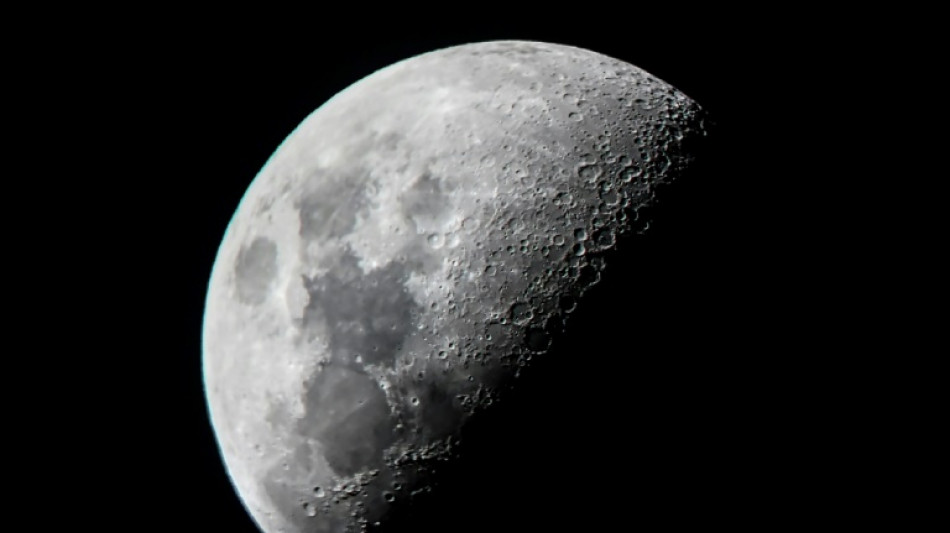
One giant step: Moon race heats up / Photo: Ye Aung THU - AFP/File

 NASA scan discovers new, 'once in a century' Moon crater

 Most stocks rise as Fed hikes and indicates drive to curb inflation

 UK-Sudanese author pens book to give children 'African history of Africa'

 US Congress passes sweeping Russia sanctions bill

 US stocks fall, dollar gains after Fed lifts interest rates

 US Fed raises rates to tackle 'too high' inflation in move sure to rile Trump

 US Fed raises rates to battle inflation in move likely to rile Trump

 US House faces test on sweeping Russia sanctions bill

 British PM says to make 'difficult decisions' as inflation rises

 Global fuel price demos: a round-up

 Leverate Launches MCP for Traders to Connect AI Assistants With Trading Platforms

 MEXC Launches $1M "Discover Your Wall Street DNA" Campaign to Help Traders Find Their Market Fit

 Stocks edge higher ahead of US Fed rate call

 BASIS.pro Expands On-Chain Infrastructure with XDC Network Partnership and Zypher DAO as Auto Earn Goes Live

 Pickle-flavoured tart? AI inspires Japan's convenience stores

 EU chief hosts Canada's Carney in push to 'deepen' alliance

 Meta chief pushes back on AI slowdown calls

 US Fed to deliver rate decision with markets betting on hike

 i-payout Expands U.S. Money Transmitter Licensing Footprint and Advances European EMI Strategy

 US Senate crypto bill collapses amid partisan deadlock

 OpenAI, Anthropic and Google are working to create an AI standards body

 Protesting shepherds, farmers clash with Romanian police

 Foundation Lets Ledger Users Switch to Open Source Without Starting Over

 EU to propose curbing social media, online games for under 15s

 FX Junction Reaches 40,600 Members and 26 Million Trades

The crash landing on the Moon of Russia's Luna-25 probe is the latest twist in an international push to return to the Earth's natural satellite that has drawn in the world's top powers and new players.
Technology, science and politics are all essential factors in the Moon race.
Here is the latest on various missions:
- Russia's Luna -
The launch of Luna-25 on August 11 was the first such Russian mission in almost 50 years and marked the beginning of Moscow's new lunar project.
On August 16 the lander was successfully placed in the Moon's orbit but on Sunday, space agency Roscomos announced it had "ceased to exist following a collision with the Moon's surface".
"Measures taken on August 19 and 20 to locate the craft and make contact with it were unsuccessful," the agency added.
It had been set to land on the Moon's surface on Monday and remain there for one year to collect samples and analyse soil.
Russian President Vladimir Putin has been working to strengthen space cooperation with China after ties with the West broke down following the start of Moscow's invasion of Ukraine in 2022.
Moscow had hoped to build on the legacy of the Soviet-era Luna programme, marking a return to independent lunar exploration in the face of financial troubles and corruption scandals at its space programme and growing isolation from the West.
- China's great leap -
China is pursuing plans to send a crewed mission to the Moon by 2030 and build a base there.
The world's second-largest economy has invested billions of dollars in its military-run space programme in a push to catch up with the United States and Russia.
China was the third country to place humans in orbit in 2003 and its Tiangong rocket is the crown jewel of its space programme, which has also landed rovers on Mars and the Moon.
The unmanned Chang'e-4 rocket landed on the far side of the Moon in 2019. Another robot mission to the near side raised the Chinese flag there in 2020.
That Moon landing brought rock and soil samples back to Earth, the first time that has been done in more than four decades.
- NASA's Artemis -
NASA's Artemis 3 mission is set to return humans to the Moon in 2025, including its first woman and first non-white astronaut.
Under the Artemis program, NASA is planning a series of missions of increasing complexity to return to the Moon and build up a sustained presence so it can develop and test technologies for an eventual journey to Mars.
Artemis 1 flew an uncrewed spacecraft around the Moon in 2022.
Artemis 2, planned for November 2024, will do the same with crew on board.
NASA sees the Moon as a pitstop for missions to Mars and has done a deal with Finnish mobile firm Nokia to set up a 4G network there.
However it has said the Artemis 3 mission may not land humans on the Moon. That will depend on whether certain key elements, including the landing system developed by SpaceX, are ready.
Elon Musk's firm SpaceX won the contract for a landing system based on a version of its prototype Starship rocket, which remains far from ready.
An orbital test flight of the uncrewed Starship ended in a dramatic explosion in April.
- New players -
Recent technological progress has reduced the cost of space missions and opened the way for new players in the public and private sector to get involved.
India's latest, Chandrayaan-3, entered the Moon's orbit earlier in August. It will carry out India's second attempted lunar landing later this month.
But getting to the Moon is not an easy task. Israeli non-profit organisation SpaceIL launched its Beresheet lunar lander in 2019 but it crashed.
And in April this year Japan's ispace was the latest company to try, and fail, at the historic bid to put a private lunar lander on the Moon.
Two US companies, Astrobotic and Intuitive Machines, are set to try later in the year.
burs-lc/jmy/eab/bp/gil
M.Davis--CPN

