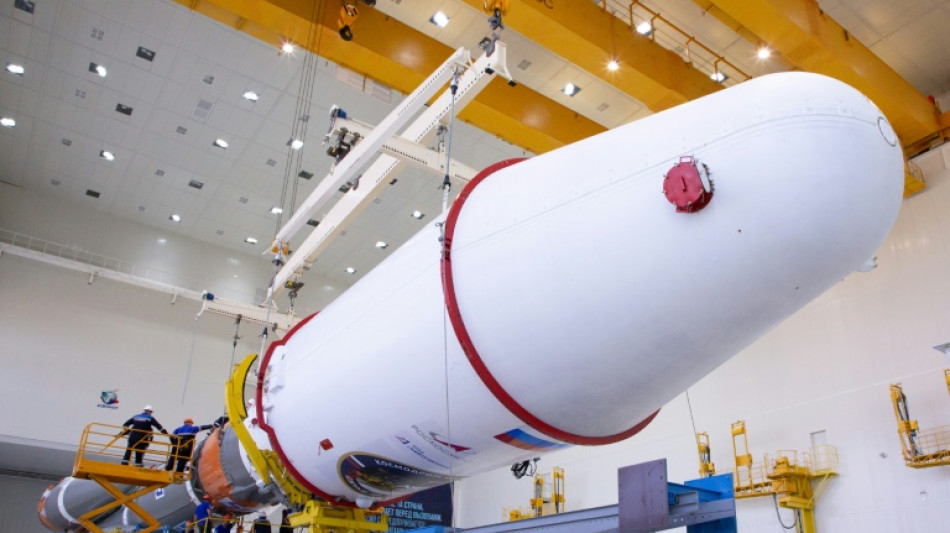
Russia to launch lunar mission Friday, first in nearly 50 years / Photo: Handout - Russian Space Agency Roscosmos/AFP

 NASA scan discovers new, 'once in a century' Moon crater

 Most stocks rise as Fed hikes and indicates drive to curb inflation

 UK-Sudanese author pens book to give children 'African history of Africa'

 US Congress passes sweeping Russia sanctions bill

 US stocks fall, dollar gains after Fed lifts interest rates

 US Fed raises rates to tackle 'too high' inflation in move sure to rile Trump

 US Fed raises rates to battle inflation in move likely to rile Trump

 US House faces test on sweeping Russia sanctions bill

 British PM says to make 'difficult decisions' as inflation rises

 Global fuel price demos: a round-up

 Leverate Launches MCP for Traders to Connect AI Assistants With Trading Platforms

 MEXC Launches $1M "Discover Your Wall Street DNA" Campaign to Help Traders Find Their Market Fit

 Stocks edge higher ahead of US Fed rate call

 BASIS.pro Expands On-Chain Infrastructure with XDC Network Partnership and Zypher DAO as Auto Earn Goes Live

 Pickle-flavoured tart? AI inspires Japan's convenience stores

 EU chief hosts Canada's Carney in push to 'deepen' alliance

 Meta chief pushes back on AI slowdown calls

 US Fed to deliver rate decision with markets betting on hike

 i-payout Expands U.S. Money Transmitter Licensing Footprint and Advances European EMI Strategy

 US Senate crypto bill collapses amid partisan deadlock

 OpenAI, Anthropic and Google are working to create an AI standards body

 Protesting shepherds, farmers clash with Romanian police

 Foundation Lets Ledger Users Switch to Open Source Without Starting Over

 EU to propose curbing social media, online games for under 15s

 FX Junction Reaches 40,600 Members and 26 Million Trades

Russia said Monday it plans to launch a lunar lander this week after multiple delays, hoping to return to the Moon for the first time in nearly fifty years.
Russian space agency Roscosmos said it had scheduled the launch of the Luna-25 lander for the early hours of Friday.
With the lunar mission, Russia's first since 1976, Moscow is seeking to restart and build on the Soviet Union's pioneering space programme.
The launch is the first mission of Moscow's new lunar project and comes as President Vladimir Putin looks to strengthen cooperation in space with China after ties with the West broke down following the start of Moscow's offensive in Ukraine last year.
Engineers have assembled a Soyuz rocket at the Vostochny cosmodrome in the Russian Far East for the launch of the lander, Roscosmos said.
"The Luna-25 will have to practise soft landing, take and analyse soil samples and conduct long-term scientific research," Roscosmos said in a statement.
The four-legged lander, which weighs around 800 kilograms (1,750 pounds) , is expected to touch down in the region of the lunar south pole. By contrast, most previous Moon landings have occurred near the lunar equator.
The spacecraft is expected to reach the Moon around five days after launch.
- 'Total sanctions' -
After Putin sent troops to Ukraine last year, the European Space Agency (ESA) said it would not cooperate with Moscow on the upcoming Luna-25 launch as well as future 26 and 27 missions.
Despite the pullout, Moscow said it would go ahead with its lunar plans and replace ESA equipment with Russian-made scientific instruments.
Speaking at the Vostochny cosmodrome last year, Putin said the Soviet Union put the first man into space in 1961 despite "total" sanctions.
The Kremlin chief insisted Moscow would similarly continue to develop its lunar programme despite current Western sanctions in response to the assault in Ukraine.
"We are guided by the ambition of our ancestors to move forward, despite any difficulties and any attempts to prevent us in this movement from the outside," Putin said.
In June, the head of Russia's space agency Roscosmos, Yuri Borisov, described the upcoming launch as high-risk.
"This mission involves landing at the south pole. No one in the world has ever done such things," he said during a meeting with Putin.
"The probability of successful completion of such missions is estimated at around 70 percent."
- Evacuation -
Ahead of Friday's launch, local authorities said that residents would be evacuated from the village of Shakhtinsky in the far-eastern region of Khabarovsk, where the rocket's boosters are expected to fall.
During the last Soviet Moon mission in 1976, the Luna-24 brough back samples of lunar soil.
With Sputnik, the Soviet Union launched the first man-made satellite into space in 1957 and later sent into orbit the first animal, a dog named Laika, the first man, Yuri Gagarin, and the first woman, Valentina Tereshkova.
But compared with the Soviet era, modern Russia has struggled to innovate and its space industry is fighting to secure state funding while the Kremlin prioritises military spending.
Russia's space agency is still reliant on Soviet-designed technology and has faced a number of setbacks, including corruption scandals and botched launches.
Moscow is also falling behind in the global space race, facing tough competition from the United States and China.
M.Davis--CPN

