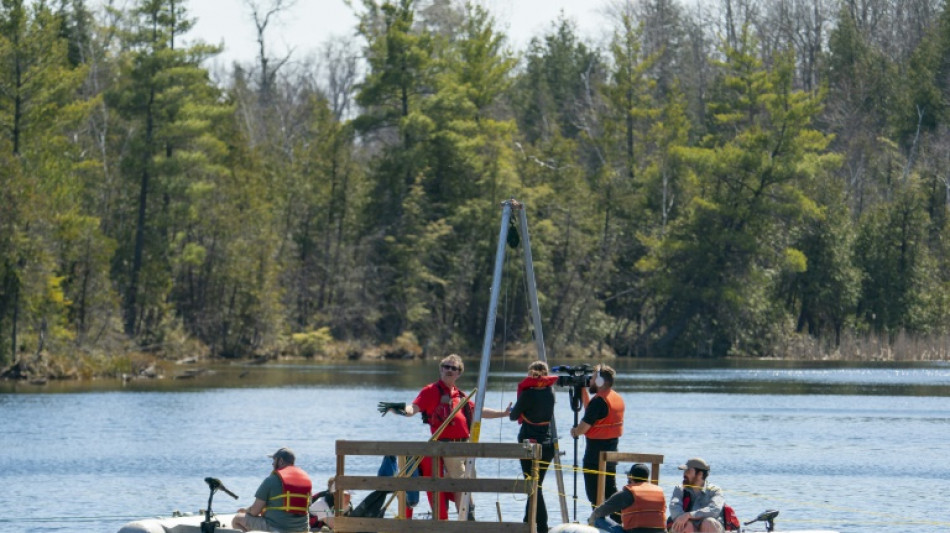
Canadian lake ground-zero for Anthropocene epoch / Photo: Peter POWER - AFP

 NASA scan discovers new, 'once in a century' Moon crater

 Most stocks rise as Fed hikes and indicates drive to curb inflation

 UK-Sudanese author pens book to give children 'African history of Africa'

 US Congress passes sweeping Russia sanctions bill

 US stocks fall, dollar gains after Fed lifts interest rates

 US Fed raises rates to tackle 'too high' inflation in move sure to rile Trump

 US Fed raises rates to battle inflation in move likely to rile Trump

 US House faces test on sweeping Russia sanctions bill

 British PM says to make 'difficult decisions' as inflation rises

 Global fuel price demos: a round-up

 Leverate Launches MCP for Traders to Connect AI Assistants With Trading Platforms

 MEXC Launches $1M "Discover Your Wall Street DNA" Campaign to Help Traders Find Their Market Fit

 Stocks edge higher ahead of US Fed rate call

 BASIS.pro Expands On-Chain Infrastructure with XDC Network Partnership and Zypher DAO as Auto Earn Goes Live

 Pickle-flavoured tart? AI inspires Japan's convenience stores

 EU chief hosts Canada's Carney in push to 'deepen' alliance

 Meta chief pushes back on AI slowdown calls

 US Fed to deliver rate decision with markets betting on hike

 i-payout Expands U.S. Money Transmitter Licensing Footprint and Advances European EMI Strategy

 US Senate crypto bill collapses amid partisan deadlock

 OpenAI, Anthropic and Google are working to create an AI standards body

 Protesting shepherds, farmers clash with Romanian police

 Foundation Lets Ledger Users Switch to Open Source Without Starting Over

 EU to propose curbing social media, online games for under 15s

 FX Junction Reaches 40,600 Members and 26 Million Trades

Scientists on Tuesday designated a small body of water near Toronto, Canada as ground-zero for the Anthropocene, the proposed geological epoch defined by humanity's massive and destabilising impact on the planet.
Layered sediment at the bottom of Lake Crawford -- laced with microplastics, fly-ash spread by burning oil and coal, and the detritus of nuclear bomb explosions -- is the single best repository of evidence that a new, and challenging, chapter in Earth's history has begun, members of the Anthropocene Working Group concluded.
"The data show a clear shift from the mid-20th century, taking Earth's system beyond the normal bounds of the Holocene", the epoch that began 11,700 years ago as the last ice age ended, working group member Andy Cundy, a professor at the University of Southampton, told AFP.
After years of deliberation, the Canadian lake was selected from among 12 candidate sites around the world -- including another lake, coral reefs, ice cores and an ocean bay in Japan -- as the Anthropocene's so-called golden spike.
"The sediment found at the bottom of the Crawford Lake provides an exquisite record of recent environmental change over the last millennia," said working group chair Simon Turner, a professor at University College London.
"It is this ability to precisely record and store this information as a geological archive that can be matched to historical global environmental changes."
Those changes are currently on dramatic display: last week was the hottest globally on record. Out-of-control forest fires have been ravaging Canada for months, while the US and China are coping with unprecedented heat, flooding and drought at the same time.
Humanity has burned so much fossil fuel that concentrations of planet-warming CO2, meanwhile, have increased by half.
Sea surface temperatures have hit new highs in recent weeks, and Antarctic sea ice last month was 17 percent below the previous record low for June.
- 'Great Acceleration' -
Last month scientists reported that so much water has been pumped from underground reservoirs that Earth's geographic North Pole has shifted -- by nearly five centimetres (two inches) per year.
According to the rules of the International Commission on Stratigraphy (ICU), which in 2009 mandated a team of geologists to assess evidence for the Anthropocene, there must be a synchronous "primary marker" for a proposed boundary that is detectable in the geological record almost anywhere on the planet.
For the Anthropocene, plutonium cast off by hydrogen bomb tests provides that "global fingerprint", explained Cundy.
"The clearest marker for a single year -- which gives an abrupt and effectively instantaneous snapshot -- is plutonium, because there's so little of it naturally present."
That means 1952 -- when the United States first detonated a huge hydrogen bomb in the Marshall Islands as a test -- could become the Anthropocene's boundary year, he said.
Smaller atom bomb explosions before that left mostly regional imprints.
A sharp, hockey-stick increase across a dozen markers of humanity's growing impact -- including population, water use, greenhouse gas emissions, and forest loss -- bunched around the middle of the 20th century add up to what scientists call the Great Acceleration.
The "epoch of humans" first proposed in 2002 by chemistry Nobel Paul Crutzen is widely accepted within science as a reality, but faces daunting hurdles for formal validation by the gatekeepers of Earth's official geological timeline of eon, eras, periods and epochs, such as the Jurassic and the Cretaceous.
The Anthropocene's recommendations must be approved by super-majority vote of two separate committees before final validation by the International Unions of Geological Sciences (IUGS).
The heads of those bodies have thus far expressed sharp scepticism towards the Anthropocene, mostly on technical grounds.
"The vote in the working group is on a routine step at the lowest level," IUGS General Secretary Stanley Finney told AFP.
The working group has yet to submit its final recommendation to the International Commission on Stratigraphy, he noted.
"Only then can it be given peer review, and the evidence and arguments truly evaluated," Finney said.
M.P.Jacobs--CPN