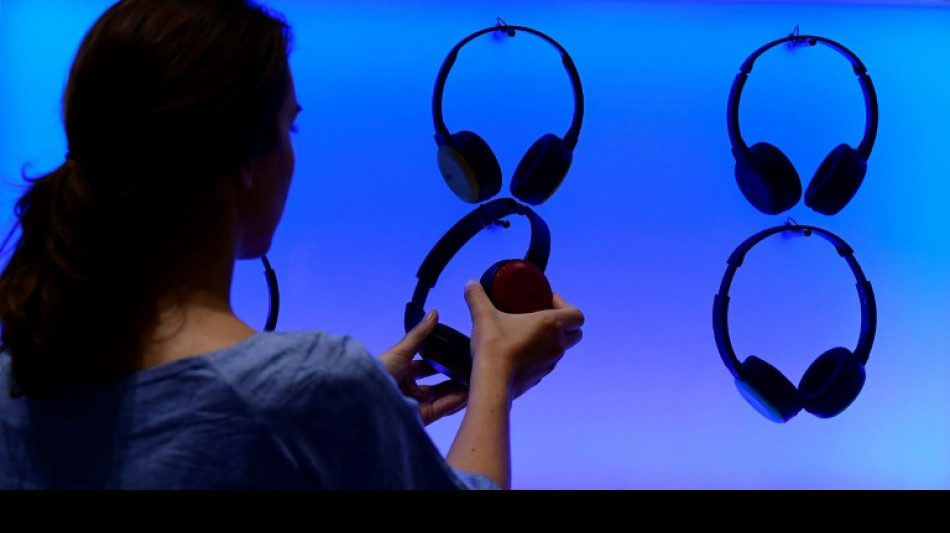
Audio book narrators say AI is already taking away business / Photo: TOBIAS SCHWARZ - AFP

 Where the US-China tariff row stands ahead of White House summit

 Indonesia cash-for-photos scheme turns animal hunters into protectors

 Argentine judge orders suspension of Falklands oil project

 US Fed raises rates to tackle 'too high' inflation, irking Trump

 Turkey releases 106 protesters, jails more LGBTQ activists

 Candidate for UN chief calls for AI regulation akin to nuclear weapons

 'We're losing control,' AI pioneer Yoshua Bengio tells AFP

 IR-MED and Dice Technologies Announce collaboration to Evaluate and Advance Pressure-Injury Prevention Platform in Japan

 Watts, Pitt, Cruz to light up Spain's top film festival

 Toogood Gold's Table Mountain Sits in the Shadow of a Nevada Gold Rush

 MEXC July–August Security Report: 38.66M USDT in Risk Funds Intercepted, Futures Insurance Fund Hits 792M USDT

 Emporio Armani names Dario Vitale new creative director

 EU to ban social media for under 13s, curb access until 15

 Wildfires push endangered Sumatran elephants to brink: Indonesian NGO

 Bank of Japan set to raise rates under pressure from inflation, US

 EU chief to unveil social media, gaming curbs for under-15s

 'Resident Evil' film brings video game's ethos to the big screen

 GA-ASI Mojave First UAS To Complete Battlefield Short Field Ops

 Sanders, Bannon warn of AI dangers in rare US left-right alignment

 Empty benches as schools reopen in Venezuela's quake-hit Guaira

 Tiny English village holds 'independence' vote over asylum seeker housing

 US Treasury chief says to meet Chinese counterpart at weekend

 BingX Evolves into a Multi-Asset Trading Platform, Connecting Users to Global Opportunities

 International Trading Institute Expands Professional Trader Development Beyond the Master’s in Trading

 Lake Energy Secures $80 Million for U.S. Renewable Energy Expansion

As people brace for the disruptive impact of artificial intelligence on jobs and everyday living, those in the world of audio books say their field is already being transformed.
AI has the ability to create human-sounding recordings -- at assembly-line speed -- while bypassing at least part of the services of the human professionals who for years have made a living with their voices.
Many of them are already seeing a sharp drop off in business.
Tanya Eby has been a full-time voice actor and professional narrator for 20 years. She has a recording studio in her home.
But in the past six months she has seen her work load fall by half. Her bookings now run only through June, while in a normal year they would extend through August.
Many of her colleagues report similar declines.
While other factors could be at play, she told AFP, "It seems to make sense that AI is affecting all of us."
There is no label identifying AI-assisted recordings as such, but professionals say thousands of audio books currently in circulation use "voices" generated from a databank.
Among the most cutting-edge, DeepZen offers rates that can slash the cost of producing an audio book to one-fourth, or less, that of a traditional project.
The small London-based company draws from a database it created by recording the voices of several actors who were asked to speak in a variety of emotional registers.
"Every voice that we are using, we sign a license agreement, and we pay for the recordings," said DeepZen CEO Kamis Taylan.
For every project, he added, "we pay royalties based on the work that we do."
Not everyone respects that standard, said Eby.
"All these new companies are popping up who are not as ethical," she said, and some use voices found in databases without paying for them.
"There's that gray area" being exploited by several platforms, Taylan acknowledged.
"They take your voice, my voice, five other people's voices combined that just creates a separate voice... They say that it doesn't belong to anybody."
All the audio book companies contacted by AFP denied using such practices.
Speechki, a Texas-based start-up, uses both its own recordings and voices from existing databanks, said CEO Dima Abramov.
But that is done only after a contract has been signed covering usage rights, he said.
- Future of coexistence? -
The five largest US publishing houses did not respond to requests for comment.
But professionals contacted by AFP said several traditional publishers are already using so-called generative AI, which can create texts, images, videos and voices from existing content -- without human intervention.
"Professional narration has always been, and will remain, core to the Audible listening experience," said a spokesperson for that Amazon subsidiary, a giant in the American audio book sector.
"However, as text-to-speech technology improves, we see a future in which human performances and text-to-speech generated content can coexist."
The giants of US technology, deeply involved in the explosively developing field of AI, are all pursuing the promising business of digitally narrated audio books.
- 'Accessible to all' -
Early this year, Apple announced it was moving into AI-narrated audio books, a move it said would make the "creation of audio books more accessible to all," notably independent authors and small publishers.
Google is offering a similar service, which it describes as "auto-narration."
"We have to democratize the publishing industry, because only the most famous and the big names are getting converted into audio," said Taylan.
"Synthetic narration just opened the door for old books that have never been recorded, and all the books from the future that never will be recorded because of the economics," added Speechki's Abramov.
Given the costs of human-based recording, he added, only some five percent of all books are turned into audio books.
But Abramov insisted that the growing market would also benefit voice actors.
"They will make more money, they will make more recordings," he said.
- The human element -
"The essence of storytelling is teaching humanity how to be human. And we feel strongly that that should never be given to a machine to teach us about how to be human," said Emily Ellet, an actor and audio book narrator who cofounded the Professional Audiobook Narrators Association (PANA).
"Storytelling," she added, "should remain human entirely."
Eby underlined a frequent criticism of digitally generated recordings.
When compared to a human recording, she said, an AI product "lacks in emotional connectivity."
Eby said she fears, however, that people will grow accustomed to the machine-generated version, "and I think that's quietly what's kind of happening."
Her wish is simply "that companies would let listeners know that they're listening to an AI-generated piece... I just want people to be honest about it."
H.Meyer--CPN
