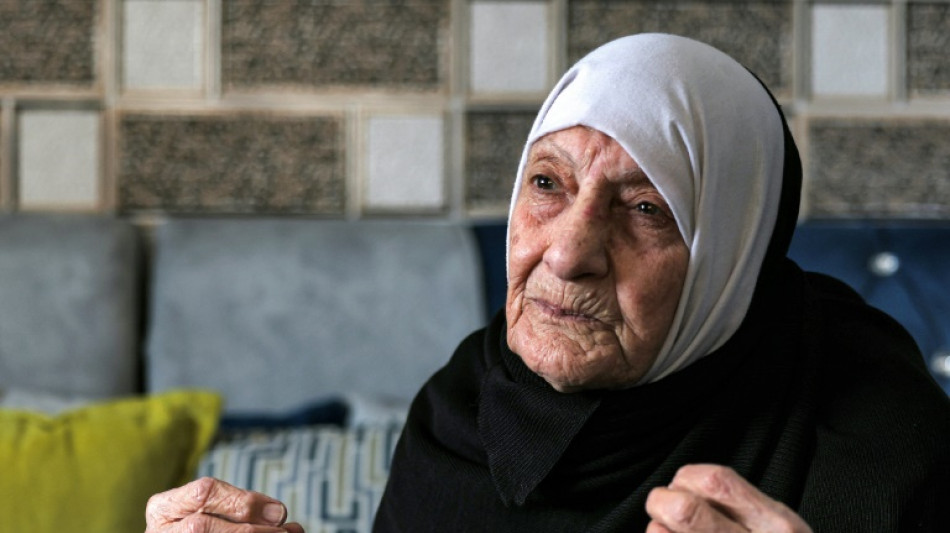
75 years after the Nakba, Palestinians still long for return / Photo: MAHMUD HAMS - AFP

 Where the US-China tariff row stands ahead of White House summit

 Indonesia cash-for-photos scheme turns animal hunters into protectors

 Argentine judge orders suspension of Falklands oil project

 US Fed raises rates to tackle 'too high' inflation, irking Trump

 Turkey releases 106 protesters, jails more LGBTQ activists

 Candidate for UN chief calls for AI regulation akin to nuclear weapons

 'We're losing control,' AI pioneer Yoshua Bengio tells AFP

 IR-MED and Dice Technologies Announce collaboration to Evaluate and Advance Pressure-Injury Prevention Platform in Japan

 Watts, Pitt, Cruz to light up Spain's top film festival

 Toogood Gold's Table Mountain Sits in the Shadow of a Nevada Gold Rush

 MEXC July–August Security Report: 38.66M USDT in Risk Funds Intercepted, Futures Insurance Fund Hits 792M USDT

 Emporio Armani names Dario Vitale new creative director

 EU to ban social media for under 13s, curb access until 15

 Wildfires push endangered Sumatran elephants to brink: Indonesian NGO

 Bank of Japan set to raise rates under pressure from inflation, US

 EU chief to unveil social media, gaming curbs for under-15s

 'Resident Evil' film brings video game's ethos to the big screen

 GA-ASI Mojave First UAS To Complete Battlefield Short Field Ops

 Sanders, Bannon warn of AI dangers in rare US left-right alignment

 Empty benches as schools reopen in Venezuela's quake-hit Guaira

 Tiny English village holds 'independence' vote over asylum seeker housing

 US Treasury chief says to meet Chinese counterpart at weekend

 BingX Evolves into a Multi-Asset Trading Platform, Connecting Users to Global Opportunities

 International Trading Institute Expands Professional Trader Development Beyond the Master’s in Trading

 Lake Energy Secures $80 Million for U.S. Renewable Energy Expansion

From her modest home in the blockaded Gaza Strip, Amina al-Dabai remembers the very different world in which she grew up more than seven decades ago.
Born in 1934, Dabai was still only a child when Israel was created on May 14, 1948.
Now she is one of 5.9 million Palestinian refugees living in the occupied West Bank, the Gaza Strip, Jordan, Lebanon and Syria according to the United Nations.
They are descendants of more than 760,000 Palestinians who fled or were expelled from their homes 75 years ago.
The event is known by Palestinians as the Nakba, or "catastrophe", during which more than 600 communities were destroyed or depopulated by Jewish forces, according to the Israeli organisation Zochrot.
The memory of the Nakba, which is commemorated on May 15, has become a rallying point for the Palestinian quest for statehood.
It falls a day after Israel declared statehood in 1948, prompting an invasion by five Arab armies which the young nation defeated.
Ahead of the anniversary, AFP spoke to eight Palestinians in their 80s and 90s who were exiled during the Nakba to the Gaza Strip.
- Soldiers in disguise -
Dabai recalled the day "Jewish soldiers in disguise" arrived in her hometown of Lydda, now known as Lod in central Israel.
Because the fighters' faces were covered in keffiyehs, a scarf that has come to symbolise the Palestinian struggle, locals thought they were reinforcements sent from Jordan.
People were so delighted they "rushed for the fountain" in the town centre to celebrate.
But realising the soldiers were Jews, they "fled into the mosque and their homes".
"They (soldiers) stormed the mosque and killed everyone inside," she added. "I was young and saw it with my own eyes."
Planned deportation, expulsion or voluntary exile? A massacre of hundreds of civilians and unarmed fighters in a conflict where both sides were guilty of atrocities?
The events of July 12 to 13, 1948, during the capture of Lod by Israeli forces, remain the subject of debate and intense controversy even to this day.
One thing seems certain: the town was emptied of almost all of its 30,000 Arab residents practically overnight.
Following the war, the West Bank fell under Jordanian rule while Gaza was controlled by Egypt.
"We lived comfortably" until that point, recalled Dabai, as she reminisced about children playing on swings, the central market, and the trickling of water from a large fountain surrounded by shops.
But she is bitter about what she lost: "We were a weak country and we did not have powerful weapons."
The day after the disguised soldiers arrived, she said, they returned with orders -- leave Lod, or be killed.
"We said we don't want to leave. They said they would kill us. So all the poor people left, and we were among them," said Dabai.
The family fled on foot, walking for several days until they reached the Christian town of Bir Zeit, near Ramallah in the West Bank, then moving on towards Egypt.
But the journey was too expensive and so the family settled in Gaza instead.
Like many, they were sure they would be back soon.
Only after the Oslo Accords established the Palestinian Authority in the 1990s did Dabai manage to obtain a permit to visit her old neighbourhood in Lod.
"I put my hand on the wall of our house and said: 'my love, my grandfather's house, is destroyed, and our neighbours' homes are inhabited by Jews'", she said.
She told AFP she would not accept any compensation for the home, and no longer expected to return, but insisted that "future generations will liberate the country and return".
"No one was filming the massacres and what was happening, in the way we do today," she added, her voice breaking.
- 'They surrounded the village' -
Umm Jaber Wishah was born in 1932 in the village of Beit Affa, near Ashkelon in what is now southern Israel.
Decades later, with her greying hair covered by a white shawl, she painfully recounts how things were initially peaceful.
When Jews first came to the area of the village, "they did not harm us and we didn't harm them," she told AFP from her home in the Bureij refugee camp in the central Gaza Strip.
"The Arabs worked for them (Jews) without problems, in safety," she added.
Yet the coexistence did not last long. She remembers the day in May 1948 that it shattered.
"I was baking bread, and they surrounded the village," she said, fighting back tears.
"They (Jewish soldiers) began besieging the village from the eastern side, and we hid from the shooting until the next day."
"The men were tied up and were then taken prisoner, the children were screaming," she said.
According to Zochrot, Beit Affa was taken by Jewish forces the first time in July 1948 for a few days. During this period the residents in all likelihood left, ahead of the village's decisive capture later that year.
As in Palestinian refugee camps across the region, Bureij has long since traded temporary tents for more permanent structures of brick and wood. But many displaced still live in poverty.
Wishah, a wooden walking stick resting against her leg, said her Bureij home "means nothing".
"Even if they gave me the whole Gaza Strip in exchange for my homeland, I wouldn't accept it. My village is Beit Affa."
- Rusty keys -
Ibtihaj Dola, from the coastal city of Jaffa, also remembers living side-by-side with Jews before Israel was established.
One of her relatives through marriage was Jewish and the city's large Jewish minority "could speak Arabic", said the 88-year-old.
Dola remembered returning home from school one day to find her family packing and preparing to flee.
They boarded a boat for Egypt. She was still wearing her school uniform.
"I know Jaffa inch by inch," she said, fiddling with four rusty keys at her bedside in Gaza's Al-Shati refugee camp.
After the Oslo Accords she found an opportunity to return to Jaffa, where she discovered a Jewish woman was living in her house.
"We drank tea together and I started crying," she said, realising the woman was not interested in the fate of the previous owners.
Many of those who were displaced assumed it would just be temporary. They locked their front doors and took large metal keys with them.
Those keys today have become a symbol of their plight and their over-riding demand to return. In many homes, these keys are kept safely in a locked box under a bed, or memorialised in drawings and embroidery.
Israel claims Palestinians left voluntarily during the fighting and has repeatedly rejected claims its forces may have been responsible for war crimes.
It has steadfastly denied Palestinians the right to return -- often a sticking point in peace talks -- claiming it would be tantamount to a demographic surrender of the state's Jewish nature.
In 2011, after demonstrators marking Nakba day clashed with police, Israeli Prime Minister Benjamin Netanyahu accused the participants of "questioning the very existence of Israel".
Recognition of the Nakba is strongly rejected by Israelis, according to Zochrot which works to raise awareness of this period in history.
According to the organisation, Israelis "are taught a false, greatly distorted but convincing narrative of 'a land without a people for a people without a land'."
- 'Injustice does not last' -
Hassan al-Kilani, born in 1934 in Burayr village just north of the Gaza Strip, said he would only accept compensation if there was a political agreement.
"We, Arabs and Palestinians, cannot match the strength of Israel, let's be realistic," he said, wearing a crisp white headscarf.
"We resist, but our resistance is limited compared to our enemy," he added.
Kilani, a former construction worker, sketched a plan of Burayr, noting the name of each family, plot by plot.
The drawing now hangs on the wall of his living room, a constant reminder of the village where he grew up.
"Everyone who remained in the country was killed... even livestock, camels and cows," he said.
On another wall of the living room, a key is hung, symbolising the longed-for return.
"Injustice does not last," he added, but acknowledged, "I am old. How many years do I have left to live?"
D.Goldberg--CPN
