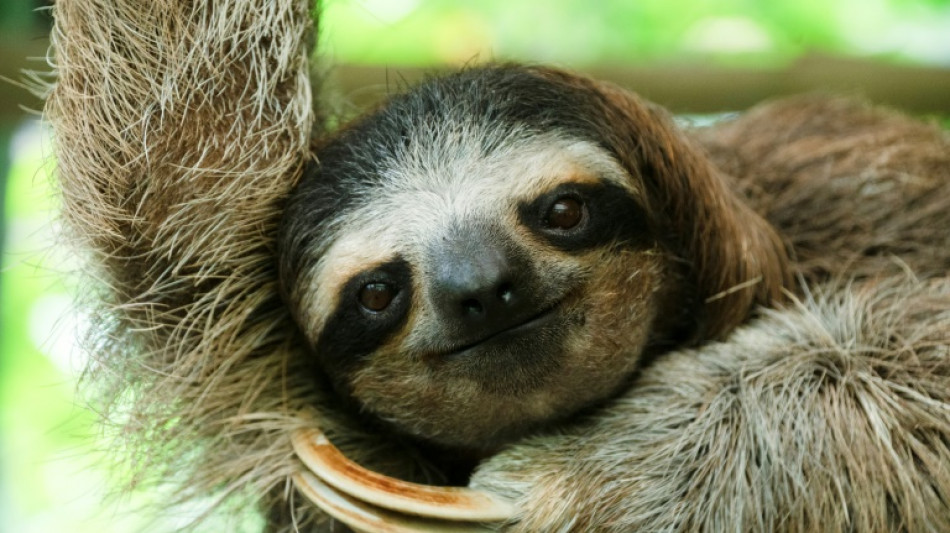
Costa Rican sloth antibiotics offer hope for human medicine / Photo: Ezequiel BECERRA - AFP

 Where the US-China tariff row stands ahead of White House summit

 Indonesia cash-for-photos scheme turns animal hunters into protectors

 Argentine judge orders suspension of Falklands oil project

 US Fed raises rates to tackle 'too high' inflation, irking Trump

 Turkey releases 106 protesters, jails more LGBTQ activists

 Candidate for UN chief calls for AI regulation akin to nuclear weapons

 'We're losing control,' AI pioneer Yoshua Bengio tells AFP

 IR-MED and Dice Technologies Announce collaboration to Evaluate and Advance Pressure-Injury Prevention Platform in Japan

 Watts, Pitt, Cruz to light up Spain's top film festival

 Toogood Gold's Table Mountain Sits in the Shadow of a Nevada Gold Rush

 MEXC July–August Security Report: 38.66M USDT in Risk Funds Intercepted, Futures Insurance Fund Hits 792M USDT

 Emporio Armani names Dario Vitale new creative director

 EU to ban social media for under 13s, curb access until 15

 Wildfires push endangered Sumatran elephants to brink: Indonesian NGO

 Bank of Japan set to raise rates under pressure from inflation, US

 EU chief to unveil social media, gaming curbs for under-15s

 'Resident Evil' film brings video game's ethos to the big screen

 GA-ASI Mojave First UAS To Complete Battlefield Short Field Ops

 Sanders, Bannon warn of AI dangers in rare US left-right alignment

 Empty benches as schools reopen in Venezuela's quake-hit Guaira

 Tiny English village holds 'independence' vote over asylum seeker housing

 US Treasury chief says to meet Chinese counterpart at weekend

 BingX Evolves into a Multi-Asset Trading Platform, Connecting Users to Global Opportunities

 International Trading Institute Expands Professional Trader Development Beyond the Master’s in Trading

 Lake Energy Secures $80 Million for U.S. Renewable Energy Expansion

The fur of Costa Rican sloths appears to harbor antibiotic-producing bacteria that scientists hope may hold a solution to the growing problem of "superbugs" resistant to humanity's dwindling arsenal of drugs.
Sloth fur, research has found, hosts bustling communities of insects, algae, fungi and bacteria, among other microbes, some of which could pose disease risk.
Yet, experts say, the famously slow-moving mammals appear to be surprisingly infection-proof.
"If you look at the sloth's fur, you see movement: you see moths, you see different types of insects... a very extensive habitat," Max Chavarria, a researcher at the University of Costa Rica, told AFP.
"Obviously when there is co-existence of many types of organisms, there must also be systems that control them," he said.
Chavarria and a team took fur samples from Costa Rican two- and three-toed sloths to examine what that control system could be.
They found the possible existence of antibiotic-producing bacteria that "makes it possible to control the proliferation of potentially pathogenic bacteria... or inhibit other competitors" such as fungi, according to a study published in the journal Environmental Microbiology.
- 'No infection' -
The sloth is a national symbol in laid back Costa Rica, and a major tourist attraction for the Central American country.
Both the two-toed (Choloepus Hoffmanni) and three-toed (Bradypus variegatus) sloth species have seen their populations decline, according to the International Union for the Conservation of Nature's Red List of Threatened Species.
They live in the canopies of trees in the jungle on the Caribbean coast, where the climate is hot and humid.
American Judy Avey runs a sanctuary in the balmy jungle to care for sloths injured after coming into contact with humans or other animals.
She treats and rehabilitates the creatures with a view to releasing them back into the wild.
"We've never received a sloth that has been sick, that has a disease or has an illness," she told AFP.
"We've received sloths that had been burned by power lines and their entire arm is just destroyed... and there's no infection.
"I think maybe in the 30 years (we've been open), we've seen five animals that have come in with an infected injury. So that tells us there's something going on in their... bodily ecosystem."
Avey, who established the sanctuary with her late Costa Rican husband, Luis Arroyo, had never even heard of a sloth back home in Alaska.
Since receiving her first sloth, whom she named "Buttercup," in 1992, she has cared for around 1,000 animals.
- Penicillin inspiration -
Researcher Chavarria took fur samples taken from sloths at the sanctuary to examine in his laboratory.
He began his research in 2020, and has already pinpointed 20 "candidate" microorganisms waiting to be named.
But he said there is a long road ahead in determining whether the sloth compounds could be useful to humans.
"Before thinking about an application in human health, it's important to first understand... what type of molecules are involved," said Chavarria.
An example of this is penicillin, discovered in 1928 by British scientist Alexander Fleming, who discovered that a fungal contamination of a laboratory culture appeared to kill a disease-causing bacteria.
His discovery of the world's first bacteria-killer, or antibiotic, earned him the 1945 Nobel Prize in medicine.
However, microbial resistance to antibiotics has been a growing problem, meaning some medicines no longer work to fight the infections they were designed to treat.
Antimicrobial resistance is a natural phenomenon, but the overuse and misuse of antibiotics in humans, animals and plants has made the problem worse.
The World Health Organization estimates that by 2050, resistance to antibiotics could cause 10 million deaths a year.
"Projects like ours can contribute to finding... new molecules that can, in the medium or long term, be used in this battle against antibiotic resistance," said Chavarria.
T.Morelli--CPN
