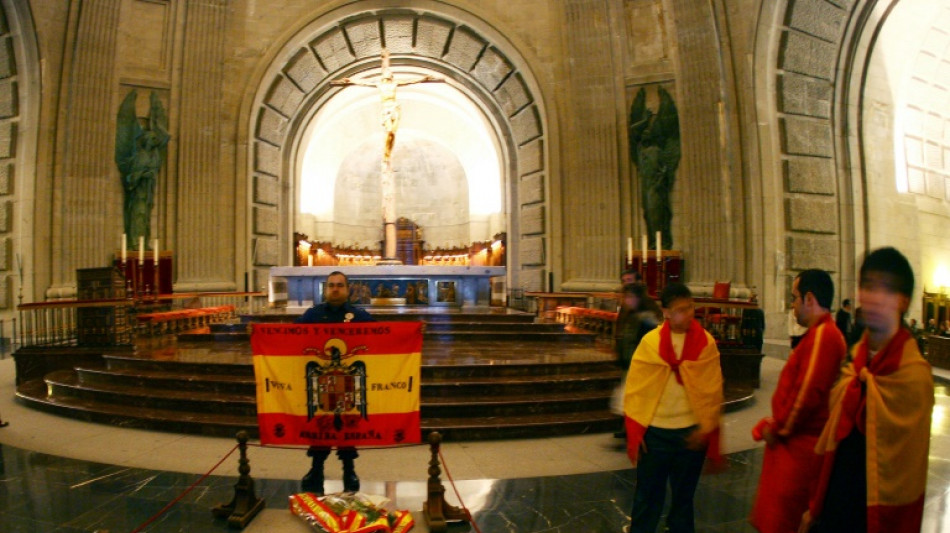
Spain exhumes remains of fascist party founder / Photo: PHILIPPE DESMAZES - AFP/File

 Where the US-China tariff row stands ahead of White House summit

 Indonesia cash-for-photos scheme turns animal hunters into protectors

 Argentine judge orders suspension of Falklands oil project

 US Fed raises rates to tackle 'too high' inflation, irking Trump

 Turkey releases 106 protesters, jails more LGBTQ activists

 Candidate for UN chief calls for AI regulation akin to nuclear weapons

 'We're losing control,' AI pioneer Yoshua Bengio tells AFP

 IR-MED and Dice Technologies Announce collaboration to Evaluate and Advance Pressure-Injury Prevention Platform in Japan

 Watts, Pitt, Cruz to light up Spain's top film festival

 Toogood Gold's Table Mountain Sits in the Shadow of a Nevada Gold Rush

 MEXC July–August Security Report: 38.66M USDT in Risk Funds Intercepted, Futures Insurance Fund Hits 792M USDT

 Emporio Armani names Dario Vitale new creative director

 EU to ban social media for under 13s, curb access until 15

 Wildfires push endangered Sumatran elephants to brink: Indonesian NGO

 Bank of Japan set to raise rates under pressure from inflation, US

 EU chief to unveil social media, gaming curbs for under-15s

 'Resident Evil' film brings video game's ethos to the big screen

 GA-ASI Mojave First UAS To Complete Battlefield Short Field Ops

 Sanders, Bannon warn of AI dangers in rare US left-right alignment

 Empty benches as schools reopen in Venezuela's quake-hit Guaira

 Tiny English village holds 'independence' vote over asylum seeker housing

 US Treasury chief says to meet Chinese counterpart at weekend

 BingX Evolves into a Multi-Asset Trading Platform, Connecting Users to Global Opportunities

 International Trading Institute Expands Professional Trader Development Beyond the Master’s in Trading

 Lake Energy Secures $80 Million for U.S. Renewable Energy Expansion

Experts were on Monday exhuming the remains of the founder of Spain's fascist Falange party from a grandiose basilica, where the body of former dictator Francisco Franco once lay, ahead of their removal to a low-key family grave.
The operation comes six months after Spain passed the so-called democratic memory law which is designed to tackle the legacy of the 1936-39 civil war and the decades of dictatorship that followed.
Jose Antonio Primo de Rivera founded the Falange party in 1933, which became one of the pillars of Francisco Franco's brutal regime, along with the military and Spain's Roman Catholic Church.
Executed in November 1936 at the start of the war for conspiring against the elected Republican government, Primo de Rivera was in 1959 buried inside the basilica in the Valley of the Fallen, 50 kilometres (30 miles) northwest of Madrid.
By 0630 GMT, two black funeral cars could be seen outside the complex, with Spanish public television saying the operation had begun to exhume and transfer his remains to San Isidro cemetery in Madrid where he will be laid alongside other family members.
Under the new law, no figure linked to the 1936 military coup that triggered the civil war should be buried in "a prominent public place" that could encourage acts of homage or exultation.
Accordingly, the family agreed to have his remains be transferred to San Isidro, selecting April 24 as the date because it marks exactly 120 years since his birth.
The basilica where Primo de Rivera's remains lay for over six decades, is part of a vast hillside mausoleum built after the civil war by Franco's regime -- in part by the forced labour of 20,000 political prisoners.
When the dictator died in 1975, he was also buried there, in a tomb by the altar, close to Primo de Rivera's grave, with the site long being a draw for those nostalgic for the Franco era.
Cabinet minister Felix Bolanos said the operation "was another step" in the government's efforts to strip the mausoleum of its status as a symbol of Francoism and far-right ideology.
"It should not be possible to pay tribute to any person evoking the dictatorship," he said after the government announced the exhumation on Thursday.
Honouring those who died or suffered violence or repression during the civil war and dictatorship has been a top priority for the left-wing government of Prime Minister Pedro Sanchez, who came to power in 2018.
In 2019, his government relocated Franco's remains from the basilica following a lengthy legal battle with the dictator's family.
- A place of memory -
The basilica -- topped by a 150-metre (500-foot) stone cross -- and mausoleum also house the remains of more than 30,000 victims from both sides of the civil war.
It is a deeply divisive symbol of a past that Spain still finds difficult to digest.
The democratic memory law, which came into effect in October 2022, aims to turn the Valley of the Fallen into a place of memory for the dark years of the dictatorship.
It also promotes the search for the regime's victims who are buried in mass graves across Spain and annuls the criminal convictions of opponents of the Franco regime.
But the law has been politically divisive with right-wing parties saying it needlessly dredges up the past.
Santiago Abascal, leader of far-right Vox, accused the government of seeking to "once again desecrate tombs and dig up hatred" with Primo de Rivera's exhumation.
The move comes as Spain gears up for regional and local elections on May 28 and a year-end general election which polls suggest will be tight.
U.Ndiaye--CPN