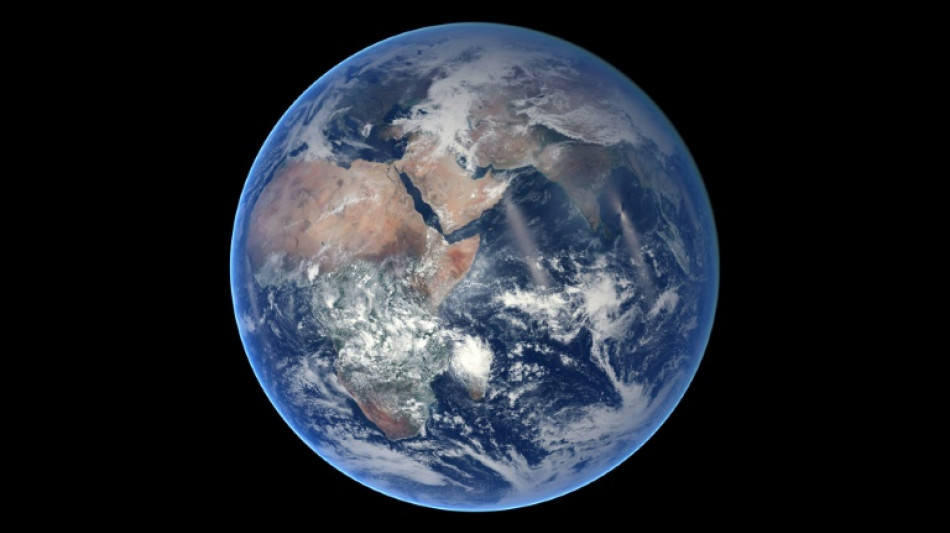
Earth's inner core may have started spinning other way: study / Photo: HANDOUT - NASA/AFP/File

 Argentine judge orders suspension of Falklands oil project

 US Fed raises rates to tackle 'too high' inflation, irking Trump

 Turkey releases 106 protesters, jails more LGBTQ activists

 Candidate for UN chief calls for AI regulation akin to nuclear weapons

 'We're losing control,' AI pioneer Yoshua Bengio tells AFP

 IR-MED and Dice Technologies Announce collaboration to Evaluate and Advance Pressure-Injury Prevention Platform in Japan

 Watts, Pitt, Cruz to light up Spain's top film festival

 Toogood Gold's Table Mountain Sits in the Shadow of a Nevada Gold Rush

 MEXC July–August Security Report: 38.66M USDT in Risk Funds Intercepted, Futures Insurance Fund Hits 792M USDT

 Emporio Armani names Dario Vitale new creative director

 EU to ban social media for under 13s, curb access until 15

 Wildfires push endangered Sumatran elephants to brink: Indonesian NGO

 Bank of Japan set to raise rates under pressure from inflation, US

 EU chief to unveil social media, gaming curbs for under-15s

 'Resident Evil' film brings video game's ethos to the big screen

 GA-ASI Mojave First UAS To Complete Battlefield Short Field Ops

 Sanders, Bannon warn of AI dangers in rare US left-right alignment

 Empty benches as schools reopen in Venezuela's quake-hit Guaira

 Tiny English village holds 'independence' vote over asylum seeker housing

 US Treasury chief says to meet Chinese counterpart at weekend

 BingX Evolves into a Multi-Asset Trading Platform, Connecting Users to Global Opportunities

 International Trading Institute Expands Professional Trader Development Beyond the Master’s in Trading

 Lake Energy Secures $80 Million for U.S. Renewable Energy Expansion

 Stocks drop, oil climbs and Treasury yields hit 19-year high

 SkySail Strategies Outperforms Wall Street's 30-Year Risk Standard With Proprietary AI Inference Model

Far below our feet, a giant may have started moving against us.
Earth's inner core, a hot iron ball the size of Pluto, has stopped spinning in the same direction as the rest of the planet and might even be rotating the other way, research suggested on Monday.
Roughly 5,000 kilometres (3,100 miles) below the surface we live on, this "planet within the planet" can spin independently because it floats in the liquid metal outer core.
Exactly how the inner core rotates has been a matter of debate between scientists -- and the latest research is expected to prove controversial.
What little is known about the inner core comes from measuring the tiny differences in seismic waves -- created by earthquakes or sometimes nuclear explosions -- as they pass through the middle of the Earth.
Seeking to track the inner core's movements, new research published in the journal Nature Geoscience analysed seismic waves from repeating earthquakes over the last six decades.
The study's authors, Xiaodong Song and Yi Yang of China's Peking University, said they found that the inner core's rotation "came to near halt around 2009 and then turned in an opposite direction".
"We believe the inner core rotates, relative to the Earth's surface, back and forth, like a swing," they told AFP.
"One cycle of the swing is about seven decades", meaning it changes direction roughly every 35 years, they added.
They said it previously changed direction in the early 1970s, and predicted the next about-face would be in the mid-2040s.
The researchers said this rotation roughly lines up with changes in what is called the "length of day" -- small variations in the exact time it takes Earth to rotate on its axis.
- Stuck in the middle -
So far there is little to indicate that what the inner core does has much effect on surface dwellers.
But the researchers said they believed there were physical links between all Earth's layers, from the inner core to the surface.
"We hope our study can motivate some researchers to build and test models which treat the whole Earth as an integrated dynamic system," they said.
Experts not involved in the study expressed caution about its findings, pointing to several other theories and warning that many mysteries remain about the centre of the Earth.
"This is a very careful study by excellent scientists putting in a lot of data," said John Vidale, a seismologist at the University of Southern California.
"(But) none of the models explain all the data very well in my opinion," he added.
Vidale published research last year suggesting that the inner core oscillates far more quickly, changing direction every six years or so. His work was based on seismic waves from two nuclear explosions in the late 1960s and early 1970s.
That timeframe is around the point when Monday's research says the inner core last changed direction -- which Vidale called "kind of a coincidence".
- Geophysicists 'divided' -
Another theory -- which Vidale said has some good evidence supporting it -- is that the inner core only moved significantly between 2001 to 2013 and has stayed put since.
Hrvoje Tkalcic, a geophysicist at the Australian National University, has published research suggesting that the inner core's cycle is every 20 to 30 years, rather than the 70 proposed in the latest study.
"These mathematical models are most likely all incorrect because they explain the observed data but are not required by the data," Tkalcic said.
"Therefore, the geophysical community will be divided about this finding and the topic will remain controversial."
He compared seismologists to doctors "who study the internal organs of patients' bodies using imperfect or limited equipment".
Lacking something like a CT scan, "our image of the inner Earth is still blurry", he said, predicting more surprises ahead.
That could include more about a theory that the inner core might have yet another iron ball inside it -- like a Russian doll.
"Something's happening and I think we're gonna figure it out," Vidale said.
"But it may take a decade."
D.Philippon--CPN