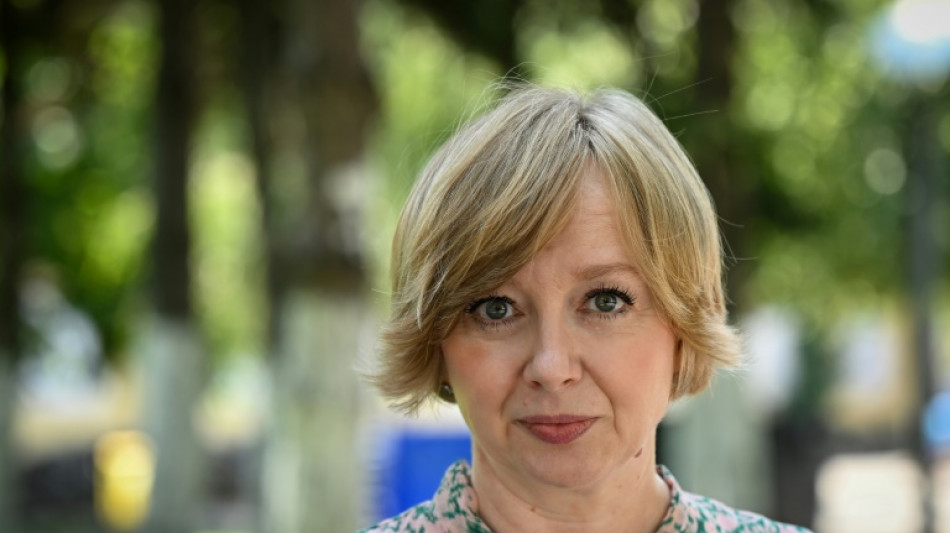
Romania's plagiarism hunter becomes the hunted / Photo: Daniel MIHAILESCU - AFP

 Lights out in Laos as electricity exports surge

 Steven Strogatz weighs AI mathematics advances and their consequences for researchers

 Anthropic boss calls for AI slowdown, Altman and Musk agree

 French IT giant Capgemini sells subsidiary after row over ICE links

 Quebec Brokerage Qubit Insurance Announces New Data on Coverage Shortfalls as Rebuilding Costs Rise

 Lady Gaga welcomes first child with fiance: US media

 Bhutan business bets on hazelnuts for farming future

 'Widow's Bay' and 'The Pitt' are favorites for Emmys night

 Coastal erosion forces cancellation of California music festival

 Argentina's Dirty War rears its head in Venice film

 UK lawmakers throw out bill to legalise assisted dying

 US inflation steady in August, fueling Fed rate hike expectations

 New York marks 25th anniversary of 9/11 attacks

 Nepal flood reconstruction bill to be $4.78 bn: foreign ministry

 JUMO and Standard Bank launch Social Finance Framework to scale inclusive finance in Africa

 Doomsday tech: could AI really kill us all?

 French comedy show 'Call my agent' makes film comeback

 It's all coming back: Celine Dion fans gear up for Paris return

 Researchers eye AI revolution in natural disaster forecasts

 US braces for inflation report that may push Fed to hike rates

 Musk threatens legal action over documentary

 Latin America fact-check group asks Meta not to replace verification practice

 AI Risks to Enter 60–80% of Liability and Cyber Insurance Underwriting by 2028, ScienceSoft Predicts

 Tribal Launches Campfire, Letting Business and Technical Teams Build on Salesforce Together

 Stocks fall as fresh oil surge fans inflation fears

Romanian journalist Emilia Sercan has made it her mission to expose plagiarism at the country’s highest levels.
But her latest investigation of whether the prime minister passed off other people's work as his own in his doctoral thesis has made her the target of a deluge of threats and leaked intimate photos she says are aimed at silencing her.
Sercan has exposed some 50 cases of plagiarism involving the great and good over the last seven years, showing ministers, prosecutors and judges breaking the rules when publishing books, scientific articles or PhD theses.
The latest to come into her crosshairs is Romania's premier, former general Nicolae Ciuca.
In mid-January, she published an investigation in the independent media outlet PressOne, accusing Ciuca of using plagiarised content in 42 pages of his 138-page 2003 doctoral thesis on military science.
Since then the journalist has been the victim of a barrage of insults and hate speech on social media to the point where Sercan said she feels "in danger".
"Never before have I felt targeted in such a way," said the 46-year-old writer and academic, who has filed two complaints to the police over the threats.
Ciuca, a retired four star general who served in Iraq and Afghanistan, leads the ruling National Liberal Party (PNL) after being cherry-picked by President Klaus Iohannis, himself a liberal.
The 55-year-old premier has rejected the accusations, saying he respected the academic rules of the time.
"I didn't plagiarise," he insisted.
- 'Kompromat' operation -
Sercan previously received a death threat in 2019 after revealing cases of plagiarism in PhD theses in the country's police academy. A Bucharest court later sentenced a rector and his deputy, who pressured a subordinate into threatening her, to a three-year suspended jail term.
But this time stolen intimate photos taken by her fiance some 20 years ago have been used to attack her.
Shortly after Sercan sent police screenshots of the images, the screenshots were published by a website in neighbouring Moldova and quickly ended up on 74 other sites, she said.
Sercan accused the authorities of having "orchestrated a kompromat operation" to try to discredit her.
Prosecutors opened a criminal case, but Sercan said the investigation seems to be making no progress.
"At the highest level of state, people are blocking the process and want to bury the case," said told AFP.
"They are using their power to cover their tracks and push me into silence."
The prosecutor's office told AFP that a criminal investigation had started and was ongoing.
Ten press freedom organisations, including Reporters Without Borders (RSF) and Committee to Protect Journalists (CPJ) said they are "disturbed by the harassment" of Sercan -- who is also a professor of journalism at the University of Bucharest -- and have called for a thorough investigation.
"All this support meant a lot for me, but not for the Romanian prosecutors, it seems," she added, saying she was "furious and frustrated" by the lack of action.
- 'Plagiarism networks' -
The journalist said members of the premier's party accused her of "having chosen the wrong moment" to reveal the plagiarism, and of wanting to destabilise the state with war raging in neighbouring Ukraine.
Three other complaints of plagiarism brought against Ciuca -- including one by an opposition MP -- have been dismissed by the courts.
A new education bill abolishing the independent body responsible for investigating plagiarism has also angered government critics.
It would also place a time limit of three years on prosecution of cases of academic misconduct.
Romania is seen as one of the most corrupt countries in the EU, and academic fraud held a particular place in its post-communist history, with many of the country's elite accused of using it as a shortcut to power and prestige.
Professor Ciprian Mihali of the University of Cluj, a specialist in the subject, said the problem has its roots in "the proliferation of universities between 1990 and 2000 after the fall of the communist regime."
PhDs became the key to reaching the upper echelons of power and "we have had to deal with the development of a real plagiarism industry," he said.
"It's a whole line of production and networks" allowing "incompetent people to rise to vital positions" and to stay there despite criticism.
Another Romanian prime minister, Victor Ponta, was accused of plagiarism by the scientific journal Nature in 2012, but refused to step down.
He was eventually forced to resign in 2015 after massive anti-corruption protests rocked the country. A few months later, the Ministry of Education stripped him of his law doctorate and he later lost a court battle to have it restored.
M.Mendoza--CPN