In Iraq's Mosul, library rises from ashes of IS reign

 Lights out in Laos as electricity exports surge

 Steven Strogatz weighs AI mathematics advances and their consequences for researchers

 Anthropic boss calls for AI slowdown, Altman and Musk agree

 French IT giant Capgemini sells subsidiary after row over ICE links

 Quebec Brokerage Qubit Insurance Announces New Data on Coverage Shortfalls as Rebuilding Costs Rise

 Lady Gaga welcomes first child with fiance: US media

 Bhutan business bets on hazelnuts for farming future

 'Widow's Bay' and 'The Pitt' are favorites for Emmys night

 Coastal erosion forces cancellation of California music festival

 Argentina's Dirty War rears its head in Venice film

 UK lawmakers throw out bill to legalise assisted dying

 US inflation steady in August, fueling Fed rate hike expectations

 New York marks 25th anniversary of 9/11 attacks

 Nepal flood reconstruction bill to be $4.78 bn: foreign ministry

 JUMO and Standard Bank launch Social Finance Framework to scale inclusive finance in Africa

 Doomsday tech: could AI really kill us all?

 French comedy show 'Call my agent' makes film comeback

 It's all coming back: Celine Dion fans gear up for Paris return

 Researchers eye AI revolution in natural disaster forecasts

 US braces for inflation report that may push Fed to hike rates

 Musk threatens legal action over documentary

 Latin America fact-check group asks Meta not to replace verification practice

 AI Risks to Enter 60–80% of Liability and Cyber Insurance Underwriting by 2028, ScienceSoft Predicts

 Tribal Launches Campfire, Letting Business and Technical Teams Build on Salesforce Together

 Stocks fall as fresh oil surge fans inflation fears

The storied library of Iraq's Mosul University boasted a million titles before Islamic State group jihadists rampaged through it, toppling book shelves and burning ancient texts.
Now, almost five years after their defeat, the war-battered northern metropolis is trying to rebuild the pride of the city long known as a literature hub boasting countless booksellers and archives guarding rare manuscripts.
Mohamed Younes, technical director of the prestigious university library, recalls the carnage he witnessed after Mosul was recaptured from IS in mid-2017 following long and gruelling street battles.
"When we came back, we saw... the books pulled from the shelves, thrown on the ground and burned," he said.
Thousands of texts on philosophy and law, science and poetry which in some way contradicted the IS's extremist world view had gone up in flames.
Some of the most valuable titles were sold on the black market.
"Before, we had more than a million titles, some of which couldn't be found in any other university in Iraq," said Younes.
When the jihadists were first at the gates of the city, he said, "we were only able to move the rare books and a number of foreign periodicals".
With the IS group's brutal takeover of Mosul, 85 percent of the collection was lost.
Before IS, Mosul University was "the mother of all books," said former student Tarek Attiya, 34, who is now enrolled at Tikrit university.
"There is a huge difference between what used to be and the situation after IS," he said.
- Refurbished building -
Now there is a revival going on to, with the help of donations, slowly line the library shelves with books again.
The library building, refurbished with financing from a UN agency, is set to reopen this month. Four floors high with a sleek glass exterior, it will have an initial 32,000 books.
It will also feature a digital trove of e-books, with a view to eventually rebuilding a million-strong collection.
Ahead of the opening, the books have been housed in the narrow premises of the university's engineering faculty where shelves are overflowing and titles are stacked on every available surface.
Significant donations from Arab and international universities have been received to "enable the revival of the library," said the director.
Renowned figures in Mosul and across Iraq have also contributed by "dipping into their personal" collections, he added.
The northern metropolis of Mosul has historically been a hub for merchants and aristocrats, with a rich cultural and intellectual life.
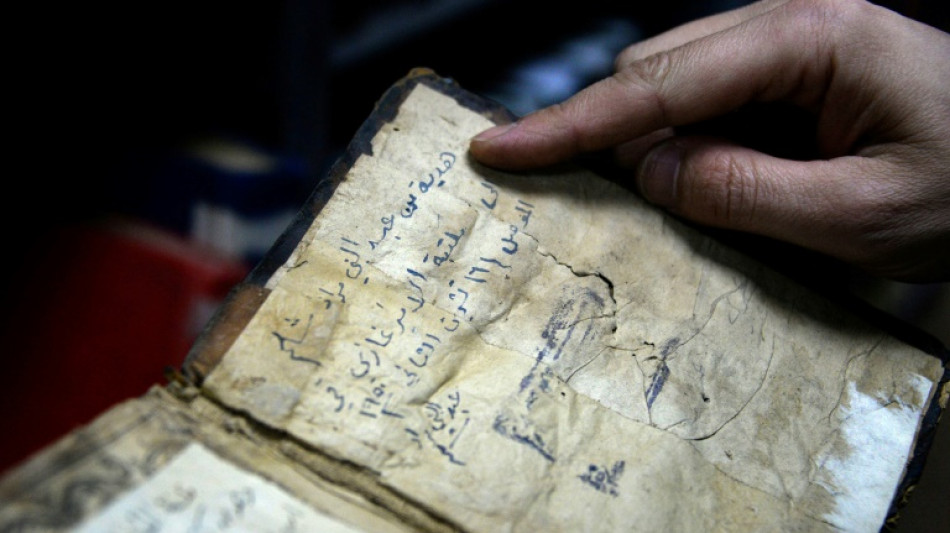
A commercial crossroad of the Middle East, Mosul was able to preserve thousands of rare and ancient works, notably religious texts.
Iraq's first printing press was operating in Mosul in the second half of the 19th century.
- Appetite for reading -
Signs of Mosul's fledgling cultural revival have begun to take root -- at least where there was anything left to save.
The library of the Waqf, the state body that manages Islamic endowments, once contained manuscripts dating back 400 years, said its head, Ahmed Abd Ahmed.
But, he added sadly, "they have all disappeared".
Elsewhere in the city, Al-Nujaifi street, historically lined with booksellers, still bears the scars of destruction wrought by the jihadists.
Many shops are abandoned, and mounds of rubble lay under old stone arches -- but a handful of shopkeepers have reopened their doors after paying out of pocket for restoration work.
Mosul's central public library -- which was founded a century ago last year, and had boasted more than 120,000 titles -- reopened its doors in late 2019, after restoration.
"We lost 2,350 books on literature, sociology or religion," said its director Jamal al-Abd Rabbo.
But he added that public donations and purchases had allowed him to rebuild the collection up to 132,000 titles.
Old leather-bound books with worn spines and creased pages still line the library's shelves.
Crucially, the public's appetite for literature remains unbroken, he said, and "some of our visitors come daily, for an hour or two, to read".
Y.Ponomarenko--CPN