Egg-free school meals scramble politics in India / Photo: Dibyangshu SARKAR - AFP

 Lights out in Laos as electricity exports surge

 Steven Strogatz weighs AI mathematics advances and their consequences for researchers

 Anthropic boss calls for AI slowdown, Altman and Musk agree

 French IT giant Capgemini sells subsidiary after row over ICE links

 Quebec Brokerage Qubit Insurance Announces New Data on Coverage Shortfalls as Rebuilding Costs Rise

 Lady Gaga welcomes first child with fiance: US media

 Bhutan business bets on hazelnuts for farming future

 'Widow's Bay' and 'The Pitt' are favorites for Emmys night

 Coastal erosion forces cancellation of California music festival

 Argentina's Dirty War rears its head in Venice film

 UK lawmakers throw out bill to legalise assisted dying

 US inflation steady in August, fueling Fed rate hike expectations

 New York marks 25th anniversary of 9/11 attacks

 Nepal flood reconstruction bill to be $4.78 bn: foreign ministry

 JUMO and Standard Bank launch Social Finance Framework to scale inclusive finance in Africa

 Doomsday tech: could AI really kill us all?

 French comedy show 'Call my agent' makes film comeback

 It's all coming back: Celine Dion fans gear up for Paris return

 Researchers eye AI revolution in natural disaster forecasts

 US braces for inflation report that may push Fed to hike rates

 Musk threatens legal action over documentary

 Latin America fact-check group asks Meta not to replace verification practice

 AI Risks to Enter 60–80% of Liability and Cyber Insurance Underwriting by 2028, ScienceSoft Predicts

 Tribal Launches Campfire, Letting Business and Technical Teams Build on Salesforce Together

 Stocks fall as fresh oil surge fans inflation fears

Teacher Raja Dey fears attendance might drop now that government-run schools have stopped serving eggs for lunch in his eastern Indian state, a dietary change that has stirred a political storm.
The humble egg, a popular food in West Bengal, was taken off the menu after the state's recently elected Hindu nationalist government said a religious charity will provide free, vegetarian cooked meals in state-run schools.
The new arrangement has rekindled a long-running debate over food, faith and nutrition in the world's most populous country, with critics accusing the government of trying to turn schoolchildren vegetarian.
Prime Minister Narendra Modi's party, which swept to power in West Bengal for the first time in regional elections held in May, often promotes vegetarianism as a part of its nationalist agenda, although most Indian Hindus eat meat and fish.
Eggs, which Hindus generally consider non-vegetarian, are even more widely consumed.
Former West Bengal chief minister Mamata Banerjee, whose regional Trinamool Congress (TMC) lost May's vote after 15 years in power, has denounced the move to remove eggs from school meals as going "against the culture" of the state, home to more than 100 million people.
"The BJP government is trying to impose vegetarianism on school children," TMC lawmaker Dola Sen told AFP.
Some teachers have expressed concerns over attendance rates as well as good nutrition.
"The mid-day meals have been one of the biggest attractions in state-run primary schools," teacher Dey told AFP.
- World's largest school lunch scheme -
While there is no nationwide data linking eggs to attendance in government-run schools, Dey said that "students turn up in large numbers on days when eggs are provided".
In the southern state of Karnataka, official figures from last year showed that attendance rose from 93.5 to 98.97 percent after egg distribution had been expanded to six days a week.
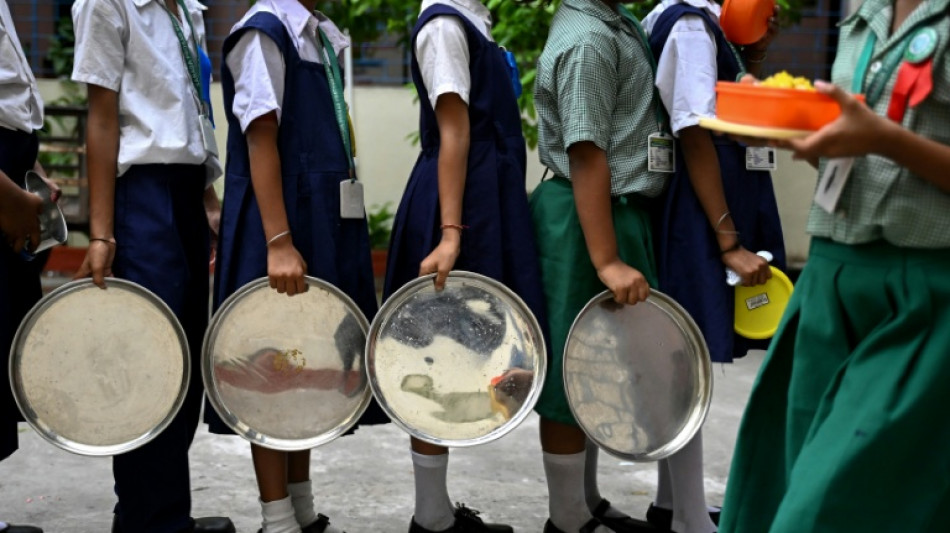
In West Bengal, eggs, previously served once a week, were replaced last month with plant-based alternatives as the state government tapped the International Society for Krishna Consciousness (ISKCON) -- commonly known as the Hare Krishna movement -- as the new provider of school meals.
ISKCON is the leading provider of India's school lunches -- the largest such programme in the world, according to the UN -- and serves only vegetarian food.
The lunch scheme is widely acknowledged to have improved enrolment rates across the country, with multiple peer-reviewed research papers identifying an increase of up to 15 percent.
There are also nutritional benefits.
A 2021 report by the International Food Policy Research Institute found that the scheme has played a key role in reducing stunting among Indian children.
With eggs off the menu, public health advocates have warned that children from poor families -- the primary target of the lunch scheme -- could lose an important source of protein and other nutrients.
- 'Gold standard' -
ISKCON has pushed back, arguing that soya chunks, cottage cheese and lentils were as nutritious.
"We will ensure that whatever nutrients a child gets from eggs will be matched or exceeded by superior quality protein and vitamins in our meals," Surovijoy Govinda Das, a senior member of ISKCON, told AFP.
The state's education minister, Dipak Barman, said that "there are many people in our country who lead a healthy life on a vegetarian diet."
Some nutritionists beg to differ.
Eggs are "the gold standard for protein quality", Sylvia Karpagam, a community health physician, told Frontline magazine.
Without "fact-based information... the country faces a looming crisis in nutrition and health outcomes", she said.
In the run-up to May's vote, TMC party members had accused Modi's BJP of seeking to ban fish and meat altogether.
The ruling party denied any such intention, but last month's menu change has revived concerns.
The matter has made it to the High Court, which has asked the state to clarify its position on handing over the lunch scheme to ISKCON. A hearing is slated for next month.
Y.Ibrahim--CPN