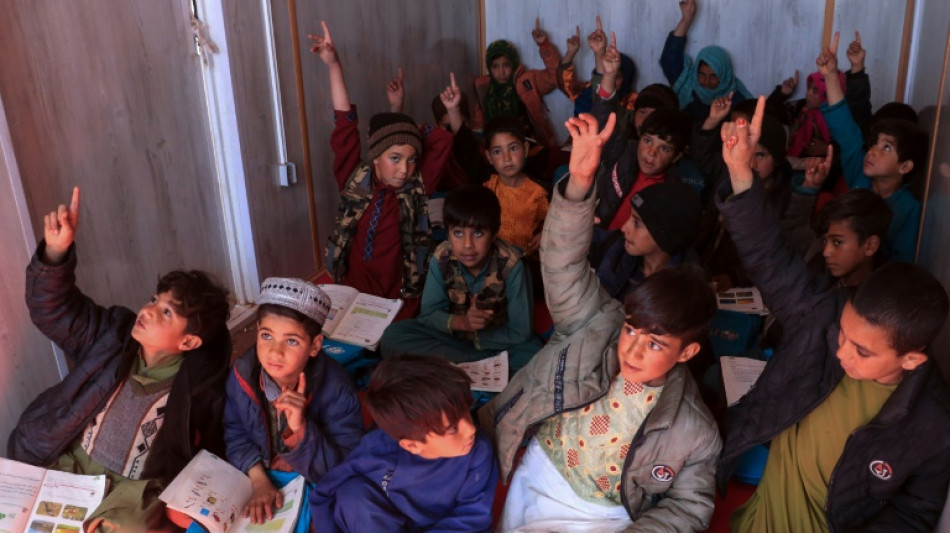
Afghan kids learn in makeshift schools six months after major quake / Photo: Mohsen KARIMI - AFP

 Lights out in Laos as electricity exports surge

 Steven Strogatz weighs AI mathematics advances and their consequences for researchers

 Anthropic boss calls for AI slowdown, Altman and Musk agree

 French IT giant Capgemini sells subsidiary after row over ICE links

 Quebec Brokerage Qubit Insurance Announces New Data on Coverage Shortfalls as Rebuilding Costs Rise

 Lady Gaga welcomes first child with fiance: US media

 Bhutan business bets on hazelnuts for farming future

 'Widow's Bay' and 'The Pitt' are favorites for Emmys night

 Coastal erosion forces cancellation of California music festival

 Argentina's Dirty War rears its head in Venice film

 UK lawmakers throw out bill to legalise assisted dying

 US inflation steady in August, fueling Fed rate hike expectations

 New York marks 25th anniversary of 9/11 attacks

 Nepal flood reconstruction bill to be $4.78 bn: foreign ministry

 JUMO and Standard Bank launch Social Finance Framework to scale inclusive finance in Africa

 Doomsday tech: could AI really kill us all?

 French comedy show 'Call my agent' makes film comeback

 It's all coming back: Celine Dion fans gear up for Paris return

 Researchers eye AI revolution in natural disaster forecasts

 US braces for inflation report that may push Fed to hike rates

 Musk threatens legal action over documentary

 Latin America fact-check group asks Meta not to replace verification practice

 AI Risks to Enter 60–80% of Liability and Cyber Insurance Underwriting by 2028, ScienceSoft Predicts

 Tribal Launches Campfire, Letting Business and Technical Teams Build on Salesforce Together

 Stocks fall as fresh oil surge fans inflation fears

Children sit shoulder to shoulder crammed in rows on the floor of a shipping container with lesson books in their laps, the remains of their school unrepaired in the six months since a major earthquake devastated their village in western Afghanistan.
Hundreds of schools are still damaged since a series of strong quakes jolted Afghanistan's Herat province in October, with many students returning to lessons in tents and containers in March, according to the Herat education department.
Girls and boys in the village of Nayeb Rafi in Zindah Jan district studied in a packed container tucked between tents and small, blue homes newly built on a barren stretch of land.
"I really want to study, to have a school, and become a teacher to teach my friends," said 11-year-old Siyah Gul.
She wants to make the most of her lessons in the makeshift classroom before she is soon excluded under Taliban government rules which bar girls and women from secondary education and universities.
The October quake killed more than 1,500 people and damaged or destroyed more than 63,000 homes, according to an assessment published in February by the United Nations, the European Union and the Asian Development Bank.
Many people are still living in tents and temporary shelters, the World Health Organization said in February.
Education is the second-most affected sector, the report said, with nearly 300 public schools and other learning centres damaged and 180,000 students facing learning disruptions.
- 'Completely destroyed' -
In the village of Chahak, deep cracks scar the walls and ceilings of its pale blue schoolhouse. Broken windows still hang from their hinges and piles of dust fill the corners of classrooms.
"Chahak village was completely destroyed by the earthquake and we still haven't been provided with permanent shelters," said teacher Mohammad Naseem Nasrat.
"Our school too, which was wrecked by the earthquake, has not been restored so far. I don't know if there are plans to or not," said the 25-year-old, adding that the village's children "face an uncertain future" without proper schools.
Decades of conflict have devastated Afghanistan's education system, with an estimated 3.7 million children out of school, 60 percent of them girls, according to the UN children's agency UNICEF.
Poverty and access to schools in remote areas are major hurdles, while cultural norms often prevent girls from attending school.
One in five children aged between five and 17 are engaged in child labour, according to the United Nations, in a country facing deep economic, humanitarian and climate crises.
Eleven-year-old Sefatullah's school in Kashkak village was destroyed by the recent quakes.
"We don't have books and notebooks to study and write in," he said.
Four children were killed when the school collapsed, said teacher Mohammad Dawood, who now gives lessons in a framed tent with a large UNICEF logo on the outside.
The makeshift school serves two villages, six classes and has only one teacher -- Dawood.
"On days when it is windy or raining, we are in big trouble, we can't carry on with this situation for much longer," he said.
P.Gonzales--CPN