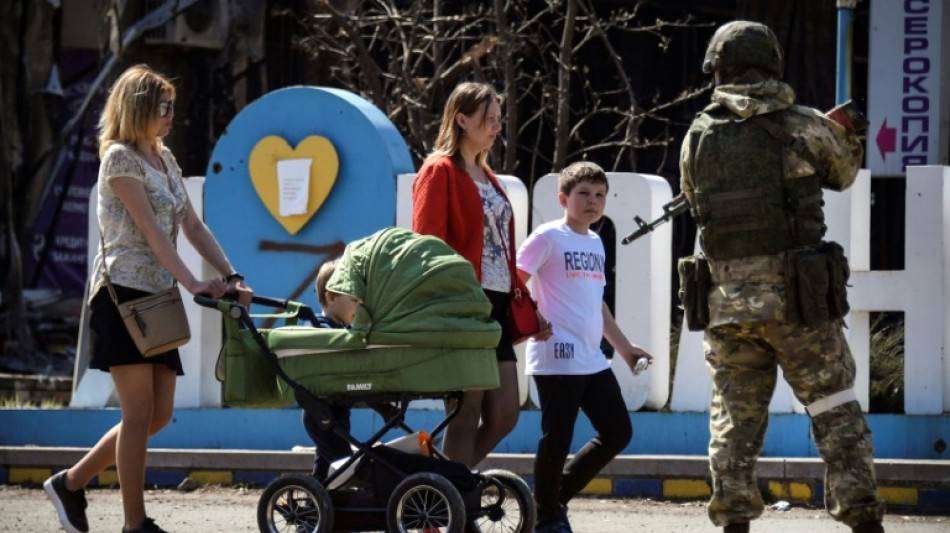
'Russia, our sacred state!': school reopens under Moscow control / Photo: Alexander NEMENOV - AFP

 Lights out in Laos as electricity exports surge

 Steven Strogatz weighs AI mathematics advances and their consequences for researchers

 Anthropic boss calls for AI slowdown, Altman and Musk agree

 French IT giant Capgemini sells subsidiary after row over ICE links

 Quebec Brokerage Qubit Insurance Announces New Data on Coverage Shortfalls as Rebuilding Costs Rise

 Lady Gaga welcomes first child with fiance: US media

 Bhutan business bets on hazelnuts for farming future

 'Widow's Bay' and 'The Pitt' are favorites for Emmys night

 Coastal erosion forces cancellation of California music festival

 Argentina's Dirty War rears its head in Venice film

 UK lawmakers throw out bill to legalise assisted dying

 US inflation steady in August, fueling Fed rate hike expectations

 New York marks 25th anniversary of 9/11 attacks

 Nepal flood reconstruction bill to be $4.78 bn: foreign ministry

 JUMO and Standard Bank launch Social Finance Framework to scale inclusive finance in Africa

 Doomsday tech: could AI really kill us all?

 French comedy show 'Call my agent' makes film comeback

 It's all coming back: Celine Dion fans gear up for Paris return

 Researchers eye AI revolution in natural disaster forecasts

 US braces for inflation report that may push Fed to hike rates

 Musk threatens legal action over documentary

 Latin America fact-check group asks Meta not to replace verification practice

 AI Risks to Enter 60–80% of Liability and Cyber Insurance Underwriting by 2028, ScienceSoft Predicts

 Tribal Launches Campfire, Letting Business and Technical Teams Build on Salesforce Together

 Stocks fall as fresh oil surge fans inflation fears

In the playground of a school in the war-torn eastern Ukrainian town of Volnovakha, now under Moscow's control, children listen to a recording of the Russian anthem, watched by armed soldiers.
Several dozen pupils have lined up outside for a formal "back to school" ceremony, a month after the town was taken by Russian troops and Moscow-backed separatists.
Volnovakha has no electricity or working telephone lines, AFP journalists found while taking part in a media trip organised by the Russian army.
Widespread shelling has destroyed houses, shops and cafes, evidence of the fierce fighting for a town strategically located halfway between the main regional city of Donetsk and the port of Mariupol.
Russian troops have besieged Mariupol for a month and a half and the city on the Sea of Azov seems likely to fall shortly.
As Russia puts it, Volnovakha has been "liberated" from neo-Nazi Ukrainians.
"It's time to learn. Hurry up, children!" a small rosy-cheeked girl with white bows in her hair announces, speaking into a microphone.
Behind her, the school staff are standing next to a Russian flag and that of the separatist Donetsk People's Republic (DNR).
Nearby a soldier in a cagoule and helmet -- one of the troops accompanying the journalists -- stands watching, holding a submachine gun.
As a sound system plays the DNR anthem and then the Russian anthem -- which opens "Russia, our sacred state, Russia, our beloved country!" -- staff and pupils stand silently, their faces impassive.
- 'Lived through horror' -
Russia's conquest of Volnovakha on March 11 allowed its forces to encircle Mariupol from the north, having attacked the strategic Sea of Azov port from the east and west.
This came after Volnovakha and its Ukrainian defending troops were bombarded for two weeks.
Many houses, shops and public buildings are now semi-ruined, windowless or burnt-out.
Russia argues that such destruction here, and elsewhere in Ukraine, came about because Kyiv's forces used the local population as human shields.
After a month under Moscow's control, there are still scenes of devastation all around. There is a huge hole in the facade of the hospital and trees nearby have been snapped in half.
Yellow-painted School Number 5, which is in the centre of the town, has also suffered from shelling, with gaping holes in place of several windows and shattered bricks. This is the only school to reopen so far.
"We lived through horror. There was terrible bombing," says Lyudmila Khmara, the 52-year-old school administrator.
She says that she wants to stay in Volnovakha, all the same, because: "nowhere is as good as home".
She says she hopes Volnovakha will become "part of Russia", where no one will be forced to speak Ukrainian, while this part of Ukraine is overwhelmingly Russian-speaking.
Moscow justifies its military operation in Ukraine citing the need to protect the Russian-speaking population.
- In survival mode -
The army is leaving nothing to chance. Even with no sign of resistance, tanks and military vehicles decorated with the letter Z patrol the streets as local civilians walk around and cycle.
The municipal hospital continues to function as best it can, despite lacking electricity and suffering extensive bomb damage.
In the semi-darkness, a nurse, 46-year-old Natalya Nekrasova-Mukhina, says that most patients, from children to the elderly, come to be treated for shrapnel wounds.
Local residents are still living in survival mode.
"We have no gas, no water, no electricity and no phone line. We live like we're in a hole," says Lyudmila Dryga, 72, a retired crane operator.
Another local woman, Svetlana Shcherbakova, 59, recounts how she lost everything except ID documents when her house burned down.
"We received humanitarian aid just once, that was it," says the former supermarket security manager, her voice trembling.
A 35-year-old railway mechanic, Anton Varusha, estimates that less than half of the people living on his street have returned to live in Volnovakha, which had around 20,000 inhabitants before the bombardment.
"I don't know yet whether I'll stay here. At the moment, I have my parents here, who are old and sick," he says.
He says locals are struggling to get information on what is happening, with no electricity or internet.
"We try to listen to various radio stations, so we can somehow compare (accounts of) what is going on," he says.
H.Müller--CPN