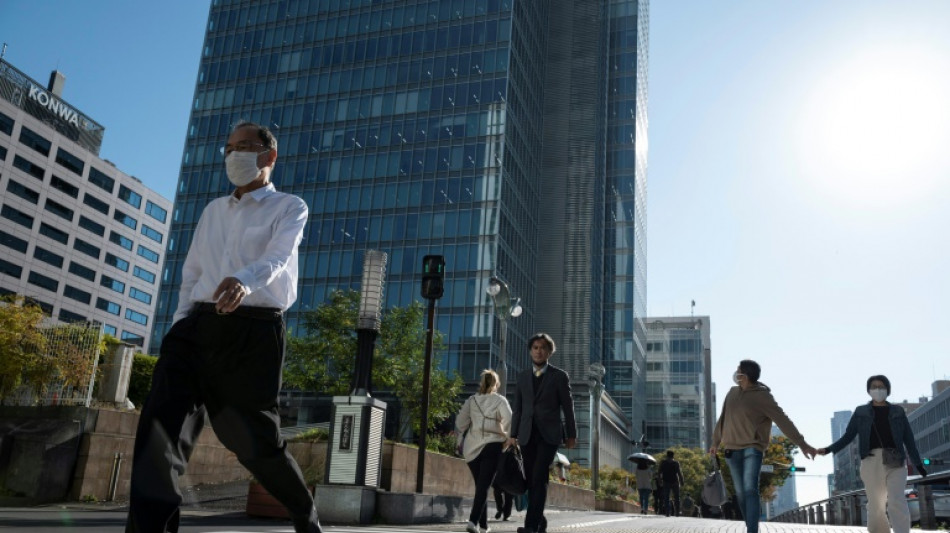
Japan inflation hits four-decade high in October / Photo: Richard A. Brooks - AFP

 'Star Trek', 'X-Men' star Patrick Stewart dead at 86

 Canada buying stake in AI firm Cohere to bolster tech sovereignty

 Grieving Spain demands answers for latest rail disaster

 Qatar prime minister tours Cityscape Qatar 2026

 Jazeera Paints showcases housing solutions at Build Your House 2026 in Qatar

 Google drags down Wall Street stocks

 Does White House ask AI to shape policy? Democrats want the receipts

 ECB holds rates steady after Lagarde says to quit early

 ECB chief Lagarde to step down early, triggering succession race

 VW says 'no time to lose' to slash costs after 5.8 billion euro loss

 Oil majors reap bumper profits as Mideast war drives prices

 Taiwan says Pakistan briefly closed airspace to Taiwanese flights

 Samsung logs record quarterly profits despite investor AI jitters

 Shares in Google owner Alphabet plummet on profit miss, ad slowdown

Japanese inflation hit a four-decade high last month, government data showed Friday, fuelled by high energy costs and a weak yen and ramping up pressure on the central bank to move away from its ultra-loose monetary policies.
Core consumer prices excluding volatile fresh food rose 3.6 percent on-year in October, marginally higher than analyst expectations.
The reading marked the fastest pace since 1982, although it remains below the sky-high levels that have pummelled the United States and other countries.
In reaction to the data, chief cabinet secretary Hirokazu Matsuno told reporters the government "must protect people's livelihoods from these price rises".
"Price increases have continued for items closely related to daily life such as utilities and food, due to rising raw material prices and the weak yen," he said.
The government said last month it would spend $260 billion on an economic stimulus package that includes support for energy bills, which have spiked since Russia's invasion of Ukraine in February.
"Policies targeting energy and food, which are the main causes of high prices" are included in the relief measures, Matsuno said as he vowed to "pass the extra budget as soon as possible".
Darren Tay, Japan Economist at Capital Economics, told AFP that the impact of inflation on the average consumer was "very real".
Prime Minister Fumio Kishida has responded with an "aggressive" stimulus package because "he knows that his electorate is not too happy with rising prices", Tay added.
- Economy 'on shaky footing' -
When energy prices were not taken into account, October's inflation was a more moderate 2.5 percent, but still higher than in September.
The headline core consumer price index (CPI) has now risen for 14 straight months -- putting pressure on the Bank of Japan to tweak its longstanding monetary easing policies.
The US Federal Reserve and other central banks have sharply hiked interest rates this year to tackle inflation.
But Japan, which since the 1990s has swung between periods of sluggish inflation and deflation, has gone against the grain and continues to keep interest rates at ultra-low levels as it tries to kickstart the torpid economy.
Although inflation is now higher than the two-percent targeted by the Bank of Japan for the past decade, it sees the recent price rises as temporary and says there is no reason to change course.
The starkly different approaches taken by the BoJ and the Fed have driven down the value of the yen against the dollar this year from levels of around 115 yen per dollar in March to 140 on Friday, having hit a 32-year low of 151 yen last month.
But while the bank keeps a close watch on inflation, Tay added: "I still don't think it's enough for them to change their policy at this point."
One reason is that Japan's latest growth data, released on Tuesday, showed a surprise contraction of the world's third-largest economy in the July-September quarter.
"That shows the bank very clearly that the economy is actually on much shakier footing than they might otherwise have expected," Tay said.
"The other thing is the global economy is probably going to enter a recession next year, in the first half," he added.
"We're basically looking at very weak economic conditions overall, and the Bank of Japan will not risk jeopardising the economy even further by tightening monetary policy at this point."
X.Wong--CPN