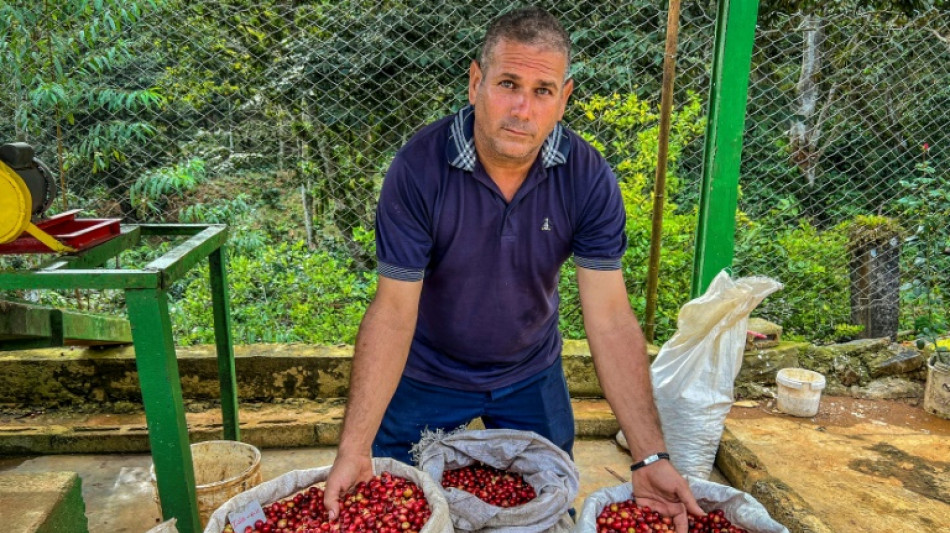
Cuba bets on specialty coffee to boost industry / Photo: ADALBERTO ROQUE - AFP

 'Star Trek', 'X-Men' star Patrick Stewart dead at 86

 Canada buying stake in AI firm Cohere to bolster tech sovereignty

 Grieving Spain demands answers for latest rail disaster

 Qatar prime minister tours Cityscape Qatar 2026

 Jazeera Paints showcases housing solutions at Build Your House 2026 in Qatar

 Google drags down Wall Street stocks

 Does White House ask AI to shape policy? Democrats want the receipts

 ECB holds rates steady after Lagarde says to quit early

 ECB chief Lagarde to step down early, triggering succession race

 VW says 'no time to lose' to slash costs after 5.8 billion euro loss

 Oil majors reap bumper profits as Mideast war drives prices

 Taiwan says Pakistan briefly closed airspace to Taiwanese flights
 Samsung logs record quarterly profits despite investor AI jitters

 Shares in Google owner Alphabet plummet on profit miss, ad slowdown

In the lush, fertile mountains of Cuba, farmer Jesus Chaviano dreams of adding his arabica beans to a list of specialty coffees the country hopes will lift an industry in decline.
It's harvest time on Chaviano's eight-hectare (20-acre) plantation in the central Guamuaya mountain range, and his 42,000 coffee plants burst with ripe reddish fruit in the shadow of avocado and banana trees.
At 800 meters (2,600 feet) altitude, conditions are ideal for the eight varieties of high-quality arabica coffee beans he planted with his "own hands."
While Cuba has been growing coffee for almost 300 years, it has never produced the specialty coffees beloved worldwide for their unique flavor profiles that come from careful cultivation in a specific terroir.
In the past two decades, the appeal of high-end coffee has soared, and so has its price on the international market.
"I think that needs to be the path we take: going after specialty coffees. Not large quantities... small batches that we can sell well," said Chaviano, 46.
As the island catches on to the appeal of high-end coffee, the first five specialty coffees will be unveiled in December at the first-ever Cuba-Cafe producers fair, which is being held in the eastern city of Santiago de Cuba.
The name and origins of the chosen coffees are being kept secret.
"We are taking the first concrete steps to add value to this coffee," said Ramon Ramos, the scientific director of Cuba's National Institute for Agroforestry Research. He added that "with the same production, the same yield, it will be sold at a much higher price."
-'It's the future'-
According to Ramos, the price for 1,000 kilograms of commercial coffee varies between $4,000 and $5,000. Meanwhile, a kilogram of specialty coffee can sell for "up to $10,000."
According to the Specialty Coffee Association (SCA) a coffee must score above 80 points on a 100-point scale to reach the required standard, after being evaluated by "a certified coffee taster."
The final score will influence the price at which it is sold.
"It's the future," says Chaviano, who built his house in the middle of his plantation, in the style of the French colonists who fled Haiti in the 18th century and brought the culture of coffee cultivation to Cuba.
In 1960, Cuba produced more than 60,000 tonnes of coffee. Last year, this figure stood at only 11,500 tonnes, less than half of what is consumed locally.
According to official figures, only 1,365 tonnes were exported.
Experts say climate change -- drastically reducing coffee-growing areas worldwide -- is partly to blame for the drop in production.
In Cuba, the emigration of plantation workers has also impacted the industry.
"Why did the country once produce a lot of coffee, but now it can't produce coffee?" asked Chaviano.
"I'm focused on doing it right and demonstrating that it's possible to produce coffee, and quality coffee," but "you have to put your heart into it," he added.
In 2021, his yield was one tonne of coffee per hectare, four times the national average.
- 'We can do it'-
Some 25 kilometers from his farm, researchers at the Jibacoa Agroforestry Research Station, have been tasked with training and providing technology to producers to improve their yields.
Director Ciro Sanchez, said the goal is to produce 30,000 tonnes of coffee by 2030.
To achieve this, the aim is to recover some plantations in areas affected by climate change, by planting more resistant varieties of coffee. Sanchez also wants to prioritize the growth of "high-quality arabica" in mountainous areas.
Chaviano is optimistic that one day his coffee will be one of the feted specialty brands being exported from Cuba.
"We can do it. We just need to work!" he said.
P.Petrenko--CPN