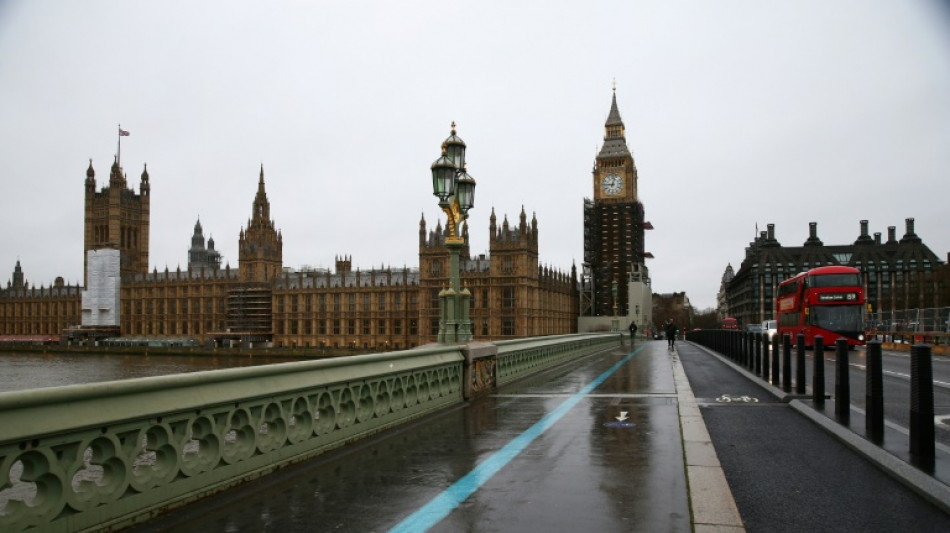
UK austerity budget stings markets / Photo: Hollie Adams - AFP

 'Star Trek', 'X-Men' star Patrick Stewart dead at 86

 Canada buying stake in AI firm Cohere to bolster tech sovereignty

 Grieving Spain demands answers for latest rail disaster

 Qatar prime minister tours Cityscape Qatar 2026

 Jazeera Paints showcases housing solutions at Build Your House 2026 in Qatar

 Google drags down Wall Street stocks
 Does White House ask AI to shape policy? Democrats want the receipts

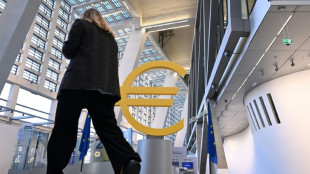 ECB holds rates steady after Lagarde says to quit early

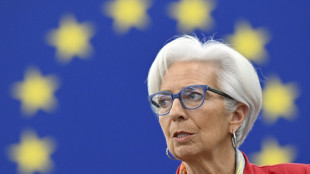 ECB chief Lagarde to step down early, triggering succession race

 VW says 'no time to lose' to slash costs after 5.8 billion euro loss

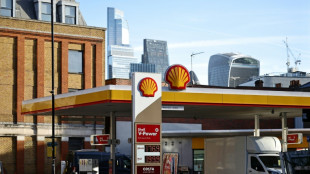 Oil majors reap bumper profits as Mideast war drives prices

 Taiwan says Pakistan briefly closed airspace to Taiwanese flights

 Samsung logs record quarterly profits despite investor AI jitters

 Shares in Google owner Alphabet plummet on profit miss, ad slowdown

A British austerity budget hit the pound and gilts on Thursday, with stocks suffering worldwide on the glum economic outlook and the prospect of painfully high interest rates to curb inflation.
Britain unveiled a painful budget with £55 billion ($65 billion) of tax hikes and spending cuts despite confirming its economy was already in recession.
Finance minister Jeremy Hunt said the measures were needed to bring financial stability after recent turmoil in the markets, insisting they would alleviate rather than aggravate the downturn.
But the measures didn't reassure British markets, with the pound falling and government borrowing costs rising. Losses on London stocks deepened, before later easing.
CMC Markets analyst Michael Hewson said upheaval in markets in September over the profligate fiscal policies of the previous government had largely subsided, meaning a budget that makes Britain a worse place to do business was no longer necessary.
"Today’s budget should have walked the line between pushing inflation lower, without completely crushing demand in the economy with too many tax rises, and spending cuts," Hewson said in a note to investors.
"Initial analysis of today’s package suggests that we’ve got a lot of the former, and not too much of the latter, which is bad news if you’re looking to get businesses to invest," he added.
The pound was down around one percent to $1.1799 in afternoon trading.
London's blue-chip FTSE 100 index was down 0.5 percent.
Traders fear the budget will worsen Britain's cost-of-living crisis after inflation spiked to a 1981 peak of 11.1 percent, and the government confirmed that the British economy was already in a recession that could last two years.
Wall Street opened sharply lower as investors worried the US Federal Reserve will continue to aggressively raise interest rates to lower rampant inflation, even if it means pushing the economy in recession.
Investors have been reassured by some data suggesting inflationary pressures are diminishing, as well as the overall economy is holding up well, but statements by some Fed policymakers spooked traders.
"Concerns that the Fed will overtighten and force the U.S. economy into a hard landing were partly behind yesterday's selling and widening inversion of the yield curve," said Patrick O'Hare at Briefing.com
"Those concerns remain in place today and have been heightened by remarks made this morning by some voting" members of the Fed's monetary policymaking committee, he added.
The Fed's main interest rate is currently at 3.75 to 4.0 percent, but one Fed member said it may need to go as high as 7.0 percent. Another said a contraction in the economy may be needed.
Oil prices fell back on worries about Chinese demand.
"China remains a downside risk for oil in the near term, despite its recent relaxation of certain Covid curbs," said Craig Erlam at OANDA online trading platform.
"A surge in cases in major cities, mass testing, and restrictions will hit economic activity despite recent measures which will weigh on demand in the world's second-largest economy," he added.
- Key figures around 1330 GMT -
London - FTSE 100: DOWN 0.5 percent at 7,316.23 points
Paris - CAC 40: DOWN 1.0 percent at 6,538.53
Frankfurt - DAX: DOWN 0.3 percent at 14,186.35
EURO STOXX 50: DOWN 0.8 percent at 3,850.90
New York - Dow: DOWN 0.8 percent at 33,283.40
Tokyo - Nikkei 225: DOWN 0.4 percent at 27,930.57 (close)
Hong Kong - Hang Seng Index: DOWN 1.2 percent at 18,045.66 (close)
Shanghai - Composite: DOWN 0.2 percent at 3,115.43 (close)
Pound/dollar: DOWN at $1.1799 from $1.1914 on Wednesday
Euro/dollar: DOWN at $1.0331 from $1.0395
Dollar/yen: UP at 140.38 yen from 139.54 yen
Euro/pound: UP at 87.55 from 87.21 pence
Brent North Sea crude: DOWN 1.2 percent at $91.72 per barrel
West Texas Intermediate: DOWN 1.9 percent at $83.97 per barrel
burs-rl/bp
Ch.Lefebvre--CPN